

Last Updated:
2026 FIFA World Cup final: Argentina vs. Spain. The expanded 48-team tournament generates billions for FIFA, broadcasters and betting companies.




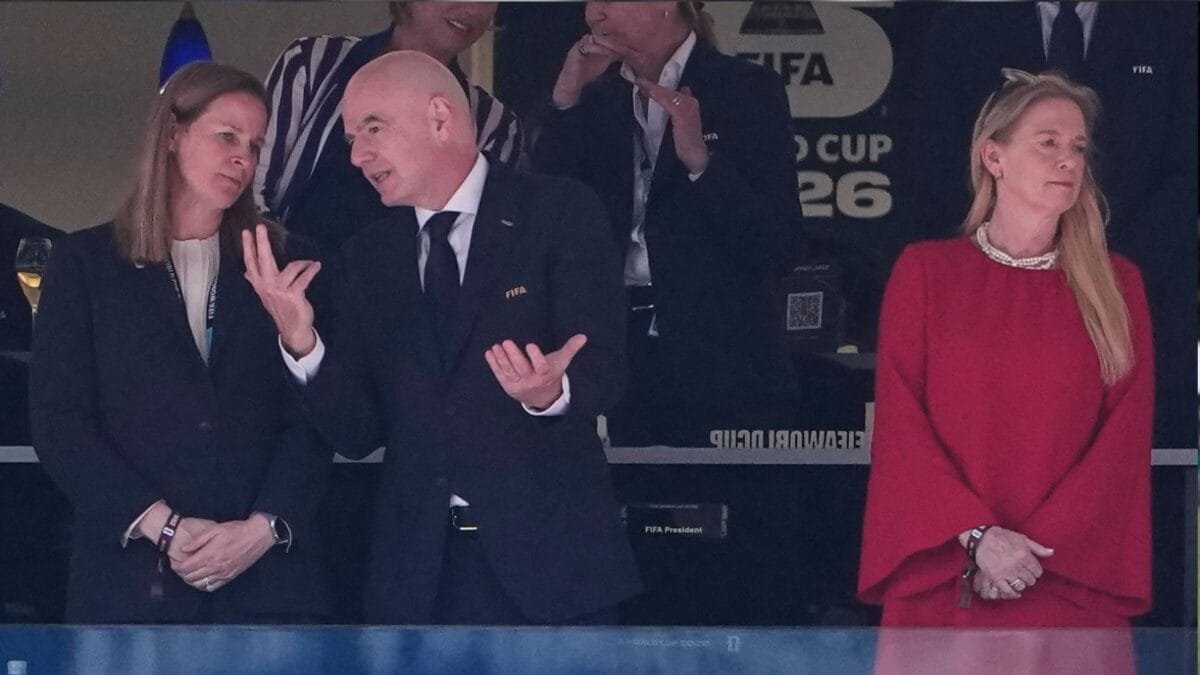
Gianni Infantino speaks with U.S. Soccer Federation President Cindy Parlow Cone (Picture credit: AP)
The 2026 FIFA World Cup is at its final stage, with the summit showdown all set to be played in two days. Defending champions Argentina find themselves in the final again, with Spain challenging them for the title. A record 48 countries took part in the showpiece this year, moving away from the traditional 32-team format.
With more teams and more games, the tournament attracted a bigger global audience while unlocking greater commercial chances. As football’s biggest stars script history on the field, billions of dollars are being generated away from it.
Let us take a look at how much FIFA, the broadcasters of the tournament and the betting companies are earning from the showpiece.
FIFA
The FIFA World Cup is the biggest revenue generator for world football’s governing body. The 2022 edition in Qatar brought in a record $7.6 billion (Rs 760 crores) and with the 2026 tournament expanding to 48 teams across the United States, Canada and Mexico, FIFA is expected to go past that figure.
As per Marion Laboure, senior strategist at Deutsche Bank Research, FIFA is ‘without question’ the biggest beneficiary, with its revenue over the current four-year cycle expected to approach $13 billion.
“FIFA also moved into the secondary market with its official resale marketplace, taking a 15% fee from both buyer and seller,” Laboure was quoted as saying by BBC.
The trend is only expected to continue, with FIFA considering another expansion to a 64-team World Cup, according to reports. Such a move could bring countries like China and India into the tournament, opening the door to billions more viewers and even greater commercial returns.
Broadcasters & sponsors
Although broadcasters have paid hefty sums for the rights to televise the tournament, soaring viewership and strong demand from advertisers mean they are also poised to reap substantial returns through advertising revenue.
FIFA introduced the widely discussed hydration breaks at this World Cup, with president Gianni Infantino insisting the measure was a sporting decision and wouldn’t generate any additional revenue for the governing body.
But the three-minute hydration breaks have created a fresh commercial chance for broadcasters and sponsors. Fox Sports, which paid $485 million for US broadcast rights, according to reports, turned the stoppages into branded segments by introducing them as being ‘sponsored by’ a partner.
Experts estimate that an average 30-second FIFA World Cup advertising spot on Fox costs between $200,000 and $300,000. During US games in the later stages of the tournament, prices surged as high as $750,000 per slot, according to reports.
“The hydration breaks are pure advertising inventory. I would be extremely surprised if they disappeared. The expanded format will stay because scale is now FIFA’s business model,” Laboure said.
Fans in the UK watching games on the BBC or ITV haven’t seen hydration break advertisements, with the former being ad-free and ITV limited by broadcasting regulations on the amount of commercial airtime permitted within an hour.
Betting companies
The 2026 FIFA World Cup is projected to become the biggest gambling event in history, with an estimated $50 billion expected to be wagered, almost $500 million per game, as per financial services firm Macquarie, which has interests in the gambling sector.
The surge in betting activity is being attributed to the tournament’s expanded format, with more than 100 games played compared to 64 in 2022. Flutter Entertainment, which owns brands such as Paddy Power, Betfair and Sky Bet, has forecast that total bets placed on the tournament could be double the previous edition’s figure, driven by the growth of the gambling market in the US and Brazil.
“Now it is all about reacting to what you are seeing on the field, adjusting your views. Whereas before it was kind of sit, watch, wait, you had to place your bet before the match,” Chad Beynon, an analyst at Macquarie, was quoted as saying by the BBC.
Sports betting in the US remains a young industry. Before 2018, it was legal only in Nevada, home to Las Vegas, but a landmark Supreme Court ruling that year opened the door for individual states to legalise sports wagering.
Read More

