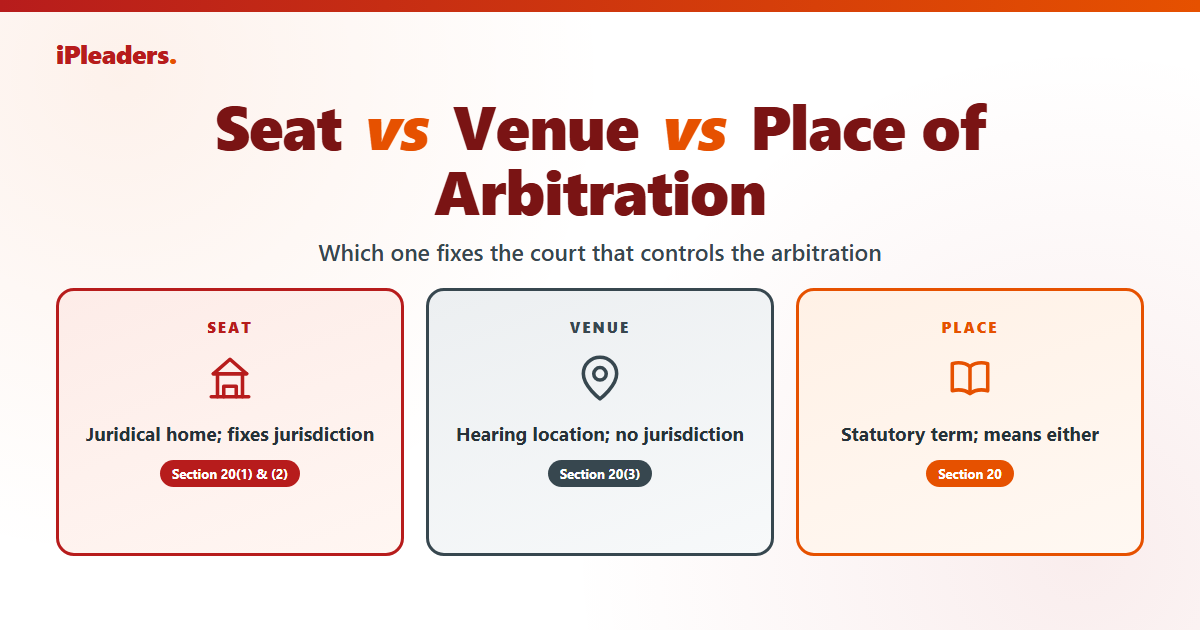


Seat vs venue vs place of arbitration is a three-way distinction that decides which court controls an arbitration, not merely where the hearings sit. “Place” is the word the Arbitration and Conciliation Act, 1996 actually uses in Section 20; the “seat” is the juridical home that fixes the supervisory court and the law governing the arbitration; the “venue” is only the physical location where the tribunal meets for convenience. The seat, not the venue, determines who hears a Section 9 interim application, a Section 11 appointment, or a Section 34 challenge. Get the labels wrong in a clause and parties can spend years fighting in the wrong court before the dispute is even heard.
This article sets out how Indian law separates the seat, the venue and the place of arbitration, what each one controls, and how to draft the clause so the point never becomes a dispute.

The confusion is built into the statute. The Act, following Article 20 of the UNCITRAL Model Law, speaks only of the “place of arbitration” and never uses the words “seat” or “venue” at all. Courts supplied those two labels to explain that the same word carries two different meanings depending on the sub-section it sits in.
Why the distinction earns its keep is jurisdiction. Once a seat is fixed, the courts at that seat get exclusive supervisory control over the arbitration, which shapes interim relief, the appointment of arbitrators, the challenge to the award, and its enforcement. A venue carries none of that on its own, so a clause that names a city as the “venue” without saying what it means invites a fight about whether that city is really the seat.

Place of arbitration under Section 20
The place of arbitration is the term the Arbitration and Conciliation Act, 1996 actually uses, and everything else is judicial gloss on it. Section 20 of the Arbitration and Conciliation Act, 1996 is headed “Place of arbitration” and is the single provision from which the ideas of seat and venue are drawn. The Act borrowed the language from Article 20 of the UNCITRAL Model Law, which also speaks only of “place,” so the drafting ambiguity is inherited rather than an Indian invention. If you want the wider framing of how the 1996 Act sets up arbitration, iPleaders has a full explainer on what arbitration is and how the 1996 Act frames it.
The trouble is that Section 20 uses the one word “place” to carry two jobs. Courts resolved it by reading each sub-section on its own terms, so that the same word means the seat in one place and the venue in another. That reading is now settled, and it is the key to the whole topic.
Section 20(1) and (2): the juridical anchor
Section 20(1) lets the parties agree on the place of arbitration. Failing agreement, Section 20(2) lets the tribunal determine it, having regard to the circumstances of the case and the convenience of the parties. When Section 20(1) or (2) is at work, the “place” the parties or tribunal choose is read as the juridical seat, the legal home of the arbitration.
This is the choice that carries legal weight. Fixing the place under Section 20(1) is, in substance, fixing the seat, and with it the supervisory court and the curial law. That is why a well-drafted clause treats this sub-section as the one to get right.
Section 20(3): meeting at any convenient location
Section 20(3) works differently. It lets the tribunal meet at any place it considers appropriate for consultation among its members, for hearing witnesses, experts or the parties, or for inspection of documents, goods or other property. The “place” in Section 20(3) is the venue, the physical location of a particular hearing or step.
So the same statutory word splits in two. Section 20(1) and (2) point to the seat; Section 20(3) points to the venue. A tribunal seated in Mumbai can lawfully hold a hearing in Delhi or Singapore under Section 20(3) without moving the seat, because the two sub-sections are doing different jobs.
Seat of arbitration and why it fixes jurisdiction
The seat of arbitration is the legal home of the proceeding, the place whose law and courts govern the arbitration itself. It is often called the juridical seat or the centre of gravity of the arbitration. The seat fixes two things at once: the lex arbitri, meaning the procedural law that governs the conduct of the arbitration, and the court that exercises supervisory jurisdiction over it.
That supervisory jurisdiction is not abstract. The seat court is the forum for interim measures under Section 9, the appointment of an arbitrator under Section 11 where the parties cannot agree, a challenge to the award under Section 34, and the enforcement of the award under Section 36. Section 42 reinforces this by providing that once an application relating to an arbitration is made to a court, that court alone retains jurisdiction over the arbitration and all subsequent applications. For the interplay between tribunal-ordered and court-ordered interim relief, iPleaders covers the split in its guide to Section 9 versus Section 17 interim relief.
The seat also decides how much of the Act applies at all. Where the seat is in India, Part I of the Act governs the arbitration; where the seat is abroad, most of Part I falls away and the arbitration answers to the courts of the foreign seat.
Seat as an exclusive jurisdiction clause
Naming a seat does more than pick a convenient court. In Indus Mobile Distribution Pvt. Ltd. v. Datawind Innovations Pvt. Ltd., (2017) 7 SCC 678, the Supreme Court held that the designation of a seat is akin to an exclusive jurisdiction clause. The clause there fixed Mumbai as the seat, though no cause of action had arisen there and neither party was based in Mumbai. The Court held that Mumbai courts alone had jurisdiction, to the exclusion of every other court in the country, precisely because Mumbai was the juridical seat.
The practical effect is significant. Once the seat is settled, a party cannot run to the court where the contract was signed or where the goods were delivered; it must go to the seat court. The seat overrides the ordinary rules on where a suit can be filed, which is why the seat is the single most consequential choice in an arbitration clause.
The BALCO foundation
The modern seat doctrine in India rests on Bharat Aluminium Co. v. Kaiser Aluminium Technical Services Inc., (2012) 9 SCC 552, a five-judge Constitution Bench ruling. BALCO overruled the earlier position in Bhatia International and held that Part I of the Act does not apply to arbitrations seated outside India. In doing so, it drew the territorial line that separates Indian-seated from foreign-seated arbitration and brought the seat concept into Indian law in a structured way.
BALCO is the reason the seat question matters as much as it does. By tying the reach of Part I to the location of the seat, the Court made the seat the hinge on which supervisory jurisdiction turns. Every later seat-versus-venue decision builds on that foundation.
Venue of arbitration: location without jurisdiction
The venue of arbitration is only the physical place where the tribunal sits to do its work. It is a matter of convenience: where the hearings happen, where witnesses are examined, where documents are inspected. On its own, the venue confers no supervisory jurisdiction on the courts of that place.
Because the venue is about logistics, it can differ from the seat without any legal consequence. A tribunal can be seated in New Delhi and hold hearings in London for the convenience of overseas witnesses, and the seat stays in New Delhi. The London courts do not acquire supervisory jurisdiction merely because the hearings took place there.
A change of venue during the proceedings does not shift the seat either. In BBR (India) Pvt. Ltd. v. S.P. Singla Constructions Pvt. Ltd., (2023) 1 SCC 693, the physical location of the arbitration moved when a new arbitrator was appointed, but the Supreme Court held that the juridical seat, once fixed, did not travel with the hearings. The distinction held: the venue moved, the seat did not.
There is one important qualification. The parties themselves can change the seat, not just the venue, if they agree to it. In Inox Renewables Ltd. v. Jayesh Electricals Ltd., (2023) 3 SCC 810, the clause named Jaipur as the venue, but the parties mutually shifted the arbitration to Ahmedabad, and the arbitrator recorded that shift in the award. The Court held that the mutual change made Ahmedabad the seat, and the Gujarat courts, not the Rajasthan courts, gained exclusive jurisdiction. The lesson is that a genuine, recorded agreement to move the seat is effective, while a mere change in hearing location is not.
2012
BALCO v. Kaiser Aluminium
Seat concept enters Indian law; Part I does not apply to a foreign seat.
2017
Indus Mobile v. Datawind
Naming a seat is akin to an exclusive jurisdiction clause.
2018
UOI v. Hardy Exploration
A venue becomes the seat only with concomitant factors (later doubted).
2019
BGS SGS Soma v. NHPC
Shashoua principle adopted: an unqualified venue is the seat; Hardy held per incuriam.
2020
Mankastu Impex v. Airvisual
The phrase “place of arbitration” is not by itself determinative of the seat.
2024
Arif Azim v. Micromax
Express venue plus a chosen curial law and no contrary indicator makes it the seat.
iPleaders · blog.ipleaders.in
How Indian courts tell the seat from the venue
Indian courts separate the seat from the venue by reading the whole clause, not just the label a party happens to use. A clause that says “venue” is not automatically about logistics, and a clause that says “place” is not automatically the seat. The court looks at the language, the chosen rules, and any contrary indicators before deciding what the parties really fixed.
The path to the current test ran through several Supreme Court rulings, and it is worth tracing because the reasoning still governs today.
The Shashoua principle
The working test comes from an English decision, Roger Shashoua v. Mukesh Sharma, which Indian courts have adopted. The principle is this: where a clause designates a “venue” for the arbitration, names no separate “seat,” adds a supranational body of rules to govern the arbitration, and shows no other significant contrary indicator, the stated venue is in truth the juridical seat. In short, an unqualified venue, backed by a chosen curial law, reads as the seat.
The principle matters because most commercial clauses name only one location and call it the “venue” out of habit. The Shashoua principle tells a court to treat that single named place as the seat unless something in the clause points the other way.
When “venue” is read as the seat
The Supreme Court adopted the Shashoua principle squarely in BGS SGS Soma JV v. NHPC Ltd., (2020) 4 SCC 234. The clause named New Delhi or Faridabad as the place where arbitration proceedings would be held. The Court held that where a clause designates a venue for the whole of the arbitral proceedings, and there is no contrary indicator, that venue is the seat, and it went on to hold the earlier decision in Hardy Exploration wrongly decided on this point.
The Court returned to the same ground recently in Arif Azim Co. Ltd. v. Micromax Informatics FZE, 2024 INSC 850, decided in November 2024. The distributorship clause named the “venue of arbitration” as Dubai and chose UAE arbitration rules. The Court held that the express designation of a venue, coupled with the chosen curial law and the absence of any contrary indicator, was enough to make Dubai the juridical seat, and it rejected a formulaic search for connecting factors as the way to find the seat.
When the label does not settle it
The line has not always been drawn the same way. In Union of India v. Hardy Exploration and Production (India) Inc., (2019) 13 SCC 472, the entire arbitration took place in Kuala Lumpur, but the Court held that a venue becomes the seat only when accompanied by “concomitant factors,” and it declined to treat Kuala Lumpur as the seat on the clause before it. BGS Soma later doubted this reasoning, so Hardy Exploration is best read as the position the Court moved away from.
A named “place” does not decide the matter by itself either. In Mankastu Impex Pvt. Ltd. v. Airvisual Ltd., (2020) 5 SCC 399, the clause said the “place of arbitration shall be Hong Kong,” yet the Court held that the mere expression “place of arbitration” is not by itself determinative of the seat. The intention has to be gathered from the other clauses and the conduct of the parties, which in that case still pointed to Hong Kong as the seat. The takeaway is that courts read for intention, and a loose label will be tested against the rest of the clause.
| Parameter | Seat | Venue | Place |
|---|---|---|---|
| Meaning | Juridical home of the arbitration | Physical location of hearings | Statutory term in Section 20 |
| Statutory basis | Section 20(1) and (2) | Section 20(3) | Section 20, heading and text |
| What it controls | Supervisory court and curial law | Convenience of hearings only | Depends on the sub-section |
| Confers court jurisdiction | Yes, exclusive to the seat court | No, not on its own | Only where it means the seat |
| Can it change | Only by mutual agreement | Freely, for convenience | Not applicable; it is a label |
| Word to use in a clause | “seat” | “venue” | Avoid as the operative word |
- The seat, not the venue, fixes which court supervises the arbitration.
- Use the word “seat” for the juridical home and keep “venue” for the hearing location.
- “Place” is the statutory umbrella term: it means seat or venue depending on the sub-section.
iPleaders · blog.ipleaders.in
Seat, venue and place compared
Seat, venue and place differ on four things: what they mean, what fixes them, what they control, and whether they can change. The seat is the legal home that fixes jurisdiction and the curial law; the venue is the physical location of hearings that fixes nothing on its own; the place is the statutory umbrella term in Section 20 that means the seat or the venue depending on the sub-section. Reading the three apart is what stops a drafting habit from turning into a jurisdiction fight.
The comparison below sets the three side by side. Read the “place” column as a reminder that the statute never uses “seat” or “venue” at all, which is exactly why the other two columns had to be built by the courts.
| Parameter | Seat | Venue | Place |
|---|---|---|---|
| Meaning | Juridical home of the arbitration | Physical location of hearings | Statutory term in Section 20 |
| Statutory basis | Section 20(1) and (2) (read as seat) | Section 20(3) (read as venue) | Section 20, heading and text |
| What it controls | Supervisory court and curial law | Convenience of hearings only | Depends on the sub-section |
| Confers court jurisdiction | Yes, exclusive to the seat court | No, not on its own | Only where it means the seat |
| Can it change | Only by mutual agreement of the parties | Freely, for convenience | Not applicable; it is a label |
| Word to use in a clause | “seat” | “venue” | Avoid as the operative word |
The single most useful row is the last one. If the clause uses the word “seat” for the juridical home and keeps “venue” for the hearing location, the ambiguity that produced BGS Soma, Hardy Exploration and Arif Azim largely disappears. The litigation in those cases grew out of clauses that used “venue” or “place” loosely and left a court to reconstruct the parties’ intention.
Drafting the clause to avoid a seat-venue dispute
A clause avoids the seat-venue dispute by naming the seat expressly and using the right word for it. The cases in this area almost all trace back to loose drafting, so the fix is precision at the drafting table rather than argument after the dispute arises. A short checklist covers most of it.
First, use the word “seat,” not “venue” or “place,” for the juridical home of the arbitration, and name the city and the country. Second, if hearings may be held somewhere else for convenience, call that location the “venue” in a separate sentence so the two ideas do not blur. Third, state the law governing the arbitration agreement and the curial law, because a chosen body of rules is one of the factors a court weighs under the Shashoua principle. Fourth, add an exclusive jurisdiction line pointing to the courts of the seat, which reinforces the effect that Indus Mobile already gives the seat.
For cross-border contracts, one more decision matters: whether Part I of the Act is meant to apply. After BALCO, an arbitration seated abroad is largely outside Part I, so if the parties want Indian courts to retain a role, they must say so clearly rather than leave it to inference. A model clause and the surrounding drafting choices are set out in the iPleaders guide on how to draft an arbitration agreement in India, and LawSikho has a focused walk-through on the same seat-versus-venue and rules choices in its guide to the seat versus venue of arbitration in India.
The direction of travel favours tighter clauses. The Arif Azim ruling in 2024 shows the Supreme Court still resolving avoidable ambiguity years into a dispute, and the proposed reforms in the Arbitration and Conciliation (Amendment) Bill, 2024 lean further towards institutional arbitration and less court intervention. Clause drafting is increasingly treated as a core professional skill, and reskilling programmes such as those on the Skill Arbitrage blog reflect how far practical, cross-border legal drafting has moved into everyday practice. Weighed together, the message for a drafter is simple: fix the seat expressly, and the arbitration keeps its intended home.
Frequently asked questions
What is the difference between seat and venue of arbitration?
The seat of arbitration is the legal home of the proceeding: it fixes which courts supervise the arbitration and which procedural law governs it. The venue is only the physical location where hearings are held, chosen for convenience. The seat carries jurisdiction; the venue, on its own, does not.
Is “place of arbitration” the same as the seat or the venue?
“Place of arbitration” is the term used in Section 20 of the Arbitration and Conciliation Act, 1996, and it can mean either. Under Section 20(1) and (2), the “place” the parties or the tribunal fix is read as the seat. Under Section 20(3), the “place” where the tribunal meets for hearings is the venue.
Which court has jurisdiction, the seat court or the venue court?
The seat court. Once a seat is designated, the courts at that seat have exclusive supervisory jurisdiction over the arbitration, as the Supreme Court held in Indus Mobile Distribution v. Datawind Innovations. The venue court gets no supervisory jurisdiction merely because hearings were held there.
Can the seat of arbitration be changed after it is fixed?
Yes, but only by mutual agreement of the parties, not by a unilateral move or a change of hearing location. In Inox Renewables v. Jayesh Electricals, the parties agreed to shift the arbitration from Jaipur to Ahmedabad, and the recorded change made Ahmedabad the seat. A simple change of venue during the proceedings does not shift the seat.
What happens if the arbitration clause is silent on the seat?
Where the clause names a single location as the “venue” and adds a governing body of rules with no contrary indicator, courts apply the Shashoua principle and read that location as the seat, as in BGS SGS Soma v. NHPC. If nothing points clearly either way, the tribunal determines the seat under Section 20(2) and the court gathers the parties’ intention from the whole clause and their conduct.
Does the seat decide which country’s law governs the arbitration?
The seat fixes the curial law, meaning the procedural law that governs how the arbitration is conducted, and the supervisory court. It is distinct from the substantive law that governs the contract, which the parties can choose separately. After the BALCO ruling, a seat outside India also takes the arbitration largely outside Part I of the Arbitration and Conciliation Act, 1996.
References
Case Law
- Arif Azim Co. Ltd. v. Micromax Informatics FZE, 2024 INSC 850
- Bharat Aluminium Co. v. Kaiser Aluminium Technical Services Inc., (2012) 9 SCC 552
- BBR (India) Pvt. Ltd. v. S.P. Singla Constructions Pvt. Ltd., (2023) 1 SCC 693
- BGS SGS Soma JV v. NHPC Ltd., (2020) 4 SCC 234
- Indus Mobile Distribution Pvt. Ltd. v. Datawind Innovations Pvt. Ltd., (2017) 7 SCC 678
- Inox Renewables Ltd. v. Jayesh Electricals Ltd., (2023) 3 SCC 810
- Mankastu Impex Pvt. Ltd. v. Airvisual Ltd., (2020) 5 SCC 399
- Union of India v. Hardy Exploration and Production (India) Inc., (2019) 13 SCC 472
Statutes
- Arbitration and Conciliation Act, 1996 (sections cited: 2(2), 9, 11, 20, 34, 36, 42)
- UNCITRAL Model Law on International Commercial Arbitration, Article 20 (source of the “place of arbitration” language)
This article is for informational and educational purposes only and does not constitute legal advice. For advice on a specific dispute or the drafting of an arbitration clause, consult a qualified advocate.

