


Facing rising legal workloads and limited resources, Microsoft is re-engineering its legal function into what it calls a “frontier legal department”, using AI-powered workflows, centralised knowledge management and automated legal support to improve efficiency across more than 50 countries, Marlon Feltzner, Associate General Counsel and Head of Legal Affairs for Asia at Microsoft, said at The AI-Driven Legal Ecosystem: Bench, Bar & Business in Transition, organised by ETLegalWorld in association with Microsoft and supported by the Bombay Bar Association.
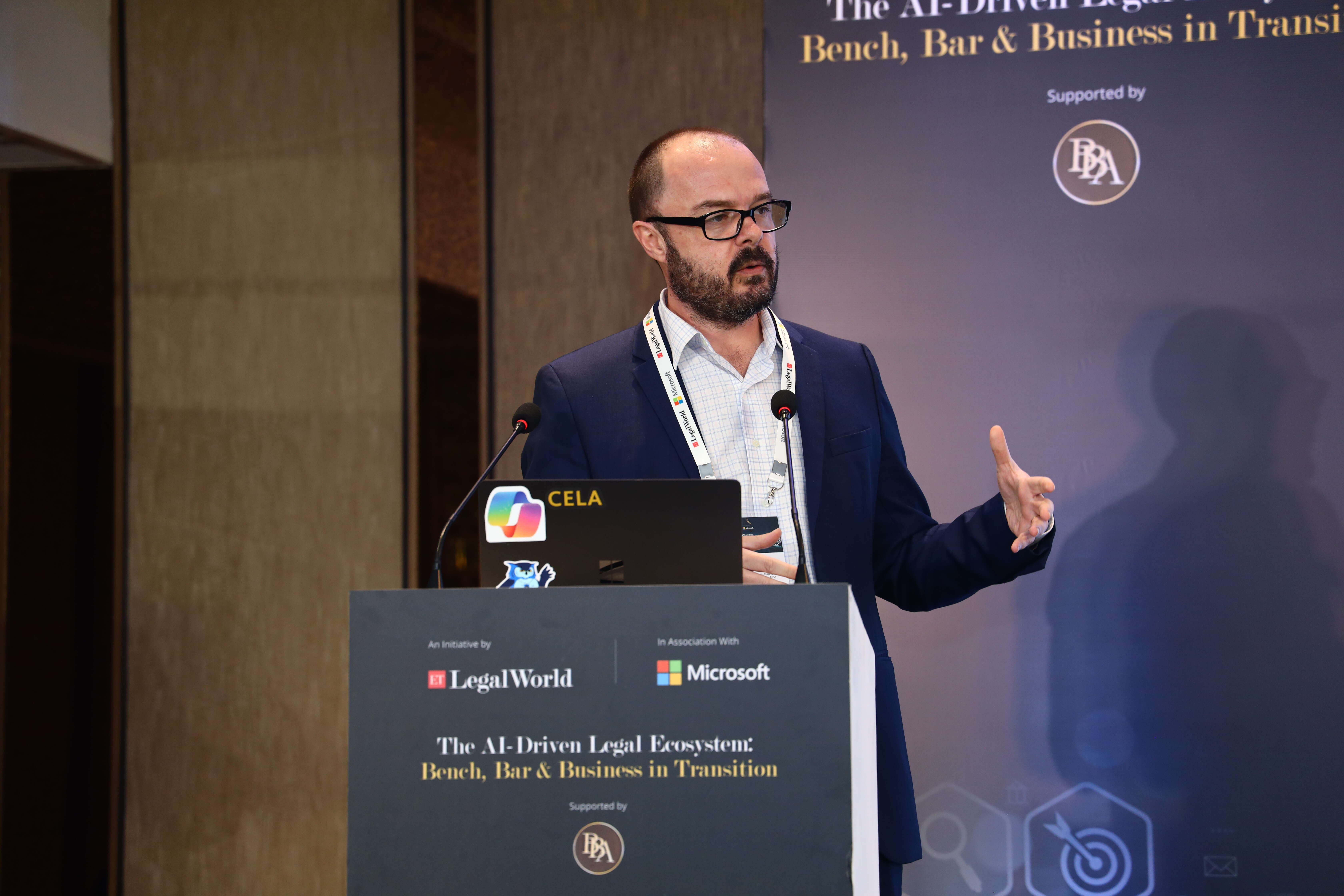
“The business demand for our work internally has increased and keeps increasing, and our resources are limited. So that’s why we created this internal concept of becoming a frontier legal department and using AI as the forefront of this,” Feltzner said.
He traced the legal profession’s technological evolution from word processors and fax machines to cloud computing, mobile devices, virtual hearings during the pandemic and now generative AI, arguing that each wave required lawyers to acquire new skills while adapting organisational culture.
“What I’ve seen when I look back through those years, what I’ve seen is that there’s a strong element of skills that are required. So yes, we need skills, but there’s also a strong element of culture. There’s change management that is required just to implement those changes in technology and how we work. And this is something that we are seeing right now with AI,” he said.
Feltzner noted that AI adoption has accelerated globally, with legal professionals increasingly moving beyond experimentation to day-to-day use. However, he cautioned that governance remains critical as employees often use unauthorised consumer AI tools without organisational oversight.
“One thing that we realized, especially from talking to law firms, is that they—and even legal departments—are still considering the dangers of adopting AI. What we know in the tech world, we call the shadow AI. What is shadow AI? It’s when you say, I’m not using AI, but your employees are,” he said.
He warned that reliance on free or consumer versions of AI platforms could expose organisations to data privacy and security risks, as they will not bring you the same level of data protection or data privacy in terms of keeping the data inside your organisation.
Drawing on Microsoft’s internal experience, Feltzner said the company initially found that AI tools improved individual productivity by about 30%, but those gains did not automatically translate into departmental efficiency.
“The ones using AI were like 30 % faster in finding a resolution, right? But when we saw that, we realized that that was very impactful at a personal level, personal productivity, but not as a department,” he said.
The company discovered that fragmented email-based workflows, siloed knowledge stored in individual inboxes, and inconsistent request management limited the broader impact of AI.
To overcome these challenges, Microsoft shifted from a traditional legal service model to what Feltzner described as a platform model, integrating AI into a unified legal support system.
The company has created a global AI-enabled legal front-end, called SILA Frontline, which consolidates legal knowledge, standardises intake of legal requests and uses AI agents to answer routine queries before escalating complex matters to legal professionals.
According to Feltzner, the platform has handled more than 1,600 requests from approximately 1,200 users within six weeks of launch, with nearly 15% of those queries resolved directly through AI.
“Interesting enough, so far, almost 15%, so 14.26, have been solved by AI. So that’s efficiency that we are able to measure in questions that we are getting and are being able to be answered by AI without taking time for an attorney and allowing the attorney to work on something more relevant,” he said.
Feltzner emphasised that leadership commitment remains the biggest driver of successful AI adoption.
“Leadership, message from the top matters more than anything,” he said, adding that organisations should treat AI implementation as a continuous journey rather than a one-time technology deployment.
He also stressed the importance of preserving institutional knowledge through AI-enabled systems rather than allowing expertise to remain locked in individual inboxes or shared drives.
“The problem was not data, we had the data, it was just how the data could be reused.,” Feltzner said.
He said Microsoft intends to expand these AI-driven workflows beyond its in-house legal teams and into collaborations with external law firms to improve knowledge preservation, consistency and response times.