

Last verified: 10 July 2026
Filing for divorce in India means asking a court to legally end a valid marriage, and the way you do it depends on two things: whether both spouses agree to separate and which personal law governed the marriage. A marriage between two Hindus, Buddhists, Jains or Sikhs is dissolved under the Hindu Marriage Act, 1955; a civil or inter-faith marriage under the Special Marriage Act, 1954; a Christian marriage under the Indian Divorce Act, 1869; a Parsi marriage under the Parsi Marriage and Divorce Act, 1936; and a Muslim marriage under Muslim personal law and the Dissolution of Muslim Marriages Act, 1939. Whichever statute applies, the petition is filed in the Family Court set up under the Family Courts Act, 1984, or in the district court where no family court exists.

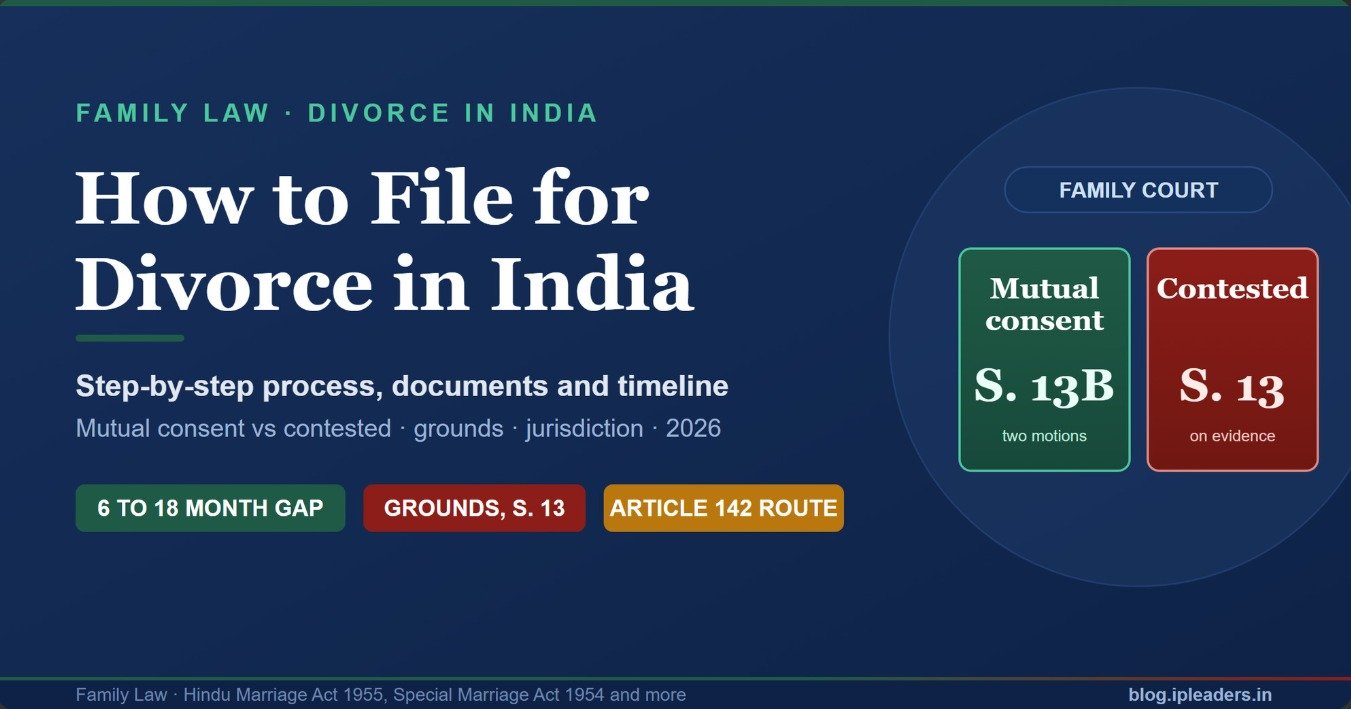
There are two routes. A mutual consent divorce is a joint petition filed by both spouses under Section 13B of the Hindu Marriage Act (and the parallel provisions in the other statutes), decided in two motions with a six to eighteen month gap between them that courts now frequently waive. A contested divorce is filed by one spouse on a statutory ground such as cruelty, desertion or adultery, and is tried on evidence when the other spouse resists. One point causes constant confusion: irretrievable breakdown of marriage, on its own, is not a ground a family court or district court can grant. Only the Supreme Court can dissolve a marriage on that basis, using its power under Article 142 of the Constitution.
This guide sets out the practical procedure end to end. It covers how to choose between the two routes, the grounds you must be able to show in a contested case, a step-by-step walkthrough of both the mutual consent and the contested process, the documents you need, where to file and the jurisdiction rules, the one-year bar on early petitions, how long a divorce realistically takes and what it costs, and the alimony, maintenance and child custody questions decided alongside the divorce itself. Where a related subject deserves its own treatment, this guide links out to a deeper resource rather than repeating it, including the grounds for divorce under the Hindu Marriage Act, how to seek protection through a domestic violence case, and a wife’s rights over her streedhan.

To file for divorce in India, first decide the route: a mutual consent petition if both spouses agree, or a contested petition on a statutory ground if they do not. Establish the ground or the mutual agreement, engage a lawyer to draft the petition, file it in the family court that has jurisdiction, serve notice on the other spouse, attend court-directed mediation, and then either record the second motion (mutual consent) or lead evidence (contested) before the court passes the decree of divorce.
The rest of this article breaks each of those steps down with the exact sections, timelines and documents that apply in 2026.
Divorce in India: the two routes and the law that applies to you
Before a single form is filed, two questions decide almost everything that follows: is the divorce by mutual consent or contested, and which personal law governs the marriage. Getting these right at the outset determines the statute, the forum, the grounds you must prove and the time the case will take.
Mutual consent versus contested: the first decision
A mutual consent divorce is available when both spouses agree that the marriage should end and can settle the surrounding issues, that is, alimony or a one-time settlement, custody of children, and the return of streedhan and belongings. It is faster, cheaper and far less adversarial because there is nothing to prove; the court only satisfies itself that consent is free and the settlement is fair. A contested divorce is what one spouse files when the other does not agree, or when there is no agreement on money or children. Here the petitioner must establish a statutory ground and prove it with evidence, and the case is fought like any civil trial.
Many divorces begin as contested petitions and convert into mutual consent later, once the spouses negotiate a settlement, often during court-directed mediation. That conversion is common and usually the quickest way to close a bitter case, which is why the settlement discussion matters even when the petition is filed on a contested ground.
Which personal law governs your divorce
The statute that applies is fixed by the law under which the marriage was solemnised or by the religion of the parties.
- Hindu Marriage Act, 1955 governs marriages where both parties are Hindus, and includes Buddhists, Jains and Sikhs. This is the most commonly used divorce law in India.
- Special Marriage Act, 1954 governs civil marriages and inter-faith marriages registered under that Act, regardless of the religion of the spouses.
- Indian Divorce Act, 1869 governs the divorce of Christians.
- Parsi Marriage and Divorce Act, 1936 governs Parsi marriages and provides for a special Parsi matrimonial court with delegates.
- Muslim law governs the dissolution of a Muslim marriage. A husband may pronounce talaq, a wife may seek khula, and the spouses may agree to a mubarat (mutual) dissolution; a Muslim wife may also approach the court under the Dissolution of Muslim Marriages Act, 1939. Instant triple talaq (talaq-e-biddat) is void and a punishable offence under the Muslim Women (Protection of Rights on Marriage) Act, 2019.
The practical consequence is that the section numbers, the mandatory separation periods and even the court differ by community. The steps in this guide use the Hindu Marriage Act as the reference framework because it applies to the largest number of divorces, and flag the equivalent provisions for the other laws where they diverge.
The marriage must be legally valid
A court can only dissolve a marriage that legally exists. Where the fact of marriage is disputed, or where the marriage was never validly solemnised, the appropriate remedy may be a decree of nullity rather than divorce. In practice, a marriage certificate or registration is the cleanest proof, and while registration is not what makes a Hindu marriage valid, it makes the petition considerably easier to prove. Couples who married under the Special Marriage Act are already registered by definition.
Grounds for divorce: what you must show
In a mutual consent case there are no grounds to prove beyond the agreement itself and the required period of separation. In a contested case, the petitioner must plead and prove one of the grounds the statute recognises. The grounds below are those under the Hindu Marriage Act, which are broadly mirrored, with variations, in the other personal laws. A fuller treatment of each ground, with the leading case law, is set out in the dedicated guide on divorce under the Hindu Marriage Act.
Grounds available to either spouse (Section 13(1))
Under Section 13(1) of the Hindu Marriage Act, either the husband or the wife may seek divorce on the following grounds:
- Cruelty, whether physical or mental. This is the most frequently pleaded ground and covers sustained conduct that makes it unsafe or unreasonable to continue living together.
- Desertion for a continuous period of at least two years immediately before the petition, meaning the withdrawal from the marriage without reasonable cause and without consent.
- Adultery, that is, voluntary sexual intercourse with a person other than the spouse after the marriage.
- Conversion to another religion, where the respondent has ceased to be a Hindu.
- Unsoundness of mind or mental disorder of a kind and degree that the petitioner cannot reasonably be expected to live with the respondent.
- Renunciation of the world by entering a religious order.
- Presumption of death, where the respondent has not been heard of as alive for at least seven years.
- Venereal disease in a communicable form.
Leprosy was once a ground for divorce but was removed by the Personal Laws (Amendment) Act, 2019, which struck it out of the Hindu Marriage Act, the Special Marriage Act, the Indian Divorce Act and the Dissolution of Muslim Marriages Act, recognising that the disease is now curable. It is no longer a valid ground, a change explained in the note on the Personal Laws (Amendment) Act, 2019.
Additional grounds available only to the wife (Section 13(2))
Section 13(2) gives a wife four further grounds that a husband cannot invoke:
- The husband has another wife living from a marriage that took place before the Act commenced (bigamy).
- The husband has been guilty of rape, sodomy or bestiality since the marriage.
- A maintenance order or decree has been passed in the wife’s favour and cohabitation has not resumed for at least one year since.
- The marriage took place before she attained the age of fifteen and she repudiated the marriage after turning fifteen but before eighteen.
Grounds after judicial separation or restitution (Section 13(1A))
Section 13(1A) allows either spouse to seek divorce where there has been no resumption of cohabitation for at least one year after a decree of judicial separation, or no restitution of conjugal rights for at least one year after a decree under Section 9. These grounds are useful where an earlier matrimonial proceeding has already been fought and the marriage has simply not revived.
Grounds under the other personal laws
The other statutes recognise comparable but not identical grounds. The Special Marriage Act, 1954 sets out its grounds in Section 27, closely tracking the Hindu Marriage Act. The Indian Divorce Act, 1869 governs Christian divorces and lists grounds including adultery, cruelty and desertion. The Parsi Marriage and Divorce Act, 1936 lists its grounds in Section 32. For Muslim women, the Dissolution of Muslim Marriages Act, 1939 provides grounds in Section 2, including the husband’s whereabouts being unknown for four years, failure to provide maintenance for two years, imprisonment for seven years or more, failure to perform marital obligations, impotence, and cruelty.
How to file for a mutual consent divorce: step by step
Mutual consent is the route most couples should use if they can reach agreement, because it is quicker, cheaper and does not require either spouse to make allegations against the other. Under the Hindu Marriage Act it runs on Section 13B; the Special Marriage Act uses Section 28, the Indian Divorce Act uses Section 10A (which requires two years of separation for Christians), and the Parsi Act uses Section 32B.
Step 1: Confirm eligibility
Section 13B requires that the spouses have been living separately for at least one year, that they have not been able to live together, and that they have mutually agreed to dissolve the marriage. “Living separately” means not living as husband and wife; it does not necessarily require living in different houses, and spouses under the same roof who have stopped living as a married couple can satisfy this test. Before filing, the couple should also settle the ancillary issues, that is, permanent alimony or a lump-sum settlement, custody and visitation for any children, and the return of streedhan and belongings, because a clean settlement is what allows the court to grant the decree quickly.
Step 2: File the first motion
Both spouses jointly file a petition for divorce by mutual consent in the family court that has jurisdiction, supported by their affidavits and the terms of settlement. On the first motion, the court records the statements of both parties to confirm that consent is free and voluntary and that the settlement is understood. This is the first of the two motions the section requires.
Step 3: The cooling-off period, and when it is waived
After the first motion, Section 13B(2) contemplates a gap of not less than six months and not more than eighteen months before the second motion, intended as a period of reflection. The Supreme Court in Amardeep Singh v. Harveen Kaur, (2017) 8 SCC 746, held that this six-month period is directory and not mandatory, and that a court can waive it. The waiver is appropriate where the mandatory separation period was already over before the first motion, where mediation and reconciliation efforts have failed with no likelihood of the parties coming together, where the parties have genuinely settled alimony, custody and other disputes, and where making them wait would only prolong their suffering. A waiver application can be moved about a week after the first motion. In practice, well-settled couples routinely apply for waiver and complete the divorce in a single extended hearing or within a few weeks.
Step 4: The second motion and the decree
On the second motion, the court again records the statements of both parties to confirm that the consent continues and has not been withdrawn. Consent must subsist right up to the passing of the decree; either spouse can withdraw consent before the decree, and the court cannot force an unwilling party to go through with a mutual consent divorce. Once satisfied, the court passes the decree of divorce, and the marriage stands dissolved from that date.
How to file for a contested divorce: step by step
A contested divorce is filed by one spouse when the other does not agree, or when there is no agreement on money or children. It follows the structure of a civil suit and is more demanding in time, cost and proof.
Step 1: Consult a lawyer and draft the petition
The first step is to engage a matrimonial lawyer and prepare the divorce petition. The petition sets out the particulars of the marriage, the ground or grounds relied on with the supporting facts, the relief sought, and a statement that there is no collusion. The strength of a contested case is decided largely at the drafting stage, because vague or unsupported allegations of cruelty or desertion are the most common reason petitions fail.
Step 2: File in the court with jurisdiction
The petition is filed in the family court, or district court, that has territorial jurisdiction under Section 19 of the Hindu Marriage Act. The permitted forums are discussed in detail below, but broadly the petition can be filed where the marriage was solemnised, where the respondent resides, where the couple last lived together, or, in the wife’s case, where she currently resides. The court fee is paid and the petition is numbered.
Step 3: Summons or notice to the respondent
Once the petition is admitted, the court issues a summons or notice to the respondent, that is, the other spouse, informing them of the case and requiring them to appear. Proper service is essential; if the respondent avoids service, the court may direct substituted service through publication or other means before proceeding.
Step 4: Written statement and framing of issues
The respondent files a written statement replying to the petition, admitting or denying the allegations and raising any defence or counter-claim. On the basis of the pleadings, the court frames the issues, that is, the specific questions of fact and law it must decide, such as whether the alleged cruelty is proved.
Step 5: Evidence and cross-examination
Each side leads evidence. The petitioner files an evidence affidavit and produces documents and witnesses, and is cross-examined by the respondent’s lawyer; the respondent then leads evidence and is cross-examined in turn. This is the heart of a contested trial and usually the longest phase, because matrimonial disputes turn on oral testimony that has to be tested. Documentary proof, medical records, messages, financial records and independent witnesses carry far more weight than the parties’ own assertions.
Step 6: Final arguments and the decree
After evidence is complete, both sides make final arguments on how the proved facts meet, or fail to meet, the statutory ground. The court then delivers its judgment, either granting the decree of divorce or dismissing the petition. If granted, the marriage is dissolved from the date of the decree, subject to any appeal.
Step 7: Appeal
A spouse dissatisfied with the outcome may appeal. Under Section 28 of the Hindu Marriage Act, appeals from decrees in matrimonial cases lie to the appropriate appellate court, ordinarily the High Court, within the prescribed limitation period. An appeal reopens the findings and can take a further period of time, which is one reason a negotiated settlement is often preferable to a fully fought trial.
Documents required to file for divorce
The exact list varies by court and by the ground pleaded, but the following documents are needed in almost every divorce filing. Preparing them before the first meeting with a lawyer saves weeks.
Core documents
- Marriage certificate or proof of solemnisation of the marriage.
- Proof of identity and current address of the petitioner (and, where available, of the respondent).
- Passport-size photographs of the marriage or of the spouses together.
- Evidence of the date since when the spouses have been living separately (relevant to both routes).
Financial documents
- Salary slips, income tax returns and bank statements showing the income of the parties.
- Details of movable and immovable property, investments and liabilities.
- An affidavit of disclosure of assets and liabilities. Following the Supreme Court’s directions in Rajnesh v. Neha, (2021) 2 SCC 324, both spouses are required to file such an affidavit in maintenance proceedings, and family courts increasingly require it in every matrimonial case.
Evidence supporting the ground (contested cases)
- For cruelty: medical records, police complaints, photographs, messages, emails or call records, and witness details.
- For desertion: proof of the date and fact of separation and of the absence of reasonable cause or consent.
- For adultery: such corroborating material as is available, given the difficulty of direct proof.
- For conversion, mental disorder or presumption of death: the relevant certificate, medical opinion or evidence of absence.
Where to file: family court, jurisdiction and the one-year bar
Filing in the wrong court, or filing too early, are avoidable mistakes that can stall or defeat a petition. Three rules govern this stage.
The family court under the Family Courts Act, 1984
Where a family court has been established, Section 7 of the Family Courts Act, 1984 gives it exclusive jurisdiction over matrimonial matters, including divorce, in that area. Where no family court exists, the district court exercises the jurisdiction. Family courts are designed to be less formal and to encourage settlement, and parties are ordinarily expected to appear in person at key stages.
Jurisdiction under Section 19 of the Hindu Marriage Act
Section 19 sets out where a petition may be presented. It may be filed in the district within whose jurisdiction the marriage was solemnised, or the respondent resides at the time of filing, or the parties last resided together, or, importantly, where the wife is residing at the time of the petition if she is the petitioner. It may also be filed where the petitioner resides if the respondent is residing outside the territories to which the Act extends or has not been heard of as alive for seven years. The option allowing the wife to file where she currently lives was added to spare a woman the burden of litigating in the city she had to leave.
The one-year bar under Section 14
Section 14 of the Hindu Marriage Act bars any divorce petition within one year of the marriage. A petition can be entertained earlier only with the leave of the court, on the ground of exceptional hardship to the petitioner or exceptional depravity on the part of the respondent. The bar is designed to discourage hasty divorces in the very early period of a marriage.
Reconciliation and mediation
Section 9 of the Family Courts Act, 1984 places a duty on the court to make an effort to help the parties arrive at a settlement, and courts routinely refer matrimonial matters to mediation, especially where the disputes are about money and children rather than the fact of breakdown. Mediation is confidential and, for a contested case, is often where a mutual consent settlement is worked out. Cooperating with the mediation reference, rather than treating it as a formality, is frequently the fastest path to a decree.
How long divorce takes and what it costs
Two of the most common questions have honest answers that depend heavily on cooperation between the spouses and the workload of the court.
Mutual consent timeline
A mutual consent divorce, where the cooling-off period is waived and the settlement is clean, can be completed in a few weeks to around six months. Where the court insists on the full statutory gap, it can take up to about eighteen months from the first motion. The single biggest accelerator is a complete, signed settlement filed with the first motion.
Contested timeline
A contested divorce typically takes between two and five years, and sometimes longer where there are appeals, transfer petitions or parallel maintenance and custody proceedings. The evidence and cross-examination stage is the main variable. Because of this, spouses who cannot reconcile but can negotiate terms often convert a contested petition into a mutual consent one to save years.
Court fees and lawyer’s costs
The court fee for a divorce petition is modest and fixed by the relevant state schedule. The real cost is the advocate’s fee, which varies widely by city, the seniority of the lawyer and whether the case is mutual or contested. A straightforward mutual consent divorce is at the lower end, while a fully contested trial with maintenance and custody disputes is materially more expensive because it runs for years. Parties who cannot afford a lawyer are entitled to free legal aid through the State and District Legal Services Authorities.
The Article 142 route before the Supreme Court
Where a marriage has broken down completely but neither a family-court ground is easily proved nor mutual consent is forthcoming, the Supreme Court can step in. In Shilpa Sailesh v. Varun Sreenivasan, 2023 INSC 468, a Constitution Bench held that the Supreme Court can dissolve a marriage on the ground of irretrievable breakdown in exercise of its power under Article 142 of the Constitution to do complete justice, even where that ground is not in the statute and even if one spouse opposes it, and that it can waive the six-month cooling-off period in an appropriate mutual consent case. This is a discretionary power exercised sparingly, only when the Court is satisfied that the marriage is emotionally dead and beyond salvage.
The reach of this power was underlined in Dhananjay Rathi v. Ruchika Rathi, 2026 SCC OnLine SC 587, decided on 13 April 2026, where the Supreme Court dissolved a marriage under Article 142 and held that a spouse cannot resile from a duly executed, court-affirmed mediated settlement except on limited grounds such as force, fraud, undue influence or the other party’s failure to perform its obligations. There, the wife had withdrawn consent after the first motion although the husband had already paid a substantial settlement and returned jewellery, and the Court rejected her later demands and closed the litigation. The case is a caution to both spouses: a settlement recorded and affirmed by the court is meant to be honoured, and backing out of one without a valid reason will not be countenanced.
Alimony, maintenance and child custody decided alongside
A divorce petition rarely travels alone. Money and children are usually decided in the same or connected proceedings, and settling them is often what unlocks the divorce itself.
Interim and permanent alimony
During the case, either spouse without sufficient independent income can seek maintenance pendente lite and litigation expenses under Section 24 of the Hindu Marriage Act. At the end, the court can order permanent alimony and maintenance under Section 25, as a monthly sum or a lump sum. Maintenance can also be claimed independently under Section 144 of the Bharatiya Nagarik Suraksha Sanhita, 2023, which from 1 July 2024 replaced Section 125 of the old Criminal Procedure Code.
How much is payable is guided by Rajnesh v. Neha, (2021) 2 SCC 324, in which the Supreme Court laid down a comprehensive framework. It requires both parties to file an affidavit of disclosure of assets and liabilities, directs that maintenance ordinarily runs from the date of the application, and lists the factors to be weighed, including the status and standard of living of the parties, the reasonable needs of the claimant and any children, the income, assets and liabilities of both spouses, the duration of the marriage, and the earning capacity of each. The judgment also guards against a claimant recovering overlapping maintenance under multiple statutes for the same period.
Child custody: the welfare principle
Custody is decided under the Guardians and Wards Act, 1890, read with the personal law, and, in a matrimonial case, Section 26 of the Hindu Marriage Act allows the court to pass custody, maintenance and education orders for the children. The governing test is the welfare of the child, which overrides the claims of either parent. Courts increasingly favour arrangements that keep both parents involved, including joint or shared custody and structured visitation, rather than treating custody as a prize for one side.
Streedhan, jewellery and property
Divorce does not by itself divide property, because India does not follow a community-of-property regime, but a wife is entitled to the return of her streedhan, that is, the gifts, jewellery and money given to her before, during and after the marriage, which remain her absolute property. The scope of streedhan and how to recover it is set out in the guide on streedhan and a wife’s right to her jewellery and gifts. Where there is violence or a threat to residence, a woman can also pursue protection, residence and monetary relief by filing a domestic violence case alongside the divorce, since those reliefs run independently of it.
Common mistakes to avoid when filing for divorce
The following are the errors that most often delay a divorce or weaken a case:
- Filing within one year of marriage without leave under Section 14, which gets the petition rejected at the threshold.
- Filing in the wrong court, ignoring the jurisdiction options in Section 19, which invites a preliminary objection and wasted months.
- Pleading a ground without evidence, particularly cruelty or desertion, where uncorroborated allegations regularly fail at trial.
- Treating mediation as a formality instead of using it to negotiate a settlement that can convert a years-long contest into a quick mutual consent decree.
- Resiling from a signed settlement after the first motion without a valid reason, which, after Dhananjay Rathi, the courts will not permit and which can result in the divorce being granted against the party who backs out.
- Hiding income or assets in maintenance proceedings, contrary to the disclosure affidavit required by Rajnesh v. Neha, which damages credibility on every issue.
- Overlooking streedhan and custody in the settlement, leaving disputes that resurface after the decree.
Frequently Asked Questions
Can I file for divorce without a lawyer in India?
There is no legal bar to appearing in person, and family courts are designed to be accessible. In practice, drafting a petition that correctly pleads the ground, complying with jurisdiction and procedure, and negotiating alimony and custody are difficult without a lawyer, and most people are better served by engaging one or by using free legal aid through the Legal Services Authorities.
How much does a divorce cost in India in 2026?
The court fee is small and fixed by state schedule. The main cost is the advocate’s fee, which depends on the city, the lawyer’s seniority and whether the case is mutual or contested. A clean mutual consent divorce is at the lower end; a fully contested trial that runs for years costs considerably more.
Can I file for divorce within one year of marriage?
Ordinarily no. Section 14 of the Hindu Marriage Act bars a petition within one year of marriage, and it can be entertained earlier only with the court’s leave, on the ground of exceptional hardship to the petitioner or exceptional depravity of the respondent.
How long does a mutual consent divorce take?
Where the cooling-off period is waived and the settlement is complete, it can be concluded in a few weeks to about six months. If the court requires the full statutory gap, it can take up to around eighteen months from the first motion.
Can the six-month cooling-off period be waived?
Yes. In Amardeep Singh v. Harveen Kaur, the Supreme Court held that the six-month period under Section 13B(2) is directory, not mandatory, and can be waived where the parties have completed the required separation, mediation has failed, all issues are settled, and further waiting would only prolong their suffering.
What are the grounds for a contested divorce?
Under Section 13(1) of the Hindu Marriage Act the grounds available to either spouse include cruelty, desertion for at least two years, adultery, conversion, unsound mind or mental disorder, renunciation of the world, presumption of death after seven years, and venereal disease. Section 13(2) gives a wife additional grounds.
Can a wife file for divorce where she currently lives?
Yes. Section 19 of the Hindu Marriage Act allows a wife who is the petitioner to file where she is residing at the time of the petition, in addition to the other permitted forums, so that she need not litigate in the place she had to leave.
Is irretrievable breakdown of marriage a ground for divorce in India?
Not before a family court or district court, where it is not a statutory ground. Only the Supreme Court can dissolve a marriage on the ground of irretrievable breakdown, using its power under Article 142 of the Constitution, as confirmed in Shilpa Sailesh v. Varun Sreenivasan.
Can one spouse get a divorce if the other refuses?
Yes, through a contested divorce, where the petitioner proves a statutory ground on evidence even though the other spouse opposes it. Mutual consent, by contrast, needs both spouses to agree throughout.
What documents do I need to file for divorce?
At a minimum, the marriage certificate or proof of marriage, identity and address proof, photographs, proof of the period of separation, and financial documents with an affidavit of assets and liabilities. Contested cases also need the evidence supporting the specific ground.
How is alimony decided in India?
Under the framework in Rajnesh v. Neha, the court weighs the standard of living, the reasonable needs of the claimant and children, the income, assets and liabilities of both spouses, the duration of the marriage and each spouse’s earning capacity, after both file an affidavit of disclosure of assets and liabilities.
Who gets custody of the children after divorce?
Custody is decided on the welfare of the child, which is paramount and overrides the claims of either parent. Courts often favour arrangements that keep both parents involved, including joint or shared custody and structured visitation.
How do inter-faith or civil-marriage couples divorce?
A marriage registered under the Special Marriage Act, 1954 is dissolved under that Act, with mutual consent under Section 28 and contested grounds under Section 27, following a procedure that parallels the Hindu Marriage Act.
How does a Muslim wife obtain a divorce?
A Muslim wife may seek khula by mutual arrangement, or approach the court under the Dissolution of Muslim Marriages Act, 1939, on grounds set out in Section 2 such as the husband’s failure to maintain her for two years, his whereabouts being unknown for four years, imprisonment, or cruelty.
Can a divorce petition be transferred to another city?
Yes. Where litigating in the city of filing causes genuine hardship, especially to a wife, a transfer petition can be moved before the appropriate High Court or the Supreme Court to shift the case to a more convenient court.
What happens to streedhan and jewellery after divorce?
Streedhan remains the wife’s absolute property and must be returned to her. It is separate from alimony or maintenance, and a wife can pursue its recovery independently.
Can we withdraw a mutual consent divorce after the first motion?
Either spouse can withdraw consent before the decree is passed, and the court cannot compel an unwilling party. However, after Dhananjay Rathi v. Ruchika Rathi, a party who has signed and had a settlement affirmed by the court cannot resile from it without a valid reason such as force, fraud or undue influence.
Can I remarry immediately after the divorce decree?
Only once the time for appeal has expired without an appeal being filed, or the appeal has been disposed of. Remarrying while an appeal remains possible or pending is risky and can be challenged.
References
- The Hindu Marriage Act, 1955: Sections 9, 13, 13B, 14, 19, 24, 25, 26, 28.
- The Special Marriage Act, 1954: Sections 27, 28.
- The Indian Divorce Act, 1869: Sections 10, 10A.
- The Parsi Marriage and Divorce Act, 1936: Sections 32, 32B.
- The Dissolution of Muslim Marriages Act, 1939: Section 2; the Muslim Women (Protection of Rights on Marriage) Act, 2019.
- The Family Courts Act, 1984: Sections 7, 9.
- The Bharatiya Nagarik Suraksha Sanhita, 2023: Section 144.
- The Personal Laws (Amendment) Act, 2019.
- Shilpa Sailesh v. Varun Sreenivasan, 2023 INSC 468.
- Amardeep Singh v. Harveen Kaur, (2017) 8 SCC 746.
- Rajnesh v. Neha, (2021) 2 SCC 324.
- Dhananjay Rathi v. Ruchika Rathi, 2026 SCC OnLine SC 587.
Legal disclaimer
This article is intended for general information only and does not constitute legal advice. Divorce law in India varies by personal law and by state, and the outcome of any case depends on its specific facts. Readers should consult a qualified matrimonial lawyer, or their nearest District Legal Services Authority for free legal aid, before acting on any information in this article.

