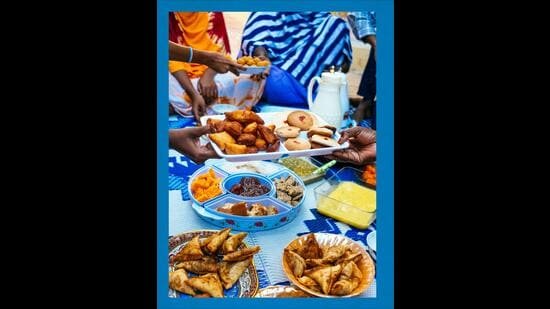

It isn’t just the samosa, called sambuus in Somalia.

There are plenty of “culinary cousins” that link India and this East African country.

Somali kitchens brew a beverage quite similar to chai, called shaah. The gelatinous dessert xalwo, made with nutmeg, cardamom and cornstarch, very closely resembles halwa. Paratha has its mirror in the flatbread sabaayad; and dosa in the sourdough pancake canjeero, which is a staple across the country.
A new cookbook, Soomaaliya: Food, Memory, and Migration, by New York-based Somali chef Ifrah F Ahmed, traces these and a range of other traditional recipes influenced by the landscape of Somalia; the country’s ancient trade links with India, Persia, Egypt, Rome and China; colonial-era Italy, England and France; and of course neighbouring Ethiopia, Kenya and (across the Red Sea) Yemen.

In a country often seen as a place of armed conflict and civil unrest, the cookbook uses 75 recipes to showcase a side to Somalia that the world rarely notices: its rich, vibrant communities and bustling kitchens, cherished recipes and proud heritage spanning thousands of years.
Having fled the civil war with her family as a child and been resettled in Seattle as refugees in 1996, Ahmed made her way back, for a visit, in 2018. On her return to New York, where she now lives, it struck her that many younger members of the community were losing touch with their language and their culinary traditions.
So, in 2019, she launched the pop-up Milk & Myrrh, which has so far travelled to Los Angeles and Seattle too, and offers a multi-course dining experience with a menu that varies in each city, reimagining Somali recipes with local ingredients. Dishes on offer, for example, include Somali-style canjeero breakfast burritos and salmon sambuus.

These experiments, coupled with a desire to preserve a tradition at risk of being lost among young people in the US, led to the idea of a cookbook.
Accordingly, alongside traditional recipes, Soomaaliya traces the history of her country, through notes that accompany recipes, introductory chapters to the book’s various courses, and essays on how social, economic and political forces have impacted food habits.
One is reminded, for instance, that Somalia’s massive camel herds were once the envy of Arabia, and the country still has one of the world’s highest ratios of camels per capita. Also included in Soomaaliya are profiles of a camel herder-turned-professor, a cookbook writer, a shaah-mix maker in the UK, “and some stunning photographs shot in Mogadishu”.

In putting it all together, Ahmed says, her goal was “to preserve food traditions in written form but also respect that intuitive approach to Somali cooking, which has been a largely oral tradition. For this reason, I developed the measurements in the recipes to serve as a general blueprint and not as a final say.”
The timing of the book felt vital, she adds. “Crops such as cambuulo or adzuki beans are at risk because the people that cultivate these indigenous foods face growing challenges from imported foods, limited subsidy support and high taxation.”
The modern Somali person is eating differently, partly as a result of this. There has been a shift away from healthy grains such as sorghum, which were once integral to the Somali diet. “Cambuulo, a food our ancestors ate long before colonisation, was traditionally cooked to welcome guests. If we lose ancient foods like these, the traditions attached to them are at risk of being lost too.”

Ahmed hopes Soomaaliya will eventually be useful to future generations of the diaspora.
The book itself is dedicated to her mother and daughter. “Without my mother, I would not have learned how to maintain this cultural connection,” she says. “I dedicate it to my daughter because it’s something I hope she’ll learn, not because she’s a girl but because I want her to have her cultural inheritance.”

