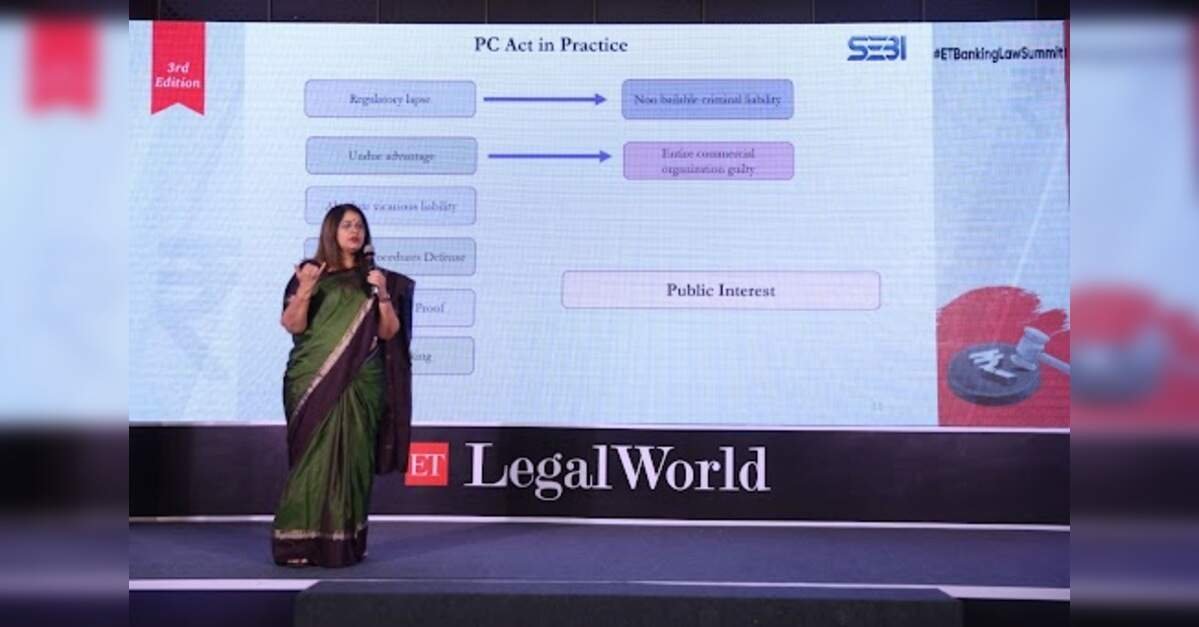


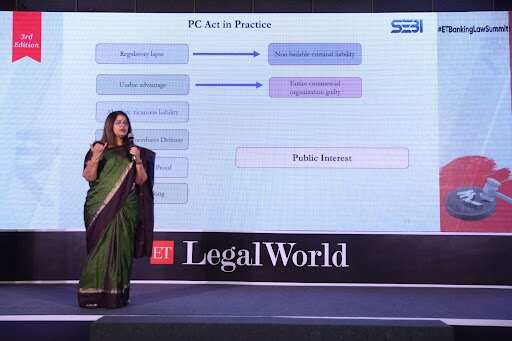
The Prevention of Corruption Act is no longer a framework that private sector institutions can view as distant from their operations, particularly when they deal with public money or perform functions linked to public duty, Yatri Dave Vitekar, Chief Vigilance Officer, SEBI, said during an exclusive presentation at ETLegalWorld’s Banking & Finance Law Summit, 3rd Edition, held in Mumbai.
Her remarks underlined a crucial priority area for banks, financial institutions and corporates: regulatory lapses and bribery-linked conduct can now carry serious criminal consequences if adequate preventive systems are not demonstrably in place.
Vitekar opened the session by asking compliance leaders in the room how many of them identified themselves as public servants. The question framed the central point of her presentation: the traditional understanding of a public servant has expanded significantly, particularly after judicial interpretation around entities dealing with public money.
She referred to the Prevention of Corruption Act and said its starting point is the conduct of public servants. However, she noted that the interpretation of who qualifies as a public servant has evolved, especially after the 2016 Supreme Court ruling involving former Global Trust Bank executive Ramesh Gelli in the context of the Ketan Parekh securities scam.
“Anybody dealing with public money is a public servant,” Vitekar said, explaining that the principle has since shaped how accountability is viewed in cases involving financial institutions and market-linked entities. The point matters for the private sector because institutions may assume that corruption law exposure is limited to government employees, while judicial interpretation has widened the field of potential applicability and consequent liability.
Vitekar said the idea of public duty is also expanding. “Anybody who is dealing with public money, and anybody who performs a public duty, is a public servant,” she said. For compliance officers, this means that the risk analysis cannot be limited to ownership structure or whether an entity is formally part of the government. The nature of funds handled, functions performed and public impact of decisions may become relevant in assessing exposure.
She said the Prevention of Corruption Act, particularly after its 2018 amendment, must be understood not only as a law dealing with bribery but also as part of a larger anti-corruption framework that includes vigilance, criminal investigation and money laundering enforcement. She placed compliance functions within this framework, saying compliance leaders are not outside the system but part of the country’s anti-corruption architecture.
Vitekar said the legal consequences can become serious when a lapse moves into the territory of criminal liability. If a company pays an undue advantage to a public servant, the commercial organisation itself may be treated as culpable, she said. She also flagged the concept of vicarious liability, noting that once the offence is established, senior management and the board may also face scrutiny.
In that context, she said the most important factor in deciding the liability of the organisation is the existence of adequate compliance systems and procedures. “As compliance heads, this is the priority area for you to ensure that your company has robust mechanisms to handle complaints and acts of misconduct. This is the only way you can save yourself and your company by saying we did have a well built and functional system,” she said.
Vitekar said such procedures should include clear policies discouraging bribery, monitoring mechanisms, punishment for violations and systems that prevent undue advantage. She also warned that in cases involving public interest, the burden may effectively shift to the corporate entity to show that the transaction was legitimate.
The presentation also moved beyond statutory compliance to the broader question of ethical conduct. Referring to the exit of former BP CEO Bernard Looney over non-disclosure of workplace relationships, Vitekar said the issue was not about personal conduct alone but about trust, disclosure and integrity. She said organisations weaken governance when they rationalise small violations or dismiss whistleblower complaints as minor.
“It is about basic integrity,” she said, adding that normalising false disclosures or procedural violations can discourage whistleblowers and damage internal governance. Vitekar concluded that ethical conduct remains the strongest preventive framework for institutions.