

Last verified: 9 July 2026

Whether menstrual leave is a legal right in India is among the most contested questions in the country’s labour and employment law in 2026, and the year has already produced two judicial answers that appear to point in opposite directions. On 13 March 2026, the Supreme Court of India declined to direct the government to give every working woman in the country paid leave during her period, cautioning that making menstrual leave compulsory could become a “double-edged sword” that discourages employers from hiring women. Menstrual leave, the Court indicated, is a matter for considered policy rather than judicial command.
Thirty-three days later, the Dharwad Bench of the Karnataka High Court reached what appears to be the opposite conclusion. Hearing a petition brought by a woman employed in a small hotel in the unorganised sector, the Court upheld her state’s menstrual leave policy as constitutionally valid and directed its strict implementation across every sector, describing menstrual leave as “not a plea for privilege” but a right rooted in dignity.
These two rulings, decided within weeks of each other, capture the central difficulty. One court declined to create a nationwide right; the other enforced a state’s existing policy as a matter of constitutional obligation. The consequence is that the answer to the question in this article’s title turns almost entirely on where a woman lives and who she works for.

A woman employed by the Bihar government has had menstrual leave since 1992, at two paid days every month. A woman covered by Karnataka’s 2025 policy now has a court-enforced right that reaches even private employers. A student in a Kerala state university has a limited form of it. For almost everyone else, private-sector employees across most of the country and central government staff, there is no legal right to menstrual leave at all, only whatever an employer chooses to offer.
The sections below set out what the two 2026 rulings actually decided, which states and companies grant menstrual leave and on what terms, why Parliament has still not enacted a law on the subject, how the Constitution bears on the debate, and how India compares with the rest of the world.
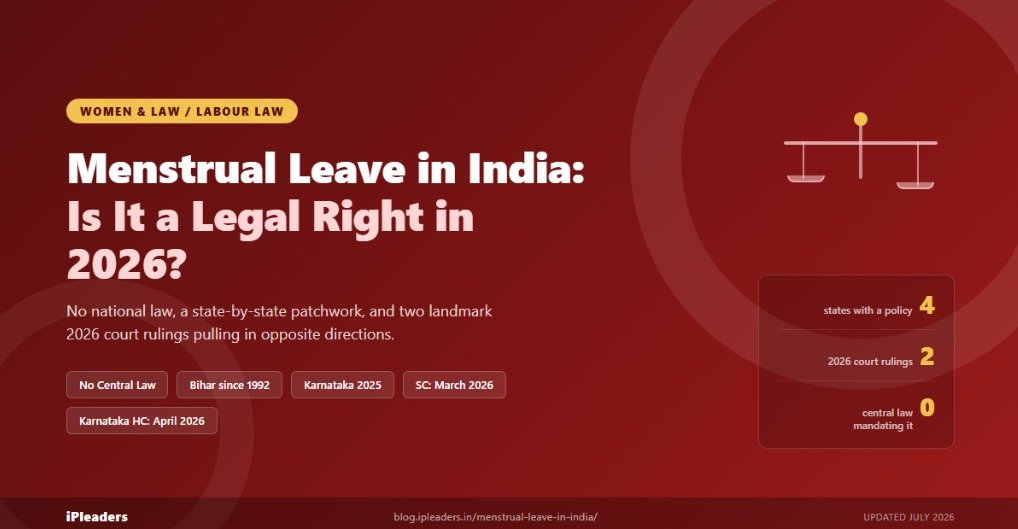
As of 2026, menstrual leave is not a nationwide legal right in India. No central law requires it. A few states grant it to their own employees: Bihar (since 1992), Odisha (2024) and Karnataka (2025, enforced by the High Court in April 2026). Kerala gives a limited version to students, and many private companies offer it voluntarily. The Supreme Court, in March 2026, declined to make it mandatory across the country.
Is menstrual leave a legal right in India? The short answer
There is no general, nationwide legal right to menstrual leave in India. No central statute creates one. Neither the Maternity Benefit Act, 1961 nor the Code on Social Security, 2020, the two laws that govern women’s workplace leave around childbirth, says anything about leave for menstruation. Whether a woman has any enforceable right depends on which of four situations she falls into.
If she is a state government employee in Bihar or Odisha, the right exists by state policy. If she is a covered worker in Karnataka, including in the private sector, the right now exists and has been enforced by the High Court. If she is a student in a Kerala state institution, a limited form exists through relaxed attendance rules. For everyone else, private-sector employees in most states and central government employees, there is no legal right to menstrual leave, and an employer that offers nothing is not breaking any law.
That patchwork is the reality behind every headline about menstrual leave in India. To understand how it came to be, and where it is heading, the place to start is the two courts that spoke in 2026. This is different from maternity leave, which is a settled statutory right of 26 weeks across the country, a distinction we return to later.
Supreme Court on menstrual leave
The demand for a national menstrual leave law reached the Supreme Court as a public interest litigation seeking a direction to the Union government and all states to frame a uniform, paid menstrual leave policy for women workers and students. On 13 March 2026, a bench led by the Chief Justice of India disposed of that petition without granting the mandate the petitioner wanted.
The Court’s central concern was practical rather than doctrinal. Compulsory menstrual leave, it observed, could act as a “double-edged sword” for women. If the law forced every employer to give paid period leave, some employers might respond by preferring to hire men, turning a benefit meant to help women into a fresh reason to keep them out of the workforce. The bench also noted that a mandate could reinforce the very stereotypes about women’s capacity that decades of equality jurisprudence have tried to dismantle.
Rather than issue a direction, the Court routed the question back to the executive. It asked the Union Ministry of Women and Child Development to consider the petitioner’s representation and to examine, in consultation with stakeholders, whether a model policy on menstrual leave should be framed. Voluntary initiatives by employers, the Court indicated, were welcome; a judicially imposed national rule was not the appropriate route.
The takeaway matters for anyone reading the headlines: the Supreme Court did not recognise menstrual leave as an enforceable fundamental right, and it did not create a national entitlement. It left the design of any such policy to the government. This was consistent with how the Court had handled the same litigation earlier, having in 2023 and again in 2024 declined to legislate from the bench and pointed the matter toward the Centre and the states (Shailendra Mani Tripathi v. Secretary, Ministry of Women and Child Development & Ors., Supreme Court, order dated 13 March 2026).
Karnataka High Court observation on menstrual leave
While the Supreme Court was declining to create a national right, one state had already created its own, and the question in Karnataka was not whether menstrual leave should exist, but whether the state would actually deliver what it had promised. The petitioner, a woman in her early forties working in a small hotel in the unorganised sector, went to the Dharwad Bench of the Karnataka High Court to force implementation of the state’s menstrual leave policy.
On 15 April 2026, the High Court ruled in her favour. It held the Karnataka Menstrual Leave Policy, 2025 constitutionally valid and directed the state to implement it strictly and uniformly across all covered sectors, pending the enactment of a full statute. Until a law is passed, the Court said, the government must operationalise the policy through guidelines, circulars and administrative instructions so that its promise does not remain on paper. The judge framed menstrual leave as “not a plea for privilege” but a right grounded in dignity and fairness.
The Court anchored its reasoning in the Constitution. It read the policy as an expression of the right to equality under Article 14, the special provision for women under Article 15(3), the right to life and dignity under Article 21, the directive to protect the health of workers under Article 39(e), and the guarantee of just and humane conditions of work under Article 42. On that basis, the policy was not a handout but a constitutionally supported measure.
The policy itself is specific. Introduced through a state notification dated 12 November 2025 and a government order dated 20 November 2025, it grants women employees between 18 and 52 years of age one day of paid menstrual leave each month, up to a maximum of 12 days a year, across factories, commercial establishments, plantations and other specified workplaces, and it reaches, crucially, the private sector (Chandravva Hanamant Gokavi v. State of Karnataka & Ors., W.P. No. 109734 of 2025, Karnataka High Court, Dharwad Bench).
It is worth being precise about why the two rulings do not actually contradict each other. The Supreme Court was asked to invent a nationwide right and declined. The Karnataka High Court was asked to enforce an existing state policy and agreed. Different questions, different answers, which is exactly why menstrual leave can be a court-enforced right in one state and no right at all in the next.
| The 2026 split: two courts, two answers | |
| Supreme Court, 13 March 2026 | Karnataka High Court, 15 April 2026 |
|---|---|
| Declined to order a mandatory national menstrual leave policy. | Upheld the Karnataka Menstrual Leave Policy, 2025 as constitutionally valid. |
| Reasoned a mandate could be a “double-edged sword” that deters employers from hiring women. | Called menstrual leave “not a plea for privilege” but a right rooted in dignity. |
| Asked the Union to consider a model policy through stakeholder consultation. | Anchored in Articles 14, 15(3), 21, 39(e) and 42; ordered strict enforcement across all sectors. |
| Result: no national right recognised. | Result: a state policy enforced, private sector included. |
The state-by-state patchwork: Bihar, Kerala, Odisha, Karnataka
Because there is no central law, menstrual leave in India is decided state by state, and the differences between states are large: in who is covered, how many days are granted, and whether the private sector is touched at all.
| Menstrual leave across Indian states (2026) | ||||
| State | Since | Who is covered | Entitlement | Sector reach |
|---|---|---|---|---|
| Bihar | 1992 | State government employees (incl. contract) | 2 paid days per month | Government only |
| Kerala | Jan 2023 | Female students (universities, ITIs) | Attendance relaxed to 73%; leave for students 18+ | Education only |
| Odisha | Oct 2024 | Women state govt employees up to age 55 | 1 paid day per month (day 1 or 2 of cycle) | Government only |
| Karnataka | 2025 (enforced Apr 2026) | Women employees aged 18 to 52 | 1 paid day per month, max 12 per year | Includes private sector |
Bihar is the pioneer, and not just in India. Since 1992 it has given its women government employees two paid days of menstrual leave every month, a policy older than almost any comparable measure anywhere in the world. The leave is a monthly entitlement that lapses if unused, and it is confined to the state’s own workforce rather than private employers.
Kerala took a different route in January 2023, targeting education rather than employment. The state revised the minimum attendance requirement for female students in its universities to 73 per cent to accommodate menstrual leave, and extended leave to female students above 18. It is a meaningful step for students, but it is not workplace leave and does not reach women in jobs.
Odisha followed in October 2024 with a policy for its own employees: women working for the state government, up to the age of 55, may take one paid day of menstrual leave a month, to be availed on the first or second day of the cycle. As in Bihar, private-sector adoption in Odisha remains voluntary.
Karnataka is the outlier that changes the national picture. Its 2025 policy grants one paid day a month, capped at 12 days a year, to women aged 18 to 52, and unlike the others it reaches beyond government offices into factories, commercial establishments, plantations, and sectors such as information technology and garments. Because the Karnataka High Court has now ordered its strict enforcement, it is the first Indian menstrual leave regime that is both broad and judicially backed, which is why it is widely seen as a possible template for other states.
Why there is no central menstrual leave law
The obvious question is why, given all this state-level activity, there is still no law for the country as a whole. The answer lies partly in what existing central law covers and partly in the Union government’s own reluctance.
No central statute grants menstrual leave. The Maternity Benefit Act, 1961 deals with pregnancy, childbirth and the months around it, not with menstruation. The Code on Social Security, 2020, the labour code that came into force on 21 November 2025 and now houses maternity benefit, carried over the maternity framework but added no provision for menstrual leave. So a woman looking for a statutory right in the central labour law simply will not find one. For how the new labour codes reshaped women’s workplace entitlements, see our guide to maternity leave rights in India.
The Union government has also actively resisted a mandatory rule. In a reply in Parliament in December 2023, the Ministry of Women and Child Development argued that menstruation is a normal part of a woman’s life and should not be treated as a “handicap” requiring a special paid-leave policy. Making menstrual leave compulsory, the Ministry warned, could expose women to discrimination at work and would force them to disclose something intensely private to employers; as the Minister put it, women should not be compelled to publicise their menstrual cycle. The government suggested that flexible options such as work from home were a better fit than mandated leave.
One point causes frequent confusion and is worth separating out. The Draft National Menstrual Hygiene Policy, 2023 is sometimes cited as evidence of a menstrual leave policy, but it is nothing of the sort. That policy concerns menstrual hygiene, awareness and access to sanitary products, not paid time off work. India has moved on menstrual hygiene; it has not moved on menstrual leave.
After the Supreme Court’s March 2026 order, the ball is back with the Union government, which has been asked to consider whether to frame a model menstrual leave policy for the states to adopt. As of July 2026, no such national policy has been finalised.
The Bills that tried, and stalled, in Parliament
Parliament has not been silent on menstrual leave; it has simply never passed anything. Three private member’s Bills over six years show sustained interest and a consistent failure to convert it into law, which is unsurprising given that private member’s Bills almost never make it to enactment.
The first was the Menstruation Benefits Bill, 2017, introduced by a Member of Parliament from Arunachal Pradesh. It proposed two days of paid menstrual leave a month for women employees, leave from school for female students, and, for women who chose to keep working during menstruation, an overtime allowance and short rest breaks. It lapsed.
A year later came the Women’s Sexual, Reproductive and Menstrual Rights Bill, 2018, introduced by a Member from Thiruvananthapuram. It took a broader view, covering sexual, reproductive and menstrual health together rather than menstrual leave alone. It too did not progress.
The most recent attempt was the Right of Women to Menstrual Leave and Free Access to Menstrual Health Products Bill, 2022, which sought three days of paid leave for women and transwomen during menstruation and extended the benefit to students. Like its predecessors, it failed to become law. The through-line is clear: strong legislative interest, no legislative outcome, and it is this vacuum that the states and private employers have since moved to fill.
Menstrual leave and the Constitution: Articles 14, 15, 21 and 42
Much of the legal argument about menstrual leave is really an argument about the Constitution, and it cuts both ways. Understanding both sides is the key to answering whether menstrual leave is a “right” in any meaningful sense.
The constitutional case in favour, the case the Karnataka High Court accepted, draws on several provisions read together. Article 14 guarantees equality, which in its substantive sense can require treating a real biological difference differently rather than ignoring it. Article 15(3) expressly permits the state to make special provisions for women. Article 21 protects life, dignity and, as the courts have increasingly recognised, reproductive and menstrual health. Two directive principles reinforce the picture: Article 39(e) directs the state to protect the health of workers, and Article 42 requires just and humane conditions of work. Read together, these support menstrual leave as a legitimate, even desirable, policy, which is the reasoning behind our explainer on the right to equality under Articles 14 to 18.
The constitutional case against a judicial mandate is the one the Supreme Court signalled, and it also runs through equality. If a compulsory menstrual leave law made women more expensive or more complicated to employ, it could reduce their access to jobs, undercutting the very equality of opportunity that Articles 14 and 16 protect. On this view, the same constitutional values that justify menstrual leave as a policy also caution against imposing it as an inflexible national command.
The honest conclusion is a nuanced one. Menstrual leave is constitutionally permissible, and arguably encouraged, as a matter of policy: a state that chooses to grant it, as Karnataka has, stands on firm constitutional ground. But on current authority it is not a free-standing, enforceable fundamental right that every woman in India can claim against every employer. It is a right where a government has chosen to create one, and not otherwise.
Which companies in India offer menstrual leave?
For many women, the practical source of menstrual leave is not the state at all but the employer. A number of Indian companies have adopted period leave voluntarily, and their policies often go further than any state scheme.
The early movers date back well before the current debate. A media company introduced a “first day of period” leave in 2017, and a digital marketing firm followed soon after. The policy entered the mainstream conversation in August 2020, when a large food-delivery company announced up to ten days of paid period leave a year for its employees. Others have since built their own versions: a rival delivery platform offers two paid days a month to its women delivery partners, and an education-technology company offers up to twelve days a year. Coverage has gradually widened to include names across manufacturing, electronics, financial services and law.
Two cautions keep this in perspective. First, these policies are entirely voluntary; no law compels them, and an employer that offers nothing is not breaking any rule outside the states and sectors that mandate leave. Second, the companies with period-leave policies remain a minority of Indian employers, so high-profile announcements should not be mistaken for a norm. Whether menstrual leave is paid depends on the specific employer or state policy, but in India every existing scheme that grants it makes it paid.
Menstrual leave around the world, and the uptake paradox
India’s debate mirrors a global one, and the international experience carries a lesson that is directly relevant to the Supreme Court’s reasoning.
| Menstrual leave around the world | |||
| Country | Since | Entitlement | Note |
|---|---|---|---|
| Japan | 1947 | Leave on request (unpaid) | Uptake under about 1% due to stigma |
| South Korea | Long-standing | 1 day per month (unpaid) | Low utilisation |
| Taiwan | Long-standing | 3 days per year | Part of statutory sick-leave framework |
| Indonesia | Long-standing | 2 days per cycle | Labour-law entitlement |
| Zambia | Long-standing | 1 day per month (“Mother’s Day”) | Enforceable by workers |
| Spain | 2023 | Paid medical leave for period pain | First European country to legislate it |
Menstrual leave is not new. Japan has had it since 1947, when its post-war labour law allowed women to take leave during difficult periods, though the leave is unpaid. Several Asian economies followed: South Korea offers a day a month, Taiwan three days a year, and Indonesia two days a cycle. Zambia grants women a monthly day known informally as “Mother’s Day.” In 2023, Spain became the first European country to legislate paid menstrual leave, reopening the debate in the West.
The most instructive fact is not who has the law but how little it is used. In Japan and South Korea, the share of eligible women who actually take menstrual leave has long been estimated at under one per cent. The reason is stigma: women fear that claiming the leave will mark them as less committed or invite judgment, so the right sits unused. That is precisely the “double-edged sword” the Supreme Court had in mind. A right on paper does not translate into a right in practice when the social cost of using it is high, and a poorly designed mandate can attract discrimination without delivering the benefit it promises.
Menstrual leave vs maternity leave: what’s the difference?
Because the two are easily confused, it helps to state the difference plainly. Maternity leave and menstrual leave are separate entitlements with different legal foundations.
Maternity leave is a statutory, nationwide right. Under the Code on Social Security, 2020, which subsumed the Maternity Benefit Act, 1961, an eligible woman is entitled to 26 weeks of paid leave around childbirth, and the entitlement applies across the country to covered establishments. It is a well-established right with decades of case law behind it.
Menstrual leave is none of those things at the national level. It is monthly rather than one-off, measured in a day or two rather than weeks, and it rests on state policies and voluntary employer schemes rather than a central statute. A woman can be fully entitled to maternity leave and have no right to menstrual leave at all, because they are governed by entirely different regimes. For the detail on the former, see our full guide to maternity leave rights in India.
What a woman can actually do in 2026
For a woman trying to work out her own position, the abstract law matters less than a few concrete checks.
The first is the state. A woman employed by the Bihar or Odisha government, or a covered worker in Karnataka, can claim menstrual leave under the relevant state policy; a student in a Kerala state institution can use the attendance relaxation. The second is the employer. Even where no law applies, many private companies grant period leave through their HR policy, so it is worth checking the employee handbook or asking the human resources team, because the benefit may exist even though nothing compels it. Workplace grievances about how such a policy is applied can also intersect with an employer’s broader obligations toward women staff, including under the framework covered in our guide on filing a POSH complaint at the workplace.
Where neither a state policy nor an employer policy exists, the realistic options are the ordinary ones: taking sick or casual leave for a difficult period, or requesting work from home, which is the very alternative the Union government has itself suggested. It is important to be candid about the limit here. Outside the mandated states and sectors, an employer can lawfully decline menstrual leave, and there is at present no legal remedy that would force one to grant it. That is the practical meaning of “not a nationwide right.”
The debate: is menstrual leave good or bad for women at work?
Menstrual leave is one of those issues where thoughtful people who share the same goal of women’s dignity and equality at work end up on opposite sides. Both cases deserve a fair hearing.
The case for is straightforward. Menstruation is a real, recurring biological experience that, for a meaningful share of women, involves pain severe enough to affect work. Recognising that with a day of leave treats women’s health as legitimate rather than something to be hidden, can improve wellbeing and productivity, and helps normalise a subject still surrounded by silence. Countries and companies that offer it frame it as basic decency, not special treatment.
The case against is the “double-edged sword” the Supreme Court flagged, and it is not mere conservatism. A mandate can make women marginally costlier or more complicated to employ, giving cost-conscious employers a quiet reason to prefer men. It can force women to disclose private health information. And the international evidence, near-zero uptake in Japan and South Korea, suggests that without a serious change in workplace culture the right may go unused while the stigma it attracts does not.
India, for now, appears to be feeling its way toward a middle path: voluntary corporate policies, state-led schemes such as Karnataka’s, and the possibility of a Union model policy that states can adapt, rather than a single national mandate imposed from the top. Whether that patchwork hardens into a national right, or remains a matter of geography and employer goodwill, is the question the next few years will answer. For HR and compliance professionals, keeping pace with these shifting obligations is part of a broader labour-law landscape that LawSikho’s Certificate Course in Labour Laws and HR Practices is built to help navigate.
Frequently asked questions
Is menstrual leave a legal right in India?
Not as a general, nationwide right. There is no central law granting menstrual leave in India. It exists only where a state policy or an employer’s own policy creates it, for example for government employees in Bihar and Odisha, and for covered workers (including in the private sector) in Karnataka.
Is there a central law on menstrual leave in India?
No. Neither the Maternity Benefit Act, 1961 nor the Code on Social Security, 2020 provides for menstrual leave, and no other central statute mandates it. The Supreme Court declined in March 2026 to order a national policy, leaving the matter to the government.
Which states in India give menstrual leave?
Bihar has given two paid days a month to its government employees since 1992. Odisha introduced one paid day a month for women state employees in 2024. Karnataka’s 2025 policy grants one paid day a month, including in the private sector, and was enforced by the High Court in 2026. Kerala provides a limited form for female students.
What is the Karnataka Menstrual Leave Policy 2025?
It is a state policy granting women employees aged 18 to 52 one day of paid menstrual leave a month, up to 12 days a year, across factories, commercial establishments, plantations and other specified workplaces. It was introduced in November 2025 and, in April 2026, the Karnataka High Court held it constitutionally valid and ordered its strict implementation.
What did the Supreme Court say about menstrual leave in 2026?
On 13 March 2026, the Supreme Court declined to direct a mandatory nationwide menstrual leave policy, warning that compulsion could become a “double-edged sword” that discourages employers from hiring women. It asked the Union government to consider framing a model policy but did not recognise menstrual leave as an enforceable fundamental right.
Is menstrual leave available in private companies?
Only voluntarily, except in Karnataka, where the state policy now reaches private employers. Elsewhere, some private companies offer period leave through their own HR policies, but they are not legally required to, and many do not.
How many days of menstrual leave can a woman take?
It depends on the applicable policy. Bihar allows two days a month for its employees; Odisha and Karnataka allow one day a month, with Karnataka capping it at 12 a year. Company policies vary, with some offering up to ten or twelve days a year.
Is menstrual leave paid or unpaid in India?
Every existing Indian scheme that grants menstrual leave, whether a state policy or a corporate policy, makes it paid. This contrasts with some countries, such as Japan, where the statutory leave is unpaid.
What is the difference between menstrual leave and maternity leave?
Maternity leave is a nationwide statutory right of 26 weeks around childbirth under the Code on Social Security, 2020. Menstrual leave is a monthly entitlement of a day or two, has no central statute, and exists only through state or employer policies. They are separate rights with different legal bases.
Can my employer refuse menstrual leave?
Outside the states and sectors that mandate it, yes. An employer with no menstrual leave policy is not breaking any law by declining it, and there is currently no legal remedy to compel one to grant it. Where a state policy such as Karnataka’s applies, the employer must comply.
Which countries have menstrual leave laws?
Japan (since 1947), South Korea, Taiwan, Indonesia and Zambia have long-standing provisions, and Spain became the first European country to legislate paid menstrual leave in 2023. In several of these countries, actual uptake is very low because of workplace stigma.
Is menstrual leave a fundamental right under Article 21?
The Karnataka High Court read menstrual leave as connected to the dignity and health guarantees of Article 21, among other provisions, when upholding the state’s policy. But the Supreme Court has not recognised it as a stand-alone fundamental right enforceable across the country, so at the national level it remains a policy matter rather than a guaranteed constitutional entitlement.
References
Cases
1. Shailendra Mani Tripathi v. Secretary, Ministry of Women and Child Development & Ors., Supreme Court of India, order dated 13 March 2026, Indian Kanoon (verify final URL)
2. Chandravva Hanamant Gokavi v. State of Karnataka & Ors., W.P. No. 109734 of 2025, High Court of Karnataka (Dharwad Bench), decided 15 April 2026, Indian Kanoon (verify final URL)
Statutes and instruments
– Constitution of India, Articles 14, 15(3), 21, 39(e), 42, India Code
– Code on Social Security, 2020, India Code
– Maternity Benefit Act, 1961, India Code
– Karnataka Menstrual Leave Policy, 2025 (State notification dated 12 November 2025; Government Order dated 20 November 2025)
– Menstruation Benefits Bill, 2017; Women’s Sexual, Reproductive and Menstrual Rights Bill, 2018; Right of Women to Menstrual Leave and Free Access to Menstrual Health Products Bill, 2022, Sansad
Legal disclaimer
This article is published for informational and educational purposes only. It does not constitute legal advice, and no lawyer-client relationship is created by reading it. Laws, policies and judicial interpretations change over time and vary by state and employer. For advice on a specific situation, consult a qualified advocate or your organisation’s HR or legal team.

