
The quiet disappearance of Satluj from ZEE5 within days of its release raises questions that go well beyond censorship. Anjali Tripathi examines whether the government’s reported takedown was legally sustainable, what it reveals about the limits of Section 69A, and how copyright has unexpectedly become a tool for restricting, rather than enabling, access to culture. Anjali is a B.A. LL.B. (Hons.) graduate from JGLS with an interest in IP rights, access to education, and the creative arts. Her previous posts can be accessed here.

Everything Flows, Except Satluj…Through Your ZEE5 App
By Anjali Tripathi

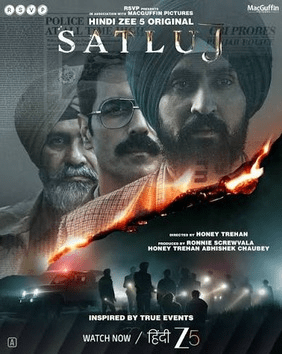
India’s relationship with censorship in films is a huge can of worms, but something very uniquely upsetting has come up recently. Honey Trehan’s film Satluj, based on the life of Jaswant Singh Khalra, quietly premiered on ZEE5 on July 3. And by July 5, it was gone!
For context: during Punjab’s counter-insurgency years, Khalra documented the enforced disappearances and illegal mass cremations of thousands – a man who spent his life proving that the State had disappeared people without leaving records. The film honouring him was removed with no published order, no decision, no hearing – only an Instagram post from the platform citing vague “current developments.” Diljit Dosanjh, who plays Khalra, probably puts it best – “(the film) suffered the same fate as Jaswant Singh Khalra” – forty-eight hours, then gone without a paper trail of its own.
What followed is the usual recipe of the modern Indian content battle: a takedown direction reportedly issued by the Ministry of Information and Broadcasting (MIB) under Section 69A of the IT Act read with Part III of the IT Rules, 2021, an Inter-Departmental Committee (IDC) examining the film two days after it was gone, a piracy explosion no marketing budget could have purchased, the lead actor telling fans to keep sharing downloaded copies, and the platform pleading, twice, against piracy. The makers are hoping to pursue the courts next. Before they do, three questions are worth sitting with: whether the government could lawfully direct ZEE5 under Section 69A at all (the intermediary question), what the takedown has done to copyright in practice (the piracy question), and what both mean for the one promise Indian copyright law keeps forgetting it made – access to culture.
The Cumbersome Journey So Far
Even before July 3, the film was wrestling the invisible monster of exhaustion-by-procedure. The makers submitted it to the CBFC in 2022 for theatrical certification; the Board reportedly cleared it with 21 cuts and an instruction to change its title, the revising committee inflated that to 85, and by the time the demands settled at an unprecedented 127 cuts – including, reportedly, references to the Punjab Police – the makers stopped playing along. Mid-process, Trehan was asked, “Who speaks the truth so loudly?” After an unexplained TIFF 2023 withdrawal and nearly four years in limbo, the film was finally released, intact and unannounced, under a new name – a deliberately secretive premiere because, as Diljit later revealed, the team feared it would never reach audiences if it announced itself.
Possibly none of this was a loophole. The Cinematograph Act and the CBFC govern theatrical exhibition; streaming content is governed by Part III of the IT Rules, 2021, which requires self-classification, not prior certification – a position the CBFC’s own chairperson confirmed. So when an unnamed official complains to PTI that the makers “kept sitting on the suggested cuts and eventually released the movie quietly on OTT” and should have followed “the laid down norms”, the official has the law exactly inverted. The laid-down norms were followed. What seems to be the needle poking the giant is that the makers exercised a lawful option the censorship architecture had not thought to close – and the takedown reads like the architecture punishing them for noticing.
The Intermediary-Shaped Hole in the Takedown
Reports in the Hindustan Times and the Indian Express say the MIB’s direction invoked Section 69A read with Part III of the IT Rules. Let us read Section 69A again, slowly: it empowers the Central Government to “direct any agency of the Government or intermediary” to block public access to information. The word “publisher” appears nowhere in it. So the first question – likely the one the makers’ challenge will turn on – is deceptively on-the-nose: when ZEE5 streams Satluj, is it an “intermediary” at all?
The IT Act’s definition in Section 2(1)(w) covers persons who receive, store or transmit records “on behalf of another person.” That fits ZEE5 hosting our comments, not ZEE5 curating, licensing, branding and monetising a film it chose to premiere. For its curated catalogue, ZEE5 is a “publisher of online curated content” – a category Part III of the 2021 Rules deliberately keeps distinct from intermediaries. The government’s own framework, in other words, says ZEE5 is probably not an intermediary here. Here lies the doctrinal knot: Rules 15 and 16 of the 2021 Rules do purport to authorise blocking directions against publishers, but they draw their validity from Section 69A – a provision that, on its plain text, reaches only intermediaries and government agencies. Delegated legislation cannot quietly enlarge its parent statute, which is why Part III has been under constitutional siege since birth: the Bombay High Court stayed the enforcement of the Code of Ethics (Rules 9(1) and 9(3)) in 2021 as prima facie violative of Article 19(1)(a) – a stay the Madras High Court later said operates nationwide. The obligations the Ministry now says ZEE5 violated were frozen by a constitutional court five years ago. Even the official briefings mix up the jargon, describing an OTT publisher being asked to comply with “intermediary guidelines.” If even the state cannot say which legal hat ZEE5 wears, perhaps the answer it needs does not exist.
Consider the sequence: the film came down on July 5; the IDC – the Rule 14 committee meant to examine content and recommend action, up to blocking under Section 69A – was referred the film on July 7. If the Rule 16 emergency power was used, the interim direction had to be placed before the committee within forty-eight hours. Whether that happened is impossible to say: no order has been published, I have not been able to locate any mention of one, and others appear to be running into the same wall. The Shreya Singhal case upheld Section 69A in 2015 precisely because of its safeguards: blocking reasons must be “recorded in writing” so they can be challenged. In Tanul Thakur’s case, the Delhi High Court had to direct the government to give the satirist a copy of the very order that blocked his website. A decade on, we appear to have perfected the form: a phantom order, addressed to a phantom intermediary, reviewed by a committee after the censorship it is meant to authorise. And if there truly is no written order – if this was achieved, say, over a phone call – then this is not Section 69A at work but what MediaNama aptly calls the “mysterious unofficial censorship” of Indian OTT: jawboning that achieves administratively what the Constitution would never permit formally (another example here), leaving the filmmakers nothing to challenge and the public nothing to know.
There is also a structural point hidden beneath the doctrinal one: the state did not need to block a film being watched by millions; it simply needed to persuade exactly one company. Copyright exclusivity concentrates the kill-switch: because ZEE5 holds the exclusive streaming rights, its compliance makes the work vanish everywhere at once, with no messy gateway-by-gateway blocking required. The pattern is by now familiar – from Tandav’s forced re-edits to Dibakar Banerjee’s Tees, still sat upon by its rights-holding platform, unreleasable by anyone else because copyright says so. So ZEE5 may not be an intermediary in law, but it has been made to function as one in fact: the conduit through which the filmmakers’ speech is extinguished without them being served, heard, or told why. Trehan says every communication about this film arrived indirectly – through lawyers and intermediaries. The (sad) joke has, I believe, written itself.
The Piracy Bit: An Unplanned Promotional Event?
Whatever the takedown was meant to achieve, here is what it actually achieved: within hours, full copies of Satluj were circulating on torrent sites, Google Drive links and WhatsApp forwards. ZEE5 has since issued two increasingly plaintive appeals against piracy. Diljit, meanwhile, went on Instagram Live and told fans to pass their downloads on, because the story “now belongs to the people” – adding, correctly, that the internet does not forget.
The blackletter position is short and unsentimental. Diljit owns no copyright in the film – under Sections 2(d)(v) and 17 of the Copyright Act, the producers are the first owners, and ZEE5 holds the exclusive communication rights; a star’s blessing is, unfortunately, not a licence. Sharing copies is infringement under Section 51 and an offence under Section 63. And the irony thickens – Parliament amended the Cinematograph Act in 2023 to insert Sections 6AA and 6AB, criminalising unauthorised copying and exhibition with up to three years’ imprisonment and fines up to five per cent of production cost, because piracy was said to be bleeding the industry dry. Fast-forward three years – the same government has engineered the largest single piracy event of 2026, by extinguishing the only lawful channel to a film audiences were literally paying to watch!
The Delhi Sikh Gurdwara Management Committee has even announced public screenings in protest – screenings that would themselves be unlawful twice over, as uncertified public exhibition under the Cinematograph Act and unlicensed communication to the public under copyright law. But unlawful against whom, enforced by whom? ZEE5 would have to sue its own audience – and what would a court say to a rights-holder withholding a work on the strength of an order nobody can produce? There may even be a colourable case for a compulsory licence under Section 31 of the Copyright Act, meant for owners who unreasonably refuse to communicate their work to the public – and a refusal resting on an unpublished, possibly non-existent direction may struggle to look reasonable. A ban of this kind cannot delete the work; it merely converts the audience into offenders. Every viewer that could have been left alone with a subscription is now a node in an infringement network the authorities have no realistic way of policing – the Streisand effect running at national scale, with criminal law attached.
Why Does Copyright Exist?
Copyright’s bargain has two halves, and we habitually remember only one. Exclusive rights are the means; the dissemination of works to the public is the end!
What makes Satluj remarkable is that every private actor in that bargain is aligned – the authors want the film seen, the rights-holder wants to distribute it, audiences want to pay for it – and it is the state that stepped in to stop the market from clearing. The lack of lawful access has turned infringement into the only remaining infrastructure of access – not a moral failing of the audience. Lawrence Liang’s old argument bears remembering: “piracy” in the Global South has always been less about free-riding and more about the only door left open to culture.
Article 19(1)(a) protects the right to receive information and ideas as well, as the Supreme Court said in Cricket Association of Bengal. The film is claimed to be built on court records, RTI responses, witness testimony and published documentation of a history Indian courts have themselves adjudicated – four Punjab Police personnel were convicted for Khalra’s abduction and murder in 2005, with sentences enhanced to life imprisonment in 2007. This is memory with citations, not rumour.
The makers say the courts are next and the courts have been here before: a decade ago, in the Udta Punjab litigation, the Bombay High Court reminded the CBFC that its power is to certify, not censor, and that adults in a democracy can be trusted with their own history. One hopes the court asks the basic questions first: under which provision was the film removed, where is the order, what are the recorded reasons – and why must every answer be reverse-engineered from an Instagram post?
The larger principle is simple. A blocking regime that cannot produce its orders as written record cannot claim to be a legal regime. Jaswant Singh Khalra’s life’s work was proving that the disappeared had existed – that somewhere, there was always a record. Heraclitus wrote that everything flows. One hopes a film named after a river eventually finds its way around the dam placed before it. For now, we cannot access the film, much like the order that erased it, which remains missing too.

