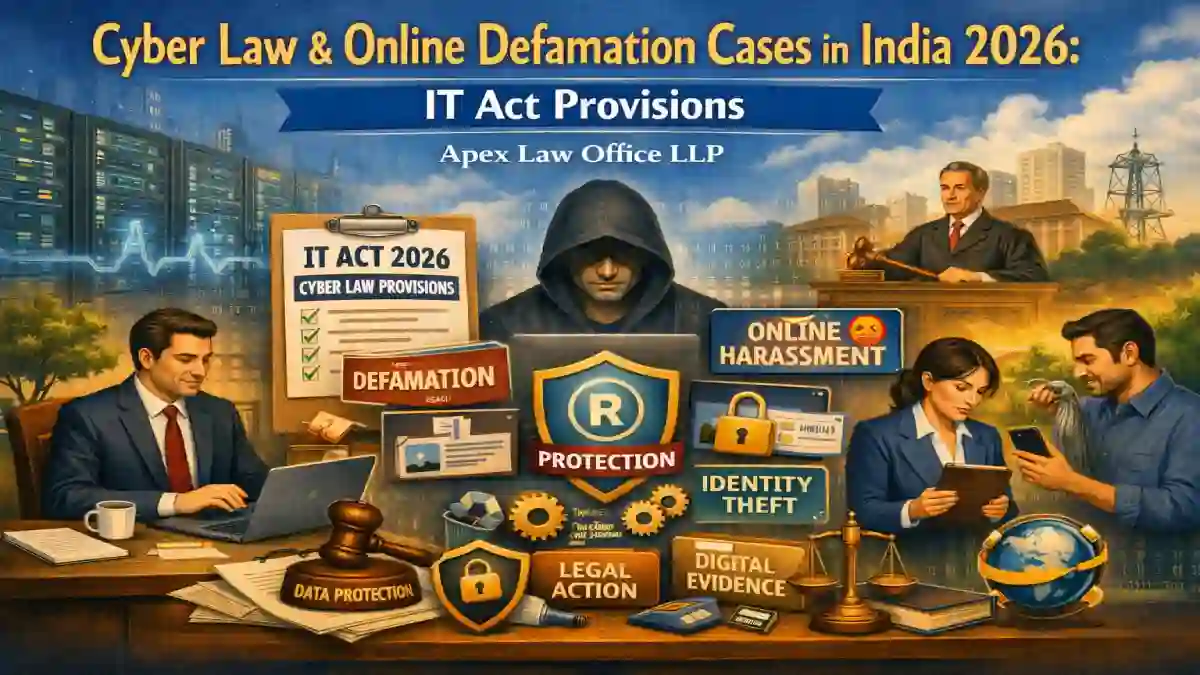

Cyber Law & Online Defamation Cases – Cyber law protects individuals, businesses, professionals, and organizations against unlawful activities committed through computers, mobile devices, and digital networks. Therefore, understanding applicable legal provisions remains essential for protecting reputation and digital rights. Online defamation occurs when false statements damage a person’s reputation through social media, websites, blogs, emails, messaging platforms, or digital publications. The Information Technology Act, 2000, along with the Bharatiya Nyaya Sanhita, 2023 (BNS), provides legal remedies against several cyber offences. Apex Law Office LLP assists victims with legal notices, complaint drafting, cyber investigations, injunction proceedings, and reputation protection. Moreover, timely legal action preserves electronic evidence and strengthens judicial remedies. Early consultation also reduces financial losses while preventing wider circulation of defamatory digital content across online platforms.
Cyber Law & Online Defamation Cases in India 2026: IT Act Provisions – Apex Law Office LLP

Importance of Early Legal Action in Online Defamation Cases
Delaying legal action often allows defamatory content to spread rapidly across digital platforms. Consequently, victims may suffer serious personal, professional, and commercial damage. Lawyers first identify publishers, intermediaries, and responsible individuals before selecting suitable legal remedies. They also preserve electronic evidence through screenshots, metadata, URLs, server records, and witness statements. Early legal notices frequently encourage voluntary removal of unlawful content without lengthy litigation. Furthermore, courts appreciate prompt action because evidence remains more reliable. Businesses, professionals, influencers, companies, NGOs, and NRIs benefit from immediate legal consultation before online reputation suffers irreversible harm. Strategic legal planning protects goodwill while supporting compensation claims against wrongdoers under applicable civil and criminal laws in India.

Common Forms of Online Defamation and Cyber Misconduct
Cyber defamation appears in several forms across modern digital communication platforms. Therefore, victims should recognize unlawful conduct before pursuing legal remedies. Common issues include:
- False social media allegations
- Fake online reviews
- Defamatory blog articles
- Malicious videos
- Edited photographs
- Fake email campaigns
- Anonymous defamatory messages
- Website reputation attacks
- Business rating manipulation
- Identity misuse
- Fake news publications
- Online impersonation
Each category requires different legal strategies. Consequently, legal experts evaluate facts, evidence, jurisdiction, and applicable statutes before commencing proceedings against responsible parties.
Essential Elements Required to Prove Online Defamation
Courts require clear evidence before granting relief in cyber defamation disputes. Therefore, victims should preserve every relevant electronic record immediately. Important elements include:
| Legal Requirement | Purpose |
|---|---|
| Publication | Public communication |
| False statement | Incorrect factual claim |
| Reputation damage | Actual legal injury |
| Electronic evidence | Digital proof |
| Identity of publisher | Responsible person |
| Causal connection | Link to harm |
| Supporting witnesses | Independent confirmation |
Strong documentation significantly improves litigation outcomes. Consequently, legal professionals carefully organize electronic records before initiating proceedings.
Legal Risks Created by Defamatory Digital Content
Online defamatory material creates multiple legal and commercial consequences for victims. Therefore, immediate legal intervention becomes essential. Common risks include:
- Business reputation loss.
- Customer confidence decline.
- Employment consequences.
- Financial losses.
- Emotional distress.
- Professional misconduct allegations.
- Brand dilution.
- Identity theft complications.
Legal experts analyse every consequence before recommending civil, criminal, or regulatory remedies. Consequently, strategic representation maximizes protection and minimizes continuing reputational damage.
Legal Framework Governing Cyber Defamation in India
Cyber defamation disputes involve several statutes working together within India’s legal framework. The Information Technology Act, 2000 regulates electronic records, intermediary obligations, and cyber offences. Additionally, applicable provisions of the Bharatiya Nyaya Sanhita, 2023 (BNS) address criminal defamation, cheating, identity misuse, forgery, and related offences wherever relevant. Investigation procedures follow the Bharatiya Nagarik Suraksha Sanhita, 2023 (BNSS), while electronic evidence is evaluated under the Bharatiya Sakshya Adhiniyam, 2023 (BSA). Civil proceedings may also follow the Code of Civil Procedure, 1908 (CPC) wherever applicable. Therefore, proper legal advice ensures compliance with procedural requirements while protecting digital reputation through appropriate civil, criminal, and regulatory remedies.
Common Legal Issues in Cyber Defamation Matters
Cyber disputes often involve overlapping civil, criminal, and regulatory issues. Therefore, comprehensive legal analysis becomes essential before filing proceedings. Frequent legal issues include:
- Online defamation
- Cyber bullying
- Fake profiles
- Identity theft
- Data misuse
- Privacy violations
- Business reputation attacks
- Social media harassment
- Email impersonation
- Website defacement
- Cyber stalking
- Digital blackmail
Appropriate jurisdiction depends upon facts, evidence, and statutory provisions. Early legal intervention strengthens enforcement while preserving valuable electronic evidence.
Jurisdiction, Cyber Police, Courts, and Government Authorities
Cyber defamation cases require proper jurisdiction because digital content often crosses multiple geographical boundaries. Therefore, legal experts evaluate territorial jurisdiction before filing complaints or civil proceedings. Victims may approach the jurisdictional Cyber Crime Police Station, local police station, or specialized cyber investigation units depending upon the offence. Civil remedies generally proceed before competent Civil Courts, while criminal prosecution follows appropriate Magistrate Courts and Sessions Courts. High Courts exercise appellate and constitutional jurisdiction wherever necessary. Additionally, the Supreme Court of India decides significant legal questions involving cyber law. Government authorities, including the Indian Cyber Crime Coordination Centre, CERT-In, and the Ministry of Electronics and Information Technology, support investigation and cybersecurity compliance. Proper forum selection improves procedural efficiency and strengthens enforcement.
Government Departments and Regulatory Authorities
Several government agencies regulate cybersecurity, electronic governance, and cybercrime response throughout India. Therefore, victims should understand their respective functions before seeking assistance. Important authorities include:
- Ministry of Electronics and Information Technology
- Indian Computer Emergency Response Team (CERT-In)
- Indian Cyber Crime Coordination Centre (I4C)
- National Cyber Crime Reporting Portal
- State Cyber Crime Police Cells
- Department of Telecommunications
- Controller of Certifying Authorities
Each authority performs distinct statutory responsibilities. Consequently, lawyers coordinate with appropriate agencies depending upon the nature and seriousness of every cyber defamation dispute.
Legal Remedies Available in Cyber Defamation Cases
Indian law provides several remedies protecting victims against online defamation and digital reputation damage. Therefore, lawyers evaluate suitable relief before commencing proceedings.
| Legal Remedy | Purpose |
|---|---|
| Temporary injunction | Prevent further publication |
| Permanent injunction | Stop continuing defamation |
| Damages | Financial compensation |
| Content removal | Delete unlawful material |
| Criminal complaint | Penal action |
| Public apology | Reputation restoration |
| Declaratory relief | Judicial clarification |
| Litigation costs | Expense recovery |
Appropriate remedies depend upon evidence quality, jurisdiction, and legal strategy. Consequently, timely legal advice substantially improves successful enforcement.
Electronic Evidence and Documentation Requirements
Electronic evidence forms the foundation of successful cyber litigation. Therefore, victims should preserve digital records immediately after discovering defamatory content. Essential documentation includes:
- Screenshots with timestamps.
- Original web links.
- Email headers.
- Chat records.
- Metadata where available.
- Device logs.
- Witness statements.
- Digital forensic reports.
The Bharatiya Sakshya Adhiniyam, 2023 (BSA) governs admissibility of electronic evidence. Proper preservation significantly strengthens judicial confidence and improves litigation outcomes.
Civil and Criminal Legal Support Strategy
Cyber defamation frequently requires both preventive and corrective legal measures. Therefore, integrated legal representation delivers stronger protection. Common legal support includes:
- Legal opinion
- Cease-and-desist notice
- Complaint drafting
- FIR assistance
- Civil suit preparation
- Interim injunction applications
- Settlement negotiations
- Appellate representation
Lawyers also coordinate with cyber investigators and digital forensic professionals whenever required. Consequently, comprehensive legal strategy protects reputation while ensuring procedural compliance before competent courts and authorities.
Police Action, Criminal Investigation, and Digital Evidence Protection
Serious cyber defamation cases often involve identity theft, impersonation, extortion, stalking, or forged electronic communications. Therefore, victims should immediately preserve digital evidence and approach competent authorities. Complaints may be filed before the jurisdictional Cyber Crime Police Station or the nearest police station. Investigation generally proceeds under the Bharatiya Nagarik Suraksha Sanhita, 2023 (BNSS), while applicable offences arise under the Bharatiya Nyaya Sanhita, 2023 (BNS) and the Information Technology Act, 2000. Electronic evidence must satisfy admissibility requirements under the Bharatiya Sakshya Adhiniyam, 2023 (BSA). Lawyers coordinate with investigating officers, digital forensic specialists, and online intermediaries to preserve evidence and prevent further publication. Consequently, prompt legal intervention increases enforcement effectiveness and protects valuable digital rights.
Legal Support from Apex Law Office LLP
Apex Law Office LLP provides comprehensive legal services for individuals, businesses, professionals, NGOs, startups, and NRIs facing cyber defamation. Therefore, clients receive strategic representation from the initial consultation through final adjudication. Legal services include reputation risk assessment, legal notice drafting, complaint preparation, intermediary takedown requests, injunction proceedings, compensation claims, appellate representation, and settlement negotiations. Lawyers also assist with domain disputes, social media impersonation, data privacy violations, and cyber harassment matters. Civil proceedings follow the Code of Civil Procedure, 1908 (CPC) wherever applicable, while criminal matters proceed under relevant statutory provisions. Consequently, structured legal advice minimizes reputational damage and strengthens successful resolution before competent courts, cyber authorities, and investigative agencies.
Preventive Measures for Reputation and Brand Protection
Preventive legal planning reduces exposure to cyber defamation and related digital risks. Therefore, businesses and individuals should adopt proactive compliance measures. Recommended actions include:
- Register important domain names.
- Monitor online reputation regularly.
- Preserve digital communications.
- Secure social media accounts.
- Report fake profiles immediately.
- Maintain copyright records.
- Implement cybersecurity policies.
- Obtain prompt legal advice.
These measures reduce litigation risks while strengthening future enforcement. Consequently, timely preventive action protects commercial goodwill, personal reputation, and valuable intellectual assets across digital platforms.
Effective Cyber Law Representation for Online Reputation Protection
Digital reputation has become an essential personal and commercial asset requiring continuous legal protection. Moreover, cyber defamation spreads rapidly and often causes lasting financial and reputational consequences. Apex Law Office LLP offers professional legal representation covering online defamation, cyber harassment, intermediary liability, digital evidence, injunctions, compensation, criminal complaints, and appellate proceedings throughout India. Experienced lawyers coordinate with Cyber Crime Police, CERT-In, regulatory authorities, and competent courts to protect client interests. Therefore, early legal intervention strengthens evidence preservation and improves judicial remedies. Ultimately, informed legal strategy ensures effective protection against unlawful online publications while safeguarding reputation under Indian cyber and information technology laws.
Frequently Asked Questions
1. What is online defamation under Indian law?
Online defamation involves publishing false statements through digital platforms that unlawfully harm another person’s reputation or business goodwill.
2. Which law governs cyber defamation in India?
The Information Technology Act, 2000, together with applicable provisions of the BNS, BNSS, BSA, and other laws, governs such matters.
3. Where should I report cyber defamation?
Victims may approach the Cyber Crime Police Station, local police, or competent court depending upon the facts and relief sought.
4. Can courts order removal of defamatory online content?
Yes. Courts may grant injunctions, removal directions, compensation, and other appropriate remedies based upon the evidence presented.
5. What evidence is important in cyber defamation cases?
Screenshots, URLs, emails, metadata, chat records, forensic reports, and witness statements significantly strengthen legal proceedings.
6. Why should I engage a cyber law advocate?
A cyber law advocate protects digital rights through legal notices, evidence preservation, litigation, police coordination, and effective courtroom representation.

