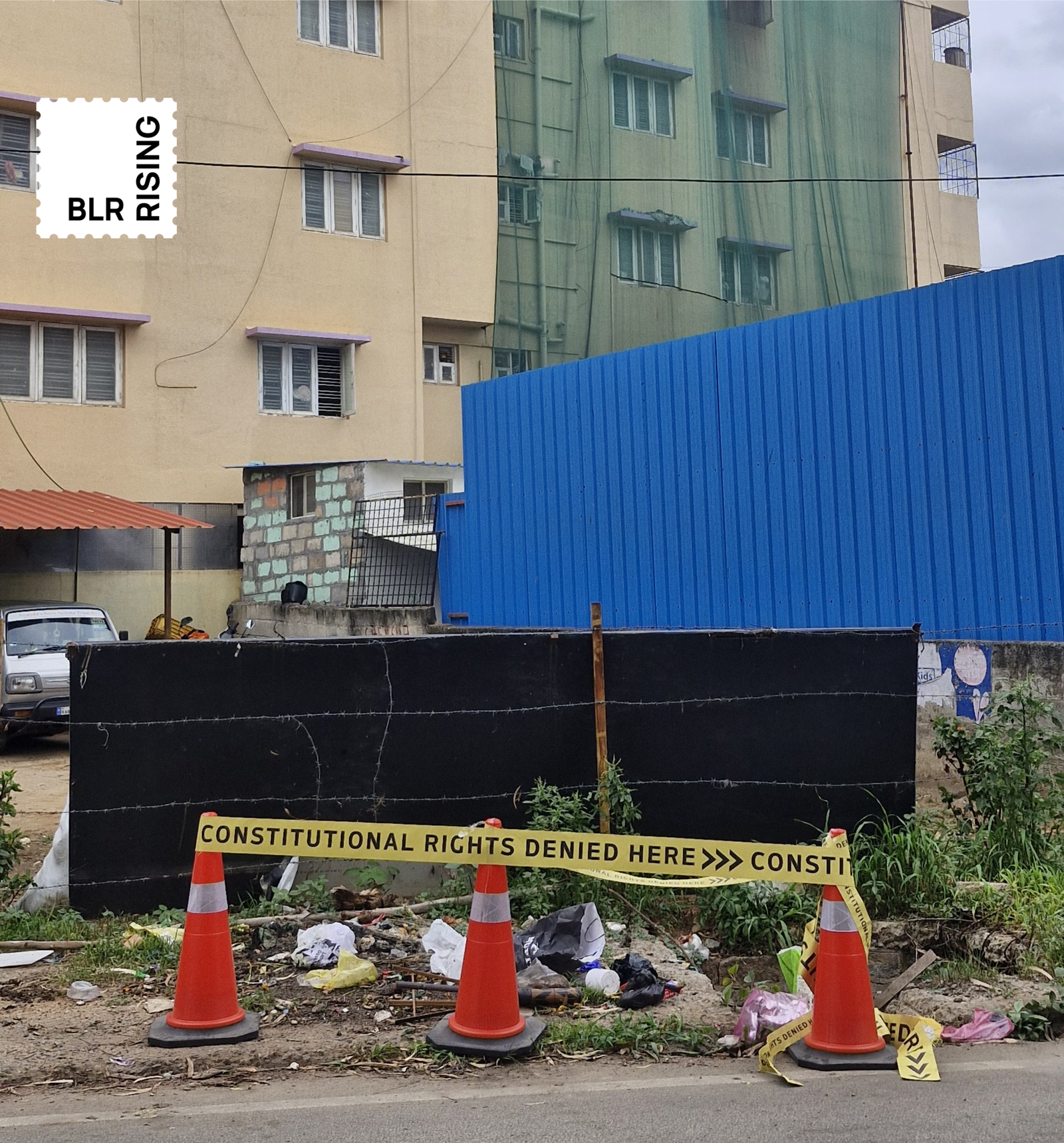


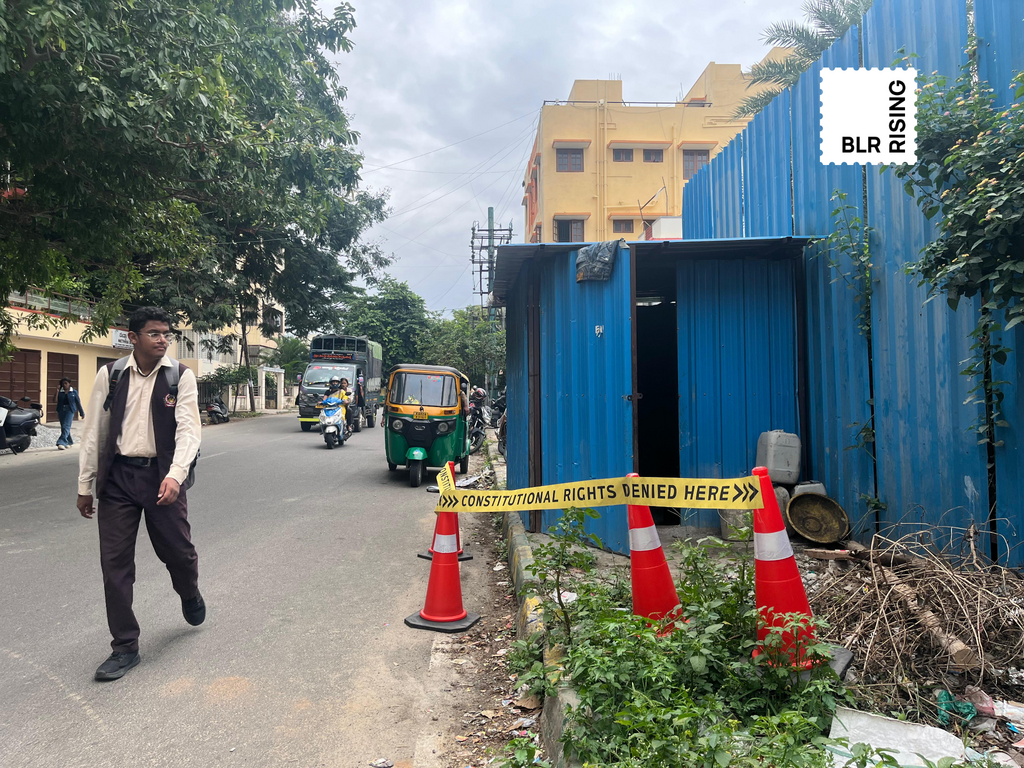
Bengaluru, June 30, 2026 – Days after the Supreme Court declared the Right to Walk on footpaths as a Fundamental Right, Greenpeace India’s Bengaluru Rising campaign, along with residents of Rajarajeshwari Nagar, marked broken, missing and encroached footpaths in Rajarajeshwari Nagar with yellow ‘crime scene’ tape carrying the message “Constitutional Right Denied Here.” The symbolic intervention draws attention to unsafe pedestrian infrastructure that, following the Court’s judgment, amounts to a denial of citizens’ constitutional rights.
Despite being one of India’s fastest-growing cities, Bengaluru remains difficult and often unsafe to navigate on foot. While the city has over 14,000 km of roads, a 2025 assessment found only 2.9 km of usable footpaths across its 1,671 km of arterial and sub-arterial roads. Across neighbourhoods, pedestrians routinely encounter broken pavements, missing stretches, construction debris and encroachments, forcing them onto carriageways and exposing them to traffic

The intervention follows the Supreme Court’s landmark judgment on June 19, which held that the right to walk safely on demarcated footpaths is a Fundamental Right flowing from Articles 19(1)(d) and 21 of the Constitution. The Court further ruled that where a road exists, civic authorities have a corresponding duty to provide and maintain safe footpaths, placing pedestrian rights above the convenience of motorised traffic.
In Bengaluru, pedestrians accounted for nearly 28% of all road fatalities in 2025, with 218 pedestrian deaths recorded by the end of November, highlighting the consequences of unsafe and inaccessible walking infrastructure
The intervention also builds on conversations held through Greenpeace India’s Bengaluru Rising Imaginariums, where Bengaluru residents consistently identified poor walkability, inaccessible footpaths and shrinking public spaces as key concerns affecting everyday life. These discussions reinforced that reclaiming footpaths is essential to reclaiming Bengaluru’s urban commons and creating a city that is safer, more inclusive and climate resilient.
“Footpaths are public commons and the foundation of an equitable transport system,” said Amruta S. N., Campaigner, Greenpeace India. “Every bus or Metro journey begins and ends with a walk. If we want more people to choose public transport and active mobility, we must first guarantee safe, continuous and accessible footpaths. This judgment is a reminder that walking is not a privilege. It is a Fundamental Right.”
Clearing footpaths requires a comprehensive approach to reclaiming pedestrian space, not just targeted enforcement. Across Bengaluru, the biggest obstacles are often infrastructure failures like poorly placed utility boxes, transformers, debris, parked vehicles and uneven footpath incline . The city must tackle all forms of obstruction through inclusive street designs that guarantee safe pedestrian movement while systematically integrating designated spaces for regulated street vending.
Satish Karnath, a resident of Rajarajeshwari Nagar, said, “Bengaluru enjoys nearly eight months of comfortable weather every year. If walking felt safe and convenient, many more people would choose to walk to the Metro or bus instead of driving short distances. Making walking safe is one of the simplest ways to reduce congestion while improving quality of life.”
Through the intervention, Greenpeace India and residents of RR Nagar call on GBA and other civic agencies to treat footpaths as essential urban commons and implement the Supreme Court’s judgment by ensuring safe, continuous and accessible pedestrian infrastructure. Reclaiming Bengaluru’s footpaths is not just about improving mobility. It is about upholding a Fundamental Right and building a city that puts people before vehicles.

