
[ad_1]
Competition Law Violations 2026 – Healthy market competition promotes innovation, consumer welfare, and economic growth. Therefore, businesses should understand competition law before entering commercial arrangements. Apex Law Office LLP advises companies, startups, MSMEs, NGOs, trade associations, investors, and NRIs on competition compliance, investigations, mergers, and enforcement proceedings. Our legal team assists with compliance audits, agreements, regulatory filings, litigation, and appeals. Proper legal advice minimizes financial exposure and regulatory penalties. Moreover, proactive compliance strengthens investor confidence and corporate governance. The Competition Act, 2002 regulates anti-competitive conduct and abuse of market dominance across India. Businesses should review commercial agreements regularly. Early legal intervention prevents enforcement actions and protects business continuity. Strategic legal representation ultimately supports lawful competition while safeguarding commercial interests and regulatory compliance.

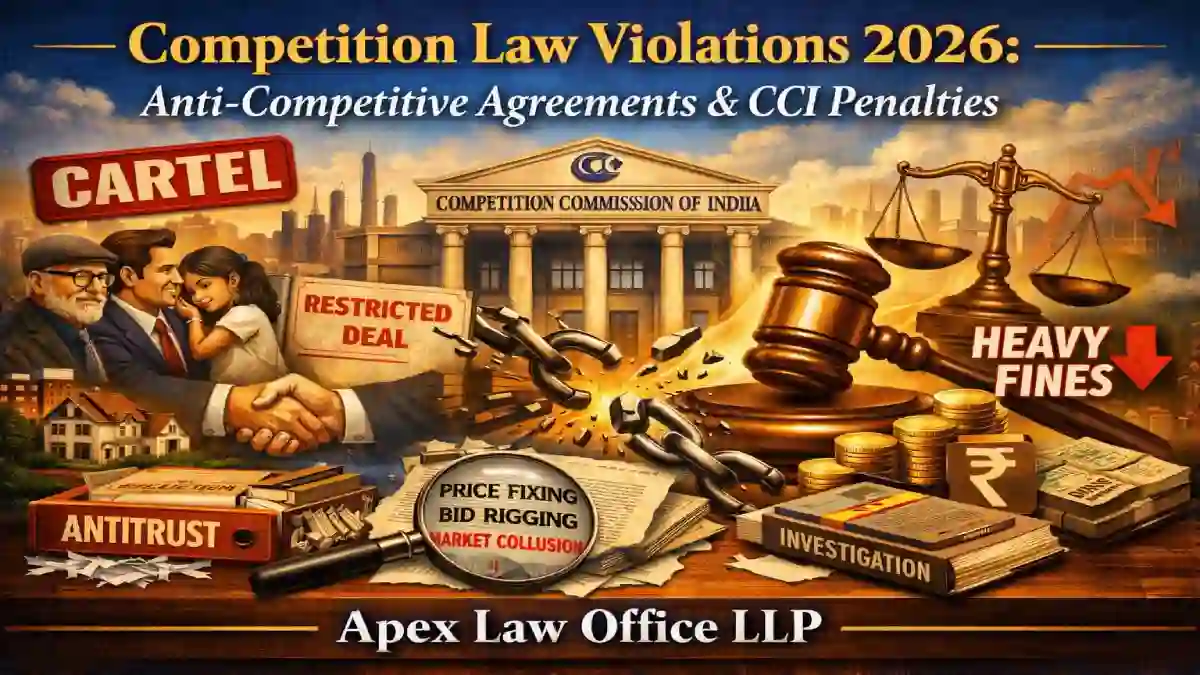
Competition Law Violations 2026: Anti-Competitive Agreements & CCI Penalties – Apex Law Office LLP

Understanding Anti-Competitive Agreements
Anti-competitive agreements restrict fair competition and adversely affect markets, consumers, and businesses. Consequently, enterprises should evaluate every commercial arrangement before execution. Horizontal agreements between competitors frequently attract regulatory scrutiny. Vertical agreements may also violate competition law under specific circumstances. Price-fixing, bid rigging, market allocation, output restriction, and cartel activities remain significant legal concerns. Additionally, exclusive supply arrangements may require detailed legal review. Proper compliance policies reduce enforcement risks. Businesses should maintain transparent commercial practices and accurate records. Competition law compliance also improves corporate reputation. Experienced legal advisors identify potential violations before regulatory investigations commence. Effective legal planning ultimately supports sustainable commercial growth within India’s evolving competition law framework.
Common Competition Law Violations
Competition authorities investigate conduct affecting competitive market conditions across multiple industries. However, preventive legal compliance significantly reduces enforcement exposure. Common legal issues include:
- Price-fixing agreements.
- Cartel formation.
- Bid rigging.
- Market sharing arrangements.
- Output limitation.
- Exclusive distribution agreements.
- Tie-in arrangements.
- Predatory pricing.
- Abuse of dominant position.
- Refusal to deal.
- Resale price maintenance.
- Anti-competitive mergers.
Every allegation requires detailed factual and legal evaluation. Proper documentation strengthens legal defence during investigations. Furthermore, compliance training reduces future regulatory violations and commercial risks.
Key Laws Governing Competition Compliance
Indian competition law regulates commercial conduct through specialized legislation and procedural laws. Every enterprise should understand applicable statutory provisions before entering commercial arrangements.
| Law | Purpose | Business Impact |
|---|---|---|
| Competition Act, 2002 | Competition regulation | Anti-competitive conduct |
| Competition (Amendment) Act, 2023 | Updated competition framework | Faster enforcement |
| Companies Act, 2013 | Corporate governance | Board compliance |
| Consumer Protection Act, 2019 | Consumer interests | Fair market practices |
| Information Technology Act, 2000 | Digital business | Online platforms |
| MSMED Act, 2006 | MSME protection | Commercial fairness |
Additionally, the Code of Civil Procedure, 1908 governs civil proceedings where applicable. Bharatiya Nyaya Sanhita, 2023 addresses criminal liability under relevant statutes. BNSS, 2023 governs criminal procedure. Bharatiya Sakshya Adhiniyam, 2023 regulates evidentiary standards before competent judicial forums.
Government Authorities and Regulatory Bodies
Several authorities supervise competition law compliance and commercial regulation across India. Therefore, businesses should understand every regulator’s jurisdiction before significant transactions.
- Competition Commission of India (CCI).
- Ministry of Corporate Affairs.
- National Company Law Appellate Tribunal.
- Registrar of Companies.
- Serious Fraud Investigation Office.
- Consumer Commissions.
- Police Stations nearby where cognizable offences arise.
- Directorate General under the Competition Commission.
- Sectoral Regulators where applicable.
Timely compliance reduces investigation risks and financial penalties. Professional legal representation ensures effective responses during inquiries, inspections, merger reviews, and appellate proceedings.
Competition Compliance Audits and Risk Assessment
Competition compliance audits identify regulatory vulnerabilities before enforcement proceedings commence. Accordingly, businesses should review agreements, pricing practices, distribution systems, communications, and procurement policies periodically. Internal compliance programs reduce organizational risks substantially. Employee training strengthens awareness regarding prohibited conduct. Commercial agreements should undergo legal review before execution. Furthermore, board members should monitor competition compliance actively. Accurate documentation supports legal defence during investigations. Whistleblower policies encourage lawful corporate governance. Comprehensive compliance reviews uncover hidden risks before authorities initiate proceedings. Professional legal advisors recommend corrective measures according to applicable competition laws. Effective compliance management ultimately protects business reputation, reduces penalties, and promotes sustainable commercial operations across competitive markets.
Commercial Agreements and Preventive Legal Advisory
Commercial agreements require careful drafting to avoid anti-competitive implications and regulatory scrutiny. Therefore, businesses should obtain legal advice before executing strategic collaborations, distribution arrangements, licensing agreements, joint ventures, or supply contracts. Legal advisors examine restrictive clauses, exclusivity provisions, pricing mechanisms, territorial restrictions, and information-sharing practices. Proper contract drafting minimizes competition law violations. Moreover, periodic agreement reviews maintain continuing statutory compliance. Internal legal audits strengthen governance and commercial accountability. Businesses should preserve negotiation records and commercial justifications carefully. Well-structured agreements balance commercial objectives with regulatory obligations. Experienced legal counsel ultimately reduces enforcement exposure while supporting lawful business expansion, market competitiveness, and investor confidence.
Competition Law Investigations, CCI Proceedings, and Defence Strategy
Competition law investigations require immediate legal assessment and structured defence planning. Therefore, businesses should preserve relevant documents before responding to regulatory notices. Apex Law Office LLP advises enterprises during investigations, inspections, dawn raids, merger reviews, and enforcement proceedings. Legal teams evaluate commercial practices, communications, pricing strategies, and contractual obligations carefully. Moreover, prompt legal representation protects procedural rights during regulatory inquiries. Internal investigations frequently identify compliance gaps before enforcement escalates. Documentary evidence, board resolutions, emails, contracts, invoices, and financial records strengthen legal defence. Businesses should implement corrective compliance measures without unnecessary delay. Strategic legal advice reduces reputational risks and regulatory exposure. Comprehensive defence planning ultimately supports lawful business operations while ensuring compliance with evolving competition law requirements.
Competition Law Services by Apex Law Office LLP
Apex Law Office LLP delivers comprehensive legal solutions for businesses, startups, trade associations, investors, NGOs, multinational corporations, and NRIs. Accordingly, our legal services include:
- Competition compliance audits.
- CCI investigation defence.
- Merger and acquisition advisory.
- Combination notification review.
- Commercial agreement drafting.
- Dominance assessment.
- Cartel investigation defence.
- Regulatory representation.
- Internal compliance policies.
- Director advisory.
- Corporate governance reviews.
- Appellate representation.
- Settlement advisory.
- Legal notices.
- Competition litigation.
Every engagement prioritizes legal compliance, commercial continuity, and strategic risk management. Furthermore, customized legal advice supports long-term regulatory confidence and sustainable business growth.
Jurisdiction, Forums, and Authorities
Competition law disputes proceed before specialized forums according to statutory jurisdiction and procedural requirements. Therefore, selecting the correct forum strengthens legal efficiency.
| Forum or Authority | Jurisdiction | Common Proceedings |
|---|---|---|
| Competition Commission of India | Original jurisdiction | Anti-competitive investigations |
| National Company Law Appellate Tribunal | Appeals | CCI orders |
| High Courts | Writ jurisdiction | Constitutional remedies |
| Supreme Court of India | Civil appeals | Final appellate proceedings |
| Consumer Commissions | Consumer grievances | Unfair trade issues |
| Civil Courts | Limited civil jurisdiction | Contractual disputes |
| Police Stations nearby | Cognizable offences where applicable | Criminal complaints |
| Directorate General, CCI | Investigation | Evidence collection |
Businesses may also interact with the Ministry of Corporate Affairs, Registrar of Companies, sectoral regulators, and taxation authorities where statutory obligations overlap.
Legal Remedies Against Competition Law Violations
Available legal remedies depend upon investigation findings, statutory provisions, and commercial circumstances. However, early legal action significantly improves compliance outcomes.
- Legal compliance advisory.
- Modification of commercial agreements.
- Competition compliance audits.
- Representation before the Competition Commission of India.
- Appeals before the National Company Law Appellate Tribunal.
- Constitutional remedies before High Courts.
- Civil remedies under the Code of Civil Procedure, 1908 where applicable.
- Settlement and commitment mechanisms where legally permissible.
- Internal corporate investigations.
- Regulatory responses.
- Injunction applications where maintainable.
- Documentary evidence preparation.
- Corporate governance reforms.
- Risk mitigation strategies.
The Competition Act, 2002 remains the principal legislation. Bharatiya Nyaya Sanhita, 2023, Bharatiya Nagarik Suraksha Sanhita, 2023, and Bharatiya Sakshya Adhiniyam, 2023 apply wherever relevant legal proceedings arise.
Why Choose Apex Law Office LLP
Apex Law Office LLP combines regulatory knowledge with commercial experience across competition law matters. Therefore, clients receive practical legal solutions tailored to evolving business environments. Our advocates advise corporations, startups, MSMEs, trade associations, financial institutions, investors, NGOs, government contractors, and NRIs. We prepare compliance policies, commercial agreements, merger documentation, regulatory submissions, legal opinions, and appellate pleadings carefully. Moreover, our legal team represents clients during Competition Commission investigations and appellate proceedings. Transparent communication strengthens informed decision-making. Ethical legal practice remains our professional commitment. Comprehensive legal planning ultimately protects commercial interests while minimizing regulatory exposure, financial penalties, and business disruption.
Competition Compliance Checklist
Every enterprise should implement structured compliance measures before expanding commercial operations. Additionally, periodic legal reviews strengthen regulatory preparedness.
- Conduct annual competition compliance audits.
- Review pricing policies.
- Examine distribution agreements.
- Monitor communication practices.
- Train directors and employees.
- Maintain compliance records.
- Preserve commercial documentation.
- Assess merger notification obligations.
- Review market conduct periodically.
- Update compliance manuals.
- Report legal concerns internally.
- Obtain legal opinions before strategic collaborations.
Effective compliance improves governance and investor confidence. Professional legal supervision further reduces enforcement risks while supporting lawful market participation.
Conclusion
Competition law compliance protects businesses, consumers, and competitive markets through transparent commercial conduct. Therefore, enterprises should adopt preventive legal strategies before entering significant commercial arrangements. Proper compliance audits, contract reviews, governance policies, and timely legal advice reduce regulatory investigations and financial penalties. The Competition Commission of India, appellate forums, and constitutional courts provide statutory mechanisms for enforcement and judicial review. Apex Law Office LLP delivers strategic legal advisory, regulatory representation, compliance audits, litigation, appellate advocacy, and commercial risk management for companies, startups, NGOs, investors, and NRIs. Professional legal guidance ultimately safeguards sustainable business growth while ensuring compliance with India’s evolving competition law framework.
Frequently Asked Questions
Q1. What is an anti-competitive agreement?
It restricts market competition through practices like price-fixing, bid rigging, market allocation, or cartel arrangements prohibited under competition law.
Q2. Which authority investigates competition law violations?
The Competition Commission of India investigates anti-competitive conduct through its statutory powers and the Director General’s investigative process.
Q3. Can businesses appeal against CCI orders?
Yes. Aggrieved parties may challenge eligible orders before the National Company Law Appellate Tribunal under applicable legal provisions.
Q4. What documents help during a CCI investigation?
Commercial agreements, invoices, pricing records, board minutes, emails, compliance policies, financial statements, and internal reports support legal defence.
Q5. How can businesses avoid competition law penalties?
Regular compliance audits, employee training, contract reviews, governance policies, and professional legal advice significantly reduce regulatory risks.
Q6. How does Apex Law Office LLP assist businesses?
The firm provides compliance audits, CCI defence, merger advisory, litigation, appeals, commercial drafting, legal opinions, and regulatory representation.
Read More
[ad_2]
Source link

