
[ad_1]
Every year, the government sets aside thousands of crores for farmer schemes. Income support, crop insurance, livestock subsidies, solar pump grants, food processing loans, the list goes on.

And yet most farmers only ever hear about one or two of them. Not because they’re ineligible. Just because nobody ever laid out the full picture for their specific situation.
Quick Answer
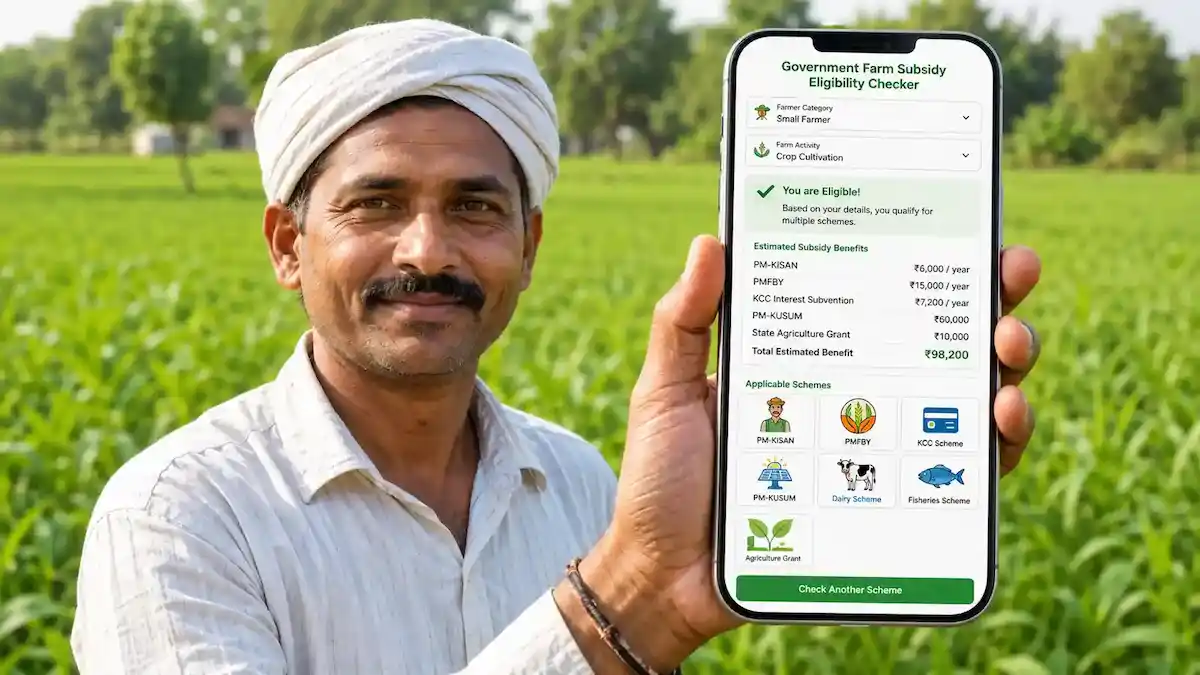
The Subsidy Eligibility Checker is a free tool that helps Indian farmers identify 14 central government schemes they may qualify for, based on farm size, primary activity, gender, and social category.
It matches your profile against schemes like PM-KISAN, PMFBY, KCC, PMMSY, NLM, PM-KUSUM, PKVY, AIF, PMFME and others, and returns a personalized shortlist in under a minute.
A farm subsidy eligibility checker is an online tool that compares your farming profile against government scheme requirements to identify which subsidies and financial assistance programmes you may qualify for. Instead of reading through a stack of separate scheme guidelines, you answer two questions and get a matched list back immediately.
✓ Copied!
About This Subsidy Eligibility Checker
The Subsidy Eligibility Checker matches your farmer category and primary farm activity against a curated database of major Indian central-government agriculture schemes — income support, credit, insurance, solar irrigation, livestock, fisheries, organic farming, food processing, and infrastructure funding — and instantly shows which ones you likely qualify for, the benefit amount, and where to apply. It replaces hours of scattered scheme research on separate department websites with one guided lookup.
Formula Used
Matching Logic: Strong Matches = your Farmer Category is listed as eligible AND the scheme targets your specific Primary Farm Activity. Also-Open-To-All results = your Farmer Category is eligible and the scheme applies to every farm activity (income support, credit, insurance-type schemes). Woman Farmer and SC/ST selections do not remove schemes from the list — they surface enhanced-subsidy tiers and women-only schemes that apply on top of the base match.
Usage Tip
Scheme rules, subsidy percentages, and enrollment windows are revised periodically by central and state departments — always confirm current terms on the official portal or with your local Krishi Vigyan Kendra / Agriculture Department office before applying, especially for capital-subsidy schemes with limited annual budgets.

Try the free eligibility finder above before you read further. Pick your farmer category and your main farm activity, and it will show you exactly which national schemes you’re likely to qualify for, what each one is worth, and where to apply.
Key Takeaways
- Finds government schemes based on your specific farming profile, not a generic list
- Helps farmers identify the major central government subsidy schemes they qualify for
- Takes less than one minute to use, completely free
- Separates activity-specific matches from general, open-to-all schemes
- Includes the benefit amount, eligibility reason, and where to apply for each match
At a Glance
| Tool Feature | Details |
|---|---|
| Time Required | Under 1 minute |
| Schemes Covered | 14+ National Schemes |
| Supports | Farmers, FPOs, SHGs |
| Inputs Required | Farmer Category + Farm Activity |
| Cost | Free |
| Mobile Friendly | Yes |
The scheme finder is built for anyone running a farm-based livelihood in India, including:
- Small and marginal farmers
- Large landholders diversifying into new activities
- Tenant farmers and sharecroppers
- Dairy, poultry, goat, sheep and piggery farmers
- Fish farmers and aquaculture operators
- Women farmers looking for enhanced subsidy tiers
- Farmer Producer Organizations (FPOs)
- Self-Help Groups (SHGs)
- Organic and natural farming practitioners
If you fall into more than one of these, that’s fine. You can run the checker once per activity and combine your results.
Why Finding the Right Scheme Is Harder Than It Should Be
Ask ten farmers what government support they’re entitled to. Most will name PM-KISAN. Maybe a crop insurance scheme too.
Very few will know that a small dairy farmer, a woman-led poultry unit, or a village FPO running a mill could be sitting on four or five different schemes at once.
Here’s why farm subsidy schemes are so hard to track.
Support is scattered across departments. Livestock schemes sit with the Department of Animal Husbandry. Fisheries schemes sit with the Ministry of Fisheries. Food processing sits with a different ministry entirely.
There’s no single window that connects your farm activity to every government scheme you might qualify for.
Eligibility isn’t one simple rule. It’s usually a mix of your landholding size, what you actually farm, your social category, and sometimes gender, all considered together.
A small farmer growing vegetables and a small farmer running a poultry shed are not eligible for the same set of agriculture grants, even though both are “small farmers” on paper.
Names and structures keep changing. PMMSY replaced older fisheries programmes. NLM absorbed several older livestock schemes into one.
Even people who follow farmer welfare policy closely find it hard to keep track of what’s currently active and under what name.
Information online is a mess. Search “government schemes for farmers” and you’ll get a mix of official portals, financial blogs, and articles that are two or three years out of date.
Very few of them answer the one question you actually care about: what farming financial assistance am I eligible for, right now, given my situation?
That’s the gap this subsidy matcher is built to close.

What the Subsidy Matcher Actually Does
At its core, this is a matching tool. You tell it two things about your farm, it checks that against a manually verified database of eligibility conditions published by the Ministry of Agriculture and Farmers Welfare, NABARD, the Department of Animal Husbandry, the Ministry of Fisheries, and other official government sources.
It returns a personalized shortlist built specifically around your answers.
Unlike a generic list of government schemes, this scheme finder doesn’t treat every reader the same. A marginal farmer growing wheat sees a different result than a large landholder running a fishery, even on the same page, using the same calculator.
The Two Questions That Drive Everything
You only need to answer two required fields.
Farmer category. This covers your landholding and organisation type: Marginal Farmer (up to about 1 hectare), Small Farmer (1 to 2 hectares), Large Farmer (above 2 hectares), Tenant Farmer or Sharecropper, or FPO/SHG/Cooperative.
This single choice decides a big chunk of your eligibility, since many central government agriculture schemes are built around landholding tiers rather than income.
Primary farm activity. This is what you actually do with your land: Crop Cultivation, Horticulture, Organic Farming, Dairy, Poultry, Goat and Sheep, Piggery, Fisheries, Beekeeping, Food Processing, or Irrigation and Solar Equipment.
Activity matters because most farmer welfare schemes are built around one specific sector. A fisheries subsidy means nothing to a poultry farmer, and the other way round.
Put these two answers together, and the recommendation engine can narrow fourteen national schemes down to the ones that genuinely apply to you.
The Optional Special Category Checkboxes
Below the two main fields sit two optional checkboxes: Woman Farmer and SC/ST Category.
These don’t add or remove schemes from your list. What they do is change the advice you get alongside your results.
A few schemes, PMMSY and Namo Drone Didi among them, offer a noticeably higher subsidy percentage for women and SC/ST applicants. The tool flags this directly so you don’t miss a better rate that a generic blog post might never mention.
How the Matching Actually Works
The logic behind the results is kept simple on purpose. Farmers are, rightly, wary of tools that feel like a black box.
Every scheme in the database is tagged with the categories it applies to and the activities it covers.
A scheme shows up in your results when your category matches, and either your activity matches too, or the scheme applies to every activity regardless.
That gives you two separate groups of results.
Strong Matches are schemes tied to your specific activity. If you picked Dairy, National Livestock Mission shows up here. If you picked Fisheries, PMMSY does.
Also Open to All Farmers covers the broader schemes, things like PM-KISAN, Kisan Credit Card, Soil Health Card and e-NAM, which depend only on your category, not what you actually grow or raise.
This split helps you prioritise. The activity-specific matches usually carry the bigger individual benefit. The broad matches are the ones almost every farmer should already be enrolled in, no matter what else they’re doing.
How to Use the Eligibility Finder in 5 Steps
Step 1: Choose your farmer category. Select Marginal, Small, Large, Tenant Farmer, or FPO/SHG/Cooperative from the dropdown.
Step 2: Choose your primary farm activity. Pick the one activity that best represents your main farming operation.
Step 3: Select optional special categories. Tick Woman Farmer or SC/ST Category if applicable, to see enhanced subsidy tiers where they exist.
Step 4: View your matches. The tool displays your Strong Matches and Also Open to All Farmers schemes, each with a benefit amount and eligibility reason.
Step 5: Apply through the listed channel. Each scheme card tells you exactly where to apply, whether that’s a government portal, your bank branch, or a state department office.
Use the free Subsidy Eligibility Checker above to instantly see which government farming schemes match your farm profile. It takes less than one minute.

Reading Your Results
Once you submit your answers, the results panel gives you a few distinct pieces of information. Each one answers something you’d otherwise have to dig for separately.
The Match Count
At the top, a badge shows your category, and a large number shows your total match count. Something like “5 Schemes.”
This gives you a quick sense of scale before you read the details. A diversified large landholder might see seven or eight matches. A narrow, specific profile might see three or four.
The Matching Logic Line
Right under the headline, a plain sentence explains how that number was worked out.
For example: “Matched on Small Farmer plus Dairy and Cattle Farming, giving 2 activity-specific matches and 3 open-to-all schemes.”
This is shown on purpose, not hidden away. You can check it against your own understanding of your farm, and rerun the finder with a different activity if you run more than one type of operation.
The Scheme Cards
Every match shows up as its own card with four things: the scheme name, the actual benefit in real terms (a rupee figure, a subsidy percentage, an interest rate cut), a short line on why you qualify, and where to apply.
This combination matters. A benefit with no eligibility reason isn’t something you can act on right away. A reason with no benefit figure doesn’t tell you if it’s worth the paperwork.
Put both together, and you can decide in a couple of minutes which two or three schemes are worth an afternoon at the bank or the block office.
If you’re planning your farm budget after receiving a subsidy, our Crop Profit Calculator can help estimate your expected income, costs, and overall profitability before the season begins.
The Recommendation Box
Below the cards sits a short note that changes based on your answers.
If you ticked Woman Farmer or SC/ST, it tells you which of your matches usually carry a better subsidy tier for that category, so you know exactly what to ask about when you visit the office.
If your match count came out low, it nudges you to check with your state agriculture department too, since state schemes sit outside this calculator’s scope.
The Disclaimer
Every result set carries a fixed line reminding you that subsidy percentages and rules shift over time, and that you should confirm the current numbers on the official portal before applying.
This isn’t filler text. A few of the fourteen schemes here have genuinely changed shape in just the last couple of years.
Government Farm Subsidy Schemes Included in This Eligibility Checker
Here’s the full list of 14 national schemes in the manually verified database:
- PM-KISAN
- Kisan Credit Card (KCC)
- Pradhan Mantri Fasal Bima Yojana (PMFBY)
- PM-KUSUM
- National Livestock Mission (NLM)
- Animal Husbandry Infrastructure Development Fund (AHIDF)
- Pradhan Mantri Matsya Sampada Yojana (PMMSY)
- National Beekeeping and Honey Mission (NBHM)
- Paramparagat Krishi Vikas Yojana (PKVY)
- Agriculture Infrastructure Fund (AIF)
- PM Formalisation of Micro Food Processing Enterprises (PMFME)
- Soil Health Card Scheme
- e-NAM (National Agriculture Market)
- Namo Drone Didi
Income Support and Credit
PM-KISAN gives landholding farmer families six thousand rupees a year, paid in three instalments of two thousand rupees, straight into their bank account. A few exclusions apply, like income-tax payers and certain government employees.
Kisan Credit Card (KCC) offers short-term credit at low interest, sometimes as low as around 4% a year with prompt repayment. It covers crop loans as well as working capital for dairy, poultry and fisheries.
Marginal farmers, small farmers, large farmers, tenant farmers and FPOs can all access it through banks and cooperative societies.
Risk Protection
PMFBY (Pradhan Mantri Fasal Bima Yojana) is the main crop insurance scheme. Your premium is capped at 2% for Kharif crops, 1.5% for Rabi crops, and 5% for commercial or horticultural crops. Government covers the rest.
It’s open to loanee and non-loanee farmers alike, as long as you’re growing a notified crop in a notified area.
Livestock, Poultry and Fisheries
National Livestock Mission (NLM) offers capital subsidy for setting up poultry, sheep and goat, piggery, or fodder units. It’s aimed at individuals, SHGs, FPOs and cooperatives.
AHIDF goes bigger. It offers loans covering up to 90% of project cost with a 3% interest subvention, meant for dairy or meat processing plants, feed units, and breed-improvement infrastructure.
PMMSY supports fisheries and aquaculture with a 40% subsidy for general category applicants, rising to 60% for women and SC/ST applicants. It covers ponds, hatcheries and cold-chain setups.
NBHM (National Beekeeping and Honey Mission) funds bee colonies, hives, and honey processing or testing infrastructure for farmers and FPOs getting into commercial apiculture.
Sustainable and Organic Farming
PKVY (Paramparagat Krishi Vikas Yojana) supports cluster-based organic farming with roughly ₹31,500 per hectare spread across three years, covering certification and input costs.
It’s built for farmer groups working together, usually in clusters of 20 hectares or more.
Infrastructure, Processing and Market Access
AIF (Agriculture Infrastructure Fund) gives a 3% interest subvention on loans up to ₹2 crore for things like cold storage and warehouses.
Individual farmers, FPOs, cooperatives and agri-entrepreneurs can all apply.
PMFME offers a 35% credit-linked subsidy, capped at ₹10 lakh per unit, to help formalise small food processing businesses. SHG-led units also get ₹40,000 seed capital per member.
Many government schemes also encourage efficient input management. Use our Fertilizer Calculator to estimate the correct nutrient requirement for your crops and reduce unnecessary fertilizer costs.
Soil Health Card Scheme gives you free soil testing every two years, with crop-specific fertilizer recommendations. Every farmer qualifies, regardless of size or activity.
e-NAM connects you to over 1,400 mandis for online trading, helping with price discovery. There’s no direct cash subsidy here, but better prices matter just as much.
Technology Adoption
PM-KUSUM supports solar irrigation pumps and grid-connected solar plants with a capital subsidy that varies by state and component.
Namo Drone Didi is narrow but generous: an 80% subsidy, up to ₹8 lakh, specifically for Women Self-Help Groups buying drones to offer spraying services to other farmers.
Why Use a Free Subsidy Checker Instead of Searching Each Scheme Separately?
| Manual Search | Eligibility Checker |
|---|---|
| Requires visiting multiple websites | One tool, one page |
| Time-consuming, often an hour or more | Under 1 minute |
| Easy to miss a scheme you qualify for | Matches all relevant schemes at once |
| Separate eligibility checks per scheme | Unified, side-by-side results |
| No guidance on which to prioritise | Strong Matches vs Also Open to All |
Advantages and Limitations
Like any tool, this one has a clear scope. Being upfront about what it doesn’t do is just as useful as listing what it does.
Advantages
- Saves significant research time
- Matches you against all supported schemes at once
- Completely free online eligibility checker, no signup required
- Works well on mobile
- Covers all the major national agriculture subsidy schemes
Limitations
- Doesn’t guarantee approval, only eligibility likelihood
- State-level schemes aren’t included
- Official eligibility rules can change without notice
- You’ll still need to gather the standard documents (Aadhaar, land records, bank details) for each application
How to Get the Most Out of the Recommendation Engine
A few habits will help you actually use this well, rather than checking it once and forgetting about it.
Run it separately for each activity you’re involved in. If you grow crops on part of your land and also run a small dairy unit, run the finder twice.
Once for Crop Cultivation, once for Dairy. Combine both result sets to get your full picture.
Start with the “Also Open to All Farmers” group. These are the foundational schemes, PM-KISAN and KCC especially, that almost every eligible farmer should already be enrolled in.
If you haven’t applied for these yet, they’re usually the fastest to act on.
Use the “why you qualify” line when you visit an office. Mentioning your exact category and activity helps the official pull up the right form faster, instead of treating your visit as a general enquiry.
Check back every few months. Subsidy percentages and benefit caps change more often than people expect. A result from a year ago might already be out of date.
Remember what it doesn’t cover. This version only looks at national schemes. If you’re in a state running strong programmes of its own, income top-ups, price support, equipment subsidies, check with your state agriculture or animal husbandry office separately.
Common Mistakes When Checking Farm Subsidy Eligibility
A few avoidable errors account for most of the confusion farmers run into with this process.
Choosing the wrong farmer category. Landholding size determines a lot of eligibility, so double check whether your land falls under marginal, small, or large before submitting.
Selecting only one activity when running multiple enterprises. If you farm crops and also keep livestock, checking just one activity means missing schemes tied to the other.
Ignoring state-level schemes. This checker covers national schemes only. Many states run their own income support or equipment subsidy programmes on top of these.
Not updating Aadhaar-linked bank details. Almost every scheme disburses funds through Direct Benefit Transfer. Outdated bank or Aadhaar details are one of the most common reasons payments get delayed or rejected.
Assuming eligibility means approval. A match here means you meet the published criteria. It doesn’t skip document verification, land record checks, or the scheme’s own approval process.
Frequently Asked Questions
Does the tool guarantee I’ll get the subsidy?
No. It shows you which schemes you’re likely eligible for based on what you enter. Final approval still depends on document checks, land records, and each scheme’s own process.
Think of it as a shortlist generator, not an approval stamp.
Why did my friend see more schemes than me with a similar farm size?
Eligibility depends on category and activity together, not just landholding size.
Two farmers with the same land size but different activities, say crop farming versus fisheries, will see different activity-specific matches even if their broad matches look the same.
Does it include state schemes?
Not in this version. It only covers national, central government schemes.
State programmes differ too much in structure and benefit amount to fit into one accurate matching tool. If your count feels low, check with your state department directly.
I run an FPO with several activities. What do I pick?
Choose FPO, SHG or Cooperative as your category. For activity, pick whichever one makes up the biggest share of what your FPO actually does.
If your operations are genuinely split across a few sectors, run the finder once per activity and combine the results.
How current is the scheme information?
It reflects the most recent details available at the time of review. Government schemes get revised fairly often, so always double check the numbers on the official portal listed in each result before you apply.
What if I don’t match any schemes at all?
That’s rare, but if it happens, double check your category and activity selections first.
After that, your local agriculture office is the right next step, since some narrow enterprises are better served by a state-specific scheme that sits outside this database.
Which farmers are eligible for PM-KISAN?
Landholding farmer families are generally eligible, subject to exclusions like income-tax payers, certain government employees, and institutional landholders.
Can tenant farmers receive subsidies?
Yes, for several schemes. KCC, PMFBY, AIF and Soil Health Card are all open to tenant farmers, though PM-KISAN specifically is tied to landholding records.
What documents are needed to apply?
Most schemes ask for Aadhaar, land records or a lease agreement for tenants, a bank passbook, and in some cases a caste certificate for SC/ST benefit tiers. Exact requirements vary by scheme.
Can I apply for multiple schemes at the same time?
Yes. Most of these schemes are designed to work alongside each other. A dairy farmer, for instance, can hold PM-KISAN, KCC and NLM support simultaneously.
Are agriculture subsidies taxable?
Direct income support schemes like PM-KISAN are generally treated as agricultural income and are not taxed the way regular income is, but it’s worth confirming your specific case with a tax advisor.
How long does approval usually take?
This varies widely by scheme and by how quickly your documents and bank details are verified. Some, like PM-KISAN enrolment, can take a few weeks. Infrastructure-linked schemes with bank loans can take longer.
Is Aadhaar mandatory for these schemes?
Yes, for almost all central schemes, since disbursement happens through Aadhaar-linked bank accounts under the Direct Benefit Transfer system.
Can women farmers receive higher subsidies?
Yes, for specific schemes. PMMSY offers up to 60% subsidy for women applicants compared to 40% for general category, and Namo Drone Didi is exclusively for Women Self-Help Groups.
Which scheme offers the highest single financial benefit?
It depends on your activity. For infrastructure-heavy projects, AHIDF and AIF offer some of the largest loan amounts with interest subvention. For a straightforward annual benefit, PM-KISAN is the most universal.
Official Sources and References
The eligibility conditions in this checker are drawn from publicly available details published by the following:
- PM-KISAN Portal (Ministry of Agriculture and Farmers Welfare)
- PMFBY official scheme guidelines
- PMMSY, Department of Fisheries
- Agriculture Infrastructure Fund, Department of Agriculture and Farmers Welfare
- PM-KUSUM, Ministry of New and Renewable Energy
- Department of Animal Husbandry and Dairying
- NABARD scheme documentation
Always cross-check current figures against these official sources before submitting an application, since benefit amounts and eligibility rules are reviewed periodically.
Final Word
Government schemes exist to take some of the financial risk out of farming. But only for the farmers who know they qualify and actually apply.

This eligibility finder helps you discover which schemes are worth applying for before you spend time collecting documents or visiting government offices.
Two quick answers save you an afternoon of scattered searching. And because the matching logic is shown right there on screen, you’re never left wondering why a scheme did or didn’t show up.
Whether you’re checking your PM-KISAN status, weighing NLM against AHIDF for a livestock project, or looking into AIF for a processing unit, running your details through the calculator takes less time than reading a single government circular.
[ad_2]
Source link

