
[ad_1]
Shreya Banchhor, Jairaj Singh Basur, and Siddhi Srivastava.


Note: This podcast was recorded prior to the judgements in Andrabi & Tasleem, which have looked at Najeeb differently.
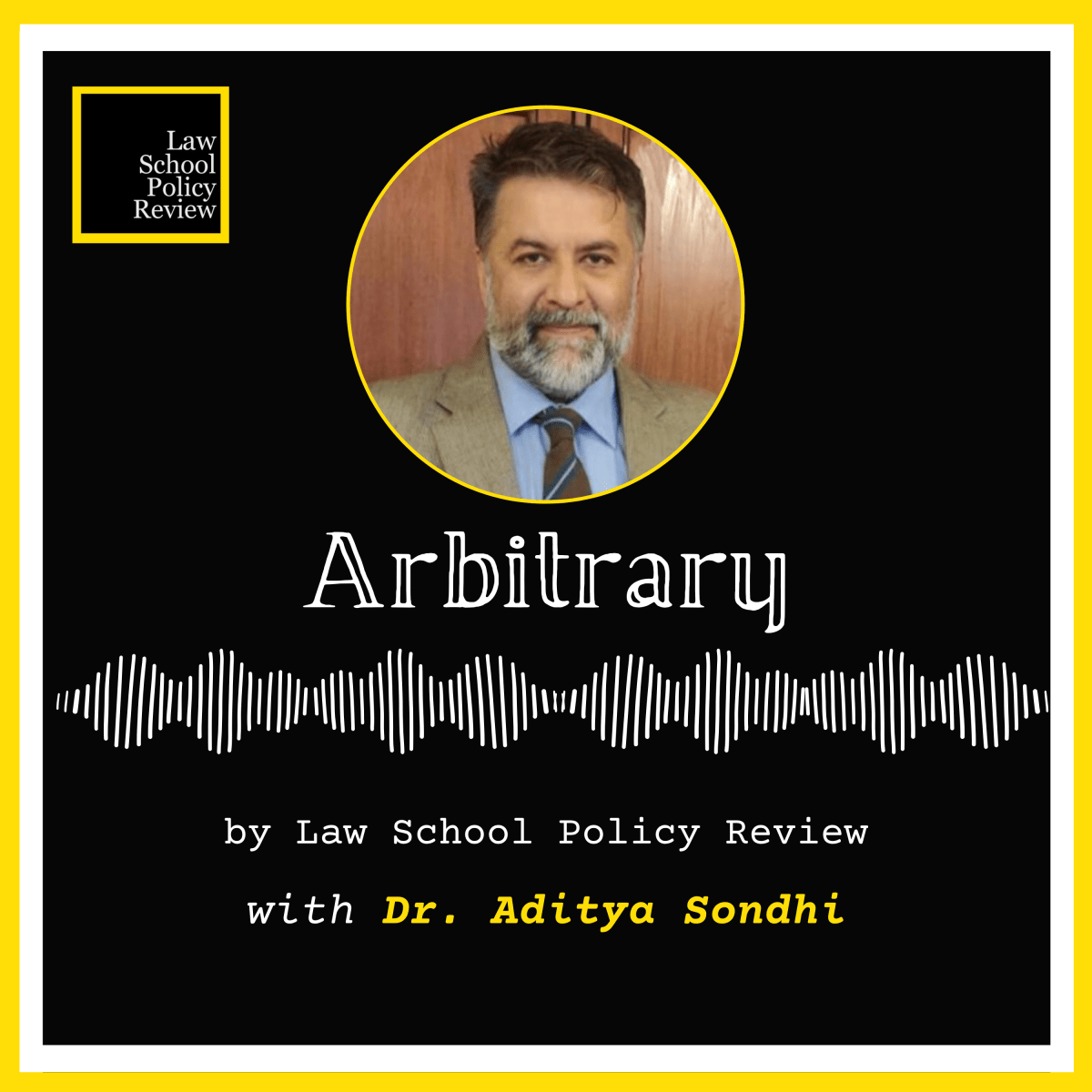
Shreya Banchhor, Jairaj Singh Basur, and Siddhi Srivastava, members of the Editorial Board at the Law School Policy Review, sit down with Dr. Aditya Sondhi, Senior Advocate at the Supreme Court of India and constitutional law scholar, for a conversation on one of criminal law’s most contested fault lines: the presumption of innocence. Through an examination of reverse onus provisions and anti-terror legislation — including the UAPA, PMLA, and the NDPS Act — the conversation probes how statutory design increasingly burdens the accused rather than the state. Dr. Sondhi reflects on restrictive bail provisions, preventive detention, and the evolution of Article 21 jurisprudence, while confronting the lived realities of criminal litigation and the obligations of trial courts. The episode concludes with Dr. Sondhi speaking about his own trajectory through law school and into independent practice.
LISTEN TO THE PODCAST
Shreya Banchhor: Today, Dr. Sondhi, just to give a brief about who you are as a person to our audience, we would just like to say that –
Doctor Aditya Sondhi is a senior advocate before the Supreme Court of India and the High Court of Karnataka, and he holds a law degree from the National Law School of India University and a PhD in Political Science from Mysore University. Doctor Sondhi has independently set up his litigation practice, where he has proved himself as an expert on matters of criminal and constitutional law.
Besides that, being a man of many interests, he has also penned multiple books on constitutional law and history. And he has also founded Usher, which is an amateur theatre circle, the General K.S. Chemaya Memorial Lectures, the Ravi Sondhi Spirit of Bangalore lectures, and the Podcast, which is a podcast series which hosts important conversations around caste.
The theme for today’s podcast as we have discussed is to highlight how the most pragmatic principle of criminal law, which is that an accused is innocent until proven guilty by the state beyond reasonable doubt, has seen a slow yet steady decline in the recent years. And the reason behind the shifting of this burden of proving innocence has now come on to the accused because of the proliferation of anti-terrorism laws, such as the Unlawful Activities Prevention Act of 1967 and the Terrorist and Disruptive Activities Prevention Act of 1985, the latter being repealed on the grounds of misuse. And it is in this context that we look forward to your insights.
On concepts of anti-terror laws, preventive detention, and reverse bonus clauses in Indian criminal laws, and now Jairaj will take over from here.
Jairaj Basur: So to begin with an introductory question, for the interest of those in our audience less familiar with the concept of reverse onus provisions, could you begin with a very brief explanation of the burden of proof in criminal law and how it is reversed in some specific laws?
Aditya Sondhi, Sr Adv: Yeah, look, the first principle of criminal law is that one is presumed innocent unless proven guilty beyond reasonable doubt. So very simply, if I give you an illustration, say the offence of cheating, the offence is made out where you’re able to show a dishonest intent to deceive and cause someone to part with their property, and that intent to deceive is really where the offence arises. And as simple as it may seem, courts are flooded with cases where on similar facts, you find both civil and criminal proceedings going on parallelly. So for example, where you have a dispute between a landowner and a purchaser, basis and agreement of sale, ordinarily your instinct would be that one would file a suit for specific performance, compensation, injunction, etc. But more often than not, you find that in these circumstances, agreement holders also initiate criminal proceedings and say that they have been cheated in cases where a party does not transfer the property to them, right? And it’s quite apparent that in the latter case, to make out a case of cheating, it’s not enough to say that one has breached the agreement by not registering the property, but has to go a step forward and show that the vendor had an intent to deceive at the time when the agreement was executed, right? So this is a simple and straightforward illustration of burden of proof and a presumption that a person is innocent and that mens rea in such cases has to be then made good by the prosecution. But this is one element of it.
On this, many legislations such as UAPA, PMLA, NDPS, and to an extent, the Evidence Act also have reversed this burden and led to presumptions in favour of the prosecution, which is to say that the mens rea, for example, under the NDPS, under Section 35, the mental state is presumed to exist in all cases where the offence requires such mens rea, especially where you’re dealing with, you know, commercial volumes or values of narcotics. PMLA has a presumption provision under section 22 to 24, especially 24, which presumes that proceeds of crime are meant to be for money laundering purposes. And so also under UAPA, where a recovery is made under Section 43 E, a presumption is incorporated in the statute that the person or the accused from whom the recovery is made of those arms as mentioned under Section 15 of the Act is relatable to the commission of a terrorist act. And even if you look at the Evidence Act, for example, the last seen theory, Section 106, you know, facts of special knowledge within the knowledge of a party has been extended in the concept of last seen to say that in circumstantial evidence cases, if there’s no other material, then in a sense, the burden shifts, the burden shifts then on the accused to explain thereafter.
The likelihood of having not committed that offense, and there are so many cases we come across where convictions are made simply on the basis of last seen, whereas there is where there is no other defence available, right? Presumptions under Section 114A relatable to commission of offences under 376, where the perpetrator is somebody in power. So all of these are instances where the burden shifts in the sense that the presumption is made favouring the prosecution. But please also remember that under these three statutes, at least that I mentioned to you, UAPA, PMLA, and NDPS –
There is another shifting of burden, not quite a shifting of burden in the context of leading of evidence and of trial, but a shifting of burden simply on the grant of bail. And all of these enactments, as you’re aware, and we’ll talk about it later, have provisions where bail has also been made far more stringent.
By expecting the court, the trial court at the time of granting bail, to arrive at certain conclusions that prima facie, the material on record, that is the charge sheet or the case diary, indicates the commission of the offence or it’s differently worded.
Under PMLA and NDPS that the trial code shall only grant bail if it is of the reasonable view that the accused is not guilty. I would like you all to see these provisions also in a sense of a shifting of a burden – not a shifting of a burden of proof, but shifting of a burden, which is that at the bail stage itself,
An accused has an onerous obligation to show that the offence is not made out so as to get bail.
Jairaj Singh Basur: To continue the discussion on this point itself, could you tell us a bit more about the fields in which such reverse onus clauses are most commonly used? Particularly, what sets them apart from ordinary fields or provisions of criminal law and how are they recognised within the constitutional framework?
Aditya Sondhi, Sr Adv: You know, the first part I think I have more or less answered in my earlier answer, but this latter part, constitutional framework, look, a lot of our criminal law jurisprudence finds itself located really under articles 20,21, 22, broadly speaking.
And much of that has been developed literally under Article 21, right? Even bail jurisprudence that I referred to earlier, even in these more stringent statutes, has been watered down by the Supreme Court applying an Article 21 interpretation to say that where there is inordinate delay and that delay is not occasioned by the accused, then Article 21 kicks in. Your right to a fair trial is vitiated, then your liberty is vitiated; therefore, you can be released on bail, even under these stringent statutes. But to answer the question, these reverse burden instances, even TADA, were challenged before the Supreme Court, and, as you know, it was upheld.
Right? And the compelling view, in fact, in TADA is that of the minority, if you read. I think Justice Sahai and Justice Ramaswamy, if I’m able to remember offhand now, wrote the dissenting view, opinion. And their opinion is actually quite compelling when you look at it from this perspective.
Which is to say that, for example, TADA had a provision that a confession recorded by a police officer will be admissible in certain circumstances. Right? That flies in the face of everything you might have studied as first principles of criminal law. And the majority upheld it, saying that because TADA deals with serious offences against the State, it’s meant to deal with extreme terror scenarios. Such provisions ought to be accepted as an exception to the law. But the minority view, in fact, said that when the offence is more grave, the penalties are more serious, resulting in some cases even with death penalties, then all the more reason the law needs to be fair and constitutionally kosher. And you ought to therefore, in more serious offences with more serious outcomes, have more onerous conditions laid down for the investigation slash prosecution, not make it easier. And we all know,
through, you know, judgments, through anecdotal evidence, through books that are written by people who’ve been under trials in TADA cases. There’s that recent book that was authored by that individual who spent, I don’t know what, 18 or 20 years in jail only to be ultimately acquitted.
And the circumstances in which those so-called confessions are extracted, right? That actually, in my opinion, undermines a constitutional theory of fairness. But a lot of these reverse burden provisions have been upheld by the courts. PMLA as an act, as you know, in Madanlal Choudhary has been upheld.
It has many other stringent provisions apart from these reverse burden, but that’s where we are.
Shreya Banchhor: Alright, thank you. I just have one more follow-up question regarding this: that when we talk about how, like even for cases or actions where actually the accused needs to be tried with fairness and which is why under-trial confessions are usually not allowed in normal cases. However, in cases of UAPA, or even TADA, according to you, a police confession can actually be used against the accused. So over here, like how do you navigate the individuals constitutional safeguards that they are entitled to?
Aditya Sondhi, Sr Adv: Well, it’s an uphill battle if you’re for the defense, right? In these instances, of course, TADA and POTA both, you know, cease to exist. They were repealed slash permitted to lapse. But in my opinion, and I would like you all to look at this more closely in the context of how both these enactments played out in the political scenario, right? There were governments that said they would scrap these laws when they came into power, and they did so on the premise that the laws were being used or rather abused against certain minority communities, right? So in a way, it was Parliament taking cognizance of the misuse of these enactments leading to their repeal. But again, it was politics at its best because whatever lapsed with TADA and POTA found itself back more or less, not this confessional provision, but otherwise the stringent provisions of the terror laws, hitherto terror laws found their way into UAPA. So UAPA is in fact a 1967 law. It’s been there for decades, but you have to see the construct of UAPA post the amendments.
And it’s a sort of an indirect way of bringing back the terror regime into UAPA. So today, even despite TADA and POTA not being in the books, they’re not being a strict terror law, by terminology in force, UAPA for all practical purposes is being deployed. And it has wide reaching definitions of what is a terrorist act, the manner I would, I would, I’m answering this in your, in the context of your question, right? You said constitutional rights.
Now, if you look at the way UAPA has been applied, You will see an Article 14 discrimination then and there.
Right, many of the cases that we do, you find are in the realm of political retaliatory violence and murders, okay? I’m not talking about open and shut cases of, say, an Ajmal Kasab kind of instance, which is a little sharper.
Politically sensitive areas in India – Look at what’s happening in Bengal right now. What happens in Kerala a great deal and the PFI as an organization, has been subjected to UAPA widely. So in the same facts, 2 incidents, retaliatory political murders, in one case you apply 302 of the IPC or the provision of the BNS – statutory bail is available.
Right? And the onerous conditions of bail in any case are missing in those legislations. And on the other hand, when UAPA is applied, all hell breaks loose. One is the onerous bail conditions. Then the fact that a lot of that evidence is received by the court through protected witnesses along with the charge sheet. Protected witnesses are anonymous. Now witness protection is a human part of criminal law. But that doesn’t mean a protected witness statement should be given any elevated importance by the court, especially at the bail stage, an accused does not even know who that witness is, right? So protected witnesses, charge sheet material, all of these provisions which say prima facie if the trial court feels it’s true, no bail, and the judgement in Watali – which said go by the charge sheet. So the prosecution version at that stage is the gospel truth, which means you spend many years in custody, right? Then comes attachment of properties. Most of these enactments have attachment provisions. So bank accounts are attached. I’m doing cases in the Supreme Court where, you know, you have joint families, a father, three sons doing some flower business, somebody’s doing a carpentry business, you have a common bank account, right? These are not sophisticated corporate entities with separate bank accounts, etc, etc. So that master bank account gets attached. Then, apart from the accused, the rest of the family, the non-accused have to run from pillar to post to get the account de-frozen. Then you have to show what that source of income was. In some states, you must have heard of Bulldozer Raj, right? So that happens. As a result, this is the full weight of the law.
And where does then the constitutional protection come in? Well, thankfully, you know, the Supreme Court in Najeeb and thereafter in Shoma Kanti Sen, Vernon has at least applied the constitutional principle to say, all right, face trial, onerous conditions, but beyond a point –
If your detention itself becomes punitive, then there’s an Article 21 violation. So you ought to be released on bail. But the difficulty here is all this only happens after somebody has spent two to three years at the minimum.
Right, in two to three years, it’s not a small period of time, right? Compare that to the first part of my that illustration where you have a 302 case after a charge sheet is filed, or if you’re entitled to statutory bail, you’re lucky, but after charge sheet is filed, if it’s a case where the material is not so damaging. You don’t have antecedents, right? You have a reasonably good track record. You should be able to get bail, even if the offence is heinous. So this is really where the constitutional safeguards are at play, right? Other than that, the Article 21 is really applied in the course of trial.
You know what I mean? You have to then go through the course of trial. You have to prove your innocence and get an equitable. That is Article 21, which is why today many, you know, scholars and lawyers have started to talk about trial courts also as constitutional courts. And Justice Oka, who has authored several judgments in the Supreme Court applying Article 21 has said it. We don’t maybe literally think trial courts are not constitutional courts, right? You’ve always regarded the High Court as a court of record and then the Supreme Court as constitutional courts. But for all practical purposes, especially the trial courts, the sessions court, the magistrates court dealing with rights and liberty are, for all practical purposes, constitutional courts, are they not? That’s where the protection or the violation is.
Shreya Banchhor: Yeah, they’re bound to apply the constitutional provisions at some point at least. And I have just one more question regarding this. So there have been a lot of Supreme Court decisions and government circulars which have come out in order to make sure that the accused is not accused is not with any difficulties or any sort of pressure during the custody or trial. However, like we would just like to know from your experience, are these directions really followed in practice and if they are followed, are they followed consistently across all places?
Aditya Sondhi, Sr Adv: Look, there are different types of directions. It depends on the nature of the directions you have in mind. If you go back to the DK Basu case, the very requirement of, you know, chaining and handcuffing was frowned on by the Supreme Court. That itself was seen as a Article 21 violation, custodial torture, manner of recording statements and confessions. Then if you see the march of the law, a very path-breaking judgement of the Supreme Court on caste discrimination in prisons, right? You must have read about that. That’s right. And then more recently, the directions of the Supreme Court in CBI versus Mahto, you know, in-rem directions, which are really Article 142 directions, to ensure that this process of speedy trial is actually seen on the ground, especially in UAPA cases, right?
You ask me how do I see it? A lot of the matters that we do in the Supreme Court at the bail stage – When you look at the statistics that emerge from the states, for example, even from Karnataka, where a number of these matters come up, the special NIA courts are flooded.
There are hundreds of trials, hundreds. In one case, I may be wrong, but I think that figure was somewhere in the range of 1000. Okay, I’m saying this at the top of my head. But even if you take it as hundreds, if a trial court has hundreds of trials before it, they all are expected to be speedily dealt with. How do you prioritize? You say day-to-day, but day-to-day those judges are human. How many cases will they hear day-to-day? How many witnesses will you depose? So you have to realise that with all of these efforts on the ground, there are other logistical differences. I’m not even going to the extent of saying there’s any malintent.
Some cases, yes, prison authorities, you can go that far. But as far as the courts are concerned, I’m not at all, you know, even pointing a finger. I’m actually saying the burden is so high that these in-rem directions may ease up things. The Chief Justices of the high courts have been asked by this particular direction to, you know, take stock of the matter, see if you have sufficient infrastructure, if you have enough judges. Even if you have enough judges in special courts, you need other support, right? You need stenographers.
On a particular day, if you don’t have enough stenographers, how will you record evidence? It’s not like international commercial arbitration that you have tech and AI recording error proof depositions, right? All that is savvy in a different world. In criminal trials, it’s a world of its own.
So these are the challenges and the court is certainly taking note of it, and which is why this new jurisprudence has come to be, which is to say, all right, all said serious allegation.
Now, a serious allegation also, please remember, is still an allegation, right? It still has to be made good.
And therefore, the court, especially at the stage of bail, and I’m coming back to bail because for many of the accused, the first relief is bail.
Right? You’re not going to get a quashing in a 482 or the equivalent of the new law in a terror matter.
Whether you get acquittal or not is secondary; they say the process is the punishment, right? So, first hope is bail.
And in that context, courts are taking cognizance of this and saying trial courts are overburdened.
I did a case before the Gujarat High Court recently. You must have heard of the Mundra port issue where there was a large seizure of heroin.
Perhaps the largest seizure in India’s history, some 2000 plus kilogrammes or something like that. Okay. Serious allegation, no doubt. NDPS and all its forces applied. Now the accused I was appearing for, keeping aside the merits of the matter, I don’t want to comment on that, Spent over three years in custody.
And the number of witnesses to be deposed by the prosecution in that case ran into, I don’t know, several hundreds, if I remember. Even after that list was pruned, it was still a voluminous number of witnesses, right? 90 or 100 or something like that.
And those witnesses are not, you know, proforma witnesses who can be deposed in a matter of minutes.
And the court found that applying the 21 principle as laid down by the Supreme Court, and the fact that the court was burdened, that trial was being delayed, that trial could not be attributed – the delay could not be attributed to the accused. It’s one thing if the accused is abusing the process and taking adjournment after adjournment.
And as I said to you earlier, antecedents.
Right? Those are also very important facet. I’m highlighting all these to you because when you look at Article 21, this becomes the crux of the 21. There’s the merits of the case. There’s the prosecution material. Then there’s all this, which is really relatable either to the system or it’s relatable to the accused.
Now, antecedents are on the accused, right?
And it’s very much for you then to argue that notwithstanding serious allegations, look at the background of the individual.
If the antecedents are zero or minuscule, it doesn’t quite then always add up with the gravitas of the allegation, right?
Jairaj Singh Basur: Yeah.
Aditya Sondhi, Sr Adv: At least at a bail stage, that becomes a significant consideration. And that’s where I think the courts have chipped away at the stringent statutes that one is dealing with these days.
Siddhi Shrivastava: India has had a long history of draconian preventive detention laws, such as MESA, TADA, POTA, most of which eventually failed after public and judicial pushback. Is there anything that makes UAPA different from previous statutes? And why has the same pressure built up around this?
Aditya Sondhi, Sr Adv: Yeah, I think I answered that earlier and I said a big factor in the doing away with TADA and POTA was really political. You know, it was political.
And in that politics was the cognizance of the fact that these acts were being disproportionately used against our citizens. And I’m sorry to say against certain communities and certain groups of citizens.
Now, why has that not happened with UAPA? It’s political will, right? You have a strong government now who says, bring on the law. You have a government that believes in law being even more stringent than it has been hitherto. So where is the question of it? That conversation also, I don’t think really arises and the best way for me to illustrate that to you is through the three new criminal laws that we introduced, right?
You know that IPC, CrPC were substituted and even the Evidence Act.
Jairaj Singh Basur: Yeah.
Aditya Sondhi, Sr Adv: Though the Evidence Act is in a sense agnostic, it applies both to civil and criminal trials. But it was supposed to be a mass criminal law reform. And I actually appeared before the special committee that was constituted, the parliamentary special committee that was constituted before these laws were introduced. And I had, amongst other suggestions, suggested that this was a watershed moment for Indian Parliament to relook at the death penalty legislation itself, because many countries have moved away from death sentencing. We have seen historically that death penalties in India have often gone wrong. And I have personally been involved in cases where concurrent death sentences have resulted ultimately not just in the sentence being remitted to life, but to acquittals, right? But Parliament thought otherwise. Parliament brought in three new statutes. The new penal law has more death penalty provisions than there were earlier. And I’ve, in fact, a lecture that I did at the Bonnevero Institute of Human Rights at Oxford University last year was exactly on this. And I tried to demonstrate the dichotomous way in which we are moving just on death sentencing. If you look at Indian Supreme Court judgments over the last, say, 10-15 years on death penalty, you will see that we have become de facto abolitionist. The Supreme Court rarely, if at all, awards death.
Jairaj Singh Basur: Yeah.
Aditya Sondhi, Sr Adv: And even in cases where you find concurrently that the offence is made out, the offence is heinous, POCSO, etc., etc., death is not given, and new principles of constitutional law are introduced based on mitigation reports, the mental health of the accused, societal background, etc., etc. and as a result, death is replaced with, say, life. Okay. Now, if you’re moving in that direction through courts, you would think that Parliament is also in sync with that understanding, right? Supreme Court is representative, we would believe, of where criminal law stands today. But Parliament moves in the other direction, which is more death sentencing, and even that special law that Mamata Banerjee’s government had introduced, which is yet to receive the centers, the president’s approval, wanted to introduce death, right, for offences by amending the penal law. So, I, you know, returning to your question, why has UAPA per se not been looked at in the same light? I think I think the political disposition and the way in which the executive looks at terror, sedition, anti-national acts, etc. is very differently from the way, say a defence lawyer would, or a scholar would, or the courts would.
Siddhi Shrivastava: Moving on, what differences, if any, are there in the specifics of reverse onus clauses in such laws, as opposed to say POCSO or NDPS?
Aditya Sondhi, Sr Adv: I think I’ve answered that question in a fair amount. Let’s move on to something.
Shreya Banchhor: I think that’s good. Yeah. Yeah. So just building on our conversation regarding UAPA and jurisprudence. So the text of the UAPA essentially prohibits the courts from giving bail if the court believes that the accusation is prima facie true. However, we would just like to know your opinion and give your experience. Does this result in the accused having to disprove like substantial parts and the prosecution’s narrative at the base stage itself as opposed to the actual trial? And in this stage, you’ve answered like most of it, but we’d like to get into more detail regarding this as to what kind of evidence is usually relied on by the court at this stage.
Jairaj Singh Basur: At this stage, especially just to add on a bit to the question, like we’ve all studied Supreme Court judgments, like Najeeb and Watali, but like we’d like to know a bit specifically about the trial court experience.
Aditya Sondhi, Sr Adv: Look, this is in a sense a pre-trial determination that the trial court is making, right? You’re considering bail invariably at the initial stage, which is even before charge may have been framed. So the question of defence evidence at that stage doesn’t really arise and nor does the law contemplate defence material being introduced. And if you look at the language of the provision in UAPA, it is the basis, the case diary or the charge sheet. Now, Watali took this to extreme levels and said, charge sheet, begin and end with it. And if the prosecution says you’ve done it, you’ve done it. So that leaves very little elbow room, right, for an accused. And I had, in fact, before the Kerala High Court, when I was arguing a matter relating to the PFI, in the context of 43D5 of UAPA, I said, look, it’s not that trial courts don’t look at the merits while granting bail.
Even under 438 or 439, right? Of CRPC, ordinary instances of bail or anticipatory bail, more so regular bail. It’s not that the trial courts will shut their eyes to the material on record. Even there, there are multiple considerations, one of which is the nature of the offense. And when you look at the nature of the offense, prima facie, you do look at the material in support of that allegation or charge, right? So I argued before the court saying that this is not to be taken to some, you know, absurd limits. It’s not supposed to be a mini trial at the stage of bail. So all right.If you’re not stopping at the prima facie evaluation that the bail court would make, saying, you know, what is the charge? What is the material? Then look at antecedents, likelihood of the accused fleeing, do they have deep roots in society, blah, blah, and say, okay, on balance, you grant or you refuse bail. In these special statutes, let’s notch it up a little bit and look at it as to how the court would look at it in a quashing petition. Okay.So as you know, under 482 CRPC, inherent powers, the High Court has the power to quash a case. It can quash an FIR, it can quash a complaint, it can even quash a charge sheet. And the test there, or at least one of the main tests there is, does the complaint read with the charge sheet, if there’s a charge sheet, make out an offense. And many times the High Court finds that even if a complaint in the charge is taken at face value, it does not make out an offence. So I’m saying, alright, let’s notch it up a little bit. You look at it from a 482 court’s perspective. The only difficulty there would be is that the defence is disadvantaged because, look, many of these cases are not based just on call records or CCTV or eyewitness records, right? If they are, then unfortunately, the accused is going to have a very tough time. But many of these cases, as I mentioned to you earlier, are based on oral statements made by protected witnesses. They may not be eyewitnesses, especially in these terror offenses, right? When there’s an overt act, as I said. Retaliatory murders, there may be two or three people directly involved. Those two or three are in trouble because the act is overt. There’s probably a recovery of a weapon. There’s an eyewitness, multiple eyewitnesses. Many of these murders actually happen in public. Like last night, you must have read. Adhikari’s PA was shot dead in cold blood in Calcutta near the airport, right?
They happen in a public place. There’s probably CCTV, somebody’s recording with a phone cam. That’s a different ballgame. But along with those two or three, many times you will find 20, 30 others will be arrested, who have no overt role, there’s no recovery from them. Then why are they charged with the stringent law? Because there are protected witnesses saying, I was at some meeting where they said this. Look, that’s actually fairly weak evidence. And that’s where, maybe in my opinion, and courts do that in some cases. Obviously, as you all know, there are different benches, there are different judges on different benches, there are, you go through the trial court, high court, and then Supreme Court process. So prejudices, perspectives, views can change from bench to bench.
But in at least in these cases, then the court has to look at it maybe from a 482 perspective and say, all right, prima facie. There’s enough doubt for the accused. Let them face trial, but let bail follow.
Shreya Banchhor: And following up on this topic, especially given that not only regarding protected witnesses, but also the way evidence tampering has also been an important issue during such proceedings. We would just like to ask regarding the Umar Khalid matter that the court had identified Imam and Umar Khalid as principal architects and denied them bail by releasing the other five accused, even though no charges had been framed and no trial had happened. And the court had relied heavily on the prosecution’s materials. Now, this appears to be some sort of circular reasoning exercise where the court is using an unproven label to justify detention and using that detention itself to prevent the very trial that would determine the veracity of that label. So what are your thoughts on this problem?
Aditya Sondhi, Sr Adv: The latter part of the detention blocking the trial I didn’t get. I don’t see how you arrive at that conclusion. Would you like to expand on that a little?
Shreya Banchhor: Yeah, so what we mean to say is that, regarding Umar Khalid’s trial, there were some instances regarding the arguments where the court had mentioned that, given the fact that Mister Khalid had been in jail for such a long time, like the prolonged detention itself sought to show how that how he had been accused of such an onerous crime and which is why he must be in jail. So like same as your argument where you just mentioned that even when like a crime is something that demands higher levels of or higher standards of trial in order to determine when an accused needs to be convicted. Instead of that, what the court and what the prosecution often does is that they take like a more lenient measure in trying to determine that person, whether the person should be convicted for such crimes or not.
Aditya Sondhi, Sr Adv: Yeah, look, it’s like this. I think in Umar Khalid, what the Supreme Court has really said is that the Article 21 principle is not a carte blanche. And it doesn’t mean that in every case, regardless of the gravity of the charge and other circumstances, simply because of prolonged trial, bail would be granted. Right? And yeah, it’s a fact. Look, Umar Khalid’s case and Umar Khalid himself have in some ways become, you know, the posters for conversation, right? And in many ways, I think Umar Khalid has suffered because of that, that he’s become the face of this entire case. Five others, as you know, got bail. The role, I’m not in that matter, I can’t speak from personal experience, but the role attributed to him and the role attributed to Sharjeel Imam were quite different actually, right? And you’d need to find (40:29) each of them very serious material to deny them bail even after this lapse of time unless you show that they are willingly protracting the trial. But there are many cases we do, which go under the radar. They may not be as prominent, where 21 is applied differently, there are benches which will say, yes, 21 alright, but we find that in this case the allegation very serious against you. So you come back after a year, you renew your bail after nine months, or we’ll ask the trial court instead to expedite it, right? There are some cases where I’ve appeared, there are peculiar situations. I’ll give you one example where the accused, in fact, went to the High Court on a quashing on a particular ground, saying that the sanction under the UAPA was defective. They also went in bail; both the matters came up to the Supreme Court. In the matter relating to the validity of the sanction, the Supreme Court itself stayed the trial because it found, as I was giving you the example of 482, it found prima facie there was a lacuna in the very inception of the case and stayed it. Now when the bail came up, the prosecution said, look, the accused have got a stay of trial. So now they can’t complain about Article 21 and delay. How do you look at that?
Aditya Sondhi, Sr Adv: Is it, is it the fault of the accused that they went to court? Is it their fault that the court stayed it, right? The court found prima facie case, therefore stayed it. Now, that can’t be held against them in my opinion. So we deal with a lot of these instances. Look, in Umar Khalid’s case, was the material serious enough to deny bail or not is a question at large. But I’ll tell you, there are many cases which are on. And there are many cases where…the Supreme Court will give you the benefit of 21 and please remember, Oftentimes, this is being given to you only in the Supreme Court. Right? It’s something I’ve talked about in other conversations. The Supreme Court is flooded with bail petitions, right? Every bench has bail petitions listed every day. And 90%, those are petitions by the accused. There are some cases where the prosecution also challenges or seeks cancellation, but those are a much smaller number, which means in all those cases, the accused have not been able to get bail in the trial court and in the High Court. Now 21 can certainly be applied by the High Courts, right?
Jairaj Singh Basur: Yeah.
Aditya Sondhi, Sr Adv: They are no doubt constitutional courts, but it’s not that simple. So to answer your question, in the background of Umar Khalid, let me say that there are multiple cases where the court feels that 21 by itself will not suffice. Some cases, the antecedents may be so sharp that 21 goes out of the window there, right? You have a concern basis the background of the accused. What if you’ve been charge sheeted in other heinous cases, right? So there are those considerations. And many times on the gravity of the charge itself, and if that pricks the conscience of the court, let me say that. And the court will say no Article 21 right now. And that’s where a lot of these via medias come about, right? Even directions to expedite trials. A court can say that if we’ve directed the trial to be expedited, then where’s the Article 21 violation? You come back, you watch whether the trial is indeed proceeding or not. If after six months, there are cases, Supreme Court says that within three months the prosecution will depose its main witnesses and file a report, right? Now, if it does it, it’s a catch-22. If it does it, then the accused will be told, look, the trial’s progressing.If it doesn’t, then the question is, who has delayed it? So I hope you’re getting the many layers to this.
Shreya Banchhor and Jairaj Singh Basur: Now, just moving onto a lighter note. Yeah, so just to conclude this podcast, we have a few questions. So firstly, what was your most memorable experience in your practice in the last few years?
Aditya Sondhi, Sr Adv: I find it hard to speak about my own practice in that context. I won’t say any particular memorable moment as such, but I think my shifting my practise to the Supreme Court four years ago stands out for me. It was a move that was long overdue. And I found it to be challenging and rewarding in equal measure. And I think the diversity and the variety of work that you see at the Supreme Court, including a lot of these criminal law matters that I mentioned to you, and the, you know, the speed at which the Supreme Court functions, contrary to perception, the Supreme Court works pretty quickly. I’m sure you’ve seen that as clerks and interns. And the finality of the Supreme Court, right, brings its own edge. So I would say, yeah, that stands out for me.
Shreya Banchhor: Second question, how would you characterise your experience as a student growing up for all the students who are watching this or reading the transcript? And just to like let you know, when we told like people in our institute that we are doing a podcast with you, there were a lot of people who came up to us because they really look up to you and how you started your own practice. So we would be really grateful if you could give your insights on your NLS experience.
Aditya Sondhi, Sr Adv: Well, thank you to all of those who had these kind words to say. I’m sorry to disappoint you, but my record at NLS was nothing to write home about. I was hardly an example of a student as my classmates and my seniors will tell you. And that’s because I wasn’t particularly interested in the law. You know, it was no fault of NLS. But till my 4th year or so, I had really no serious inclination towards the law. I got in by chance and I just sort of went through the motions and a lot of my time was spent outside the law school. Let’s put it that way, right?
Jairaj Singh Basur: Yeah. Yeah.
Aditya Sondhi, Sr Adv: But I’ll say this, that, you know, but I had my fun and that’s an important message I can actually give to you guys. It’s not all serious and it’s not all gloom and doom. And you know, you’re going to be working, especially if you join practice, you’re going to be working pretty much the rest of your lives unless you choose at some stage to, you know, pull back. So, you know, enjoy your time at law school. I’d seriously say that. Balance it. Don’t take your eyes off the ball, but enjoy your time and explore. And yeah, I woke up late because I was a little paranoid because I had so much fun, more fun than I should have. I had to get doubly serious in my final year. But the one thing I can say is that deciding to practise was a very clear decision in my mind, right? So with all my other distractions and my failings, even as a student at NLS, one thing I think that that stood out for me personally is the fact that I had the clarity that I wanted to practice, right? And that was despite not being from a lawyer’s or a judge’s family and knowing fully well that it’s not going to be easy. But that clarity is very liberating. And a lot of, you know, law students come to me with this question at that stage and it’s almost like they want to build this perfect model before they step into court. And I’m like, look, that’s not going to happen. Courts are wildly, you know, unpredictable, practice is unpredictable. There’s a great deal of uncertainty and the charm in many ways is also in that, right? But what you can control is your mental, shall we say, strength or your mental conviction that you’re up for it. You don’t have to be over prepared for it. You’re going to learn on the job, so there’s no pressure. You’re not going to be a finished product on day one. That’s a lifelong process, if you ask me. But just that mental clarity that you’re up for this, you’re willing to go to court, you’re willing to practice, I think is a very liberating thing. Because once you do that, then you overcome a great deal of mind blocks, which come with practice. Then everything else, you know, fits in. And trust me, it fits in over the years. I’m talking to you today about, you know, criminal law and so on. I never started as a criminal lawyer. And to be honest to your, to be frank to your listeners or your readers of this podcast that you will transcribe, I’ve not done much criminal trial work. In fact, I started as a commercial lawyer. I used to do predominantly company law or civil law. But I can tell you this much, and I’ve got now 28 years of practice, right? So if you look at it even in slots of, say, five years or even in terms of decades, that makes me feel pretty old, but you know, when you look at it that way, you can make that transition. It’s not that you’re going to end up doing everything on day one.
You’re not even going to many times know it. So I discovered that I enjoy public law and constitutional law much later, when I had my own practice. And it’s easier said than done. You may want to do constitutional law, but it will not necessarily come your way, right? It’s a different species in itself. And I was able to transition into that over the years by teaching constitutional law to some of your seniors. Then when I became the additional AG, I was exposed to a fair amount of that kind of law. I had then, over the years developed a greater interest in criminal law, right? And I made it a point to stay at it and as I said to you, the move to the Supreme Court has enabled me to do a lot more criminal law than I did even at the High Court. So these are not finely packaged end products that you get on the table on day one. So it’s a long answer, but I’ll say this, that you can chill out in law school. Especially if you’re going to court, you can chill out even more because you don’t have to pack your CV, right? You’re not looking for a scholarship or a master’s and so on. You can have a less impressive CV and still be welcomed into the bar, right? But this one thing I think is non-negotiable in my mind, which is having that clarity that you’re going to do it. Once you do it, then everything else I think fits in. Yeah.
Shreya Banchhor: Thanks a lot for your time. Thank you so much, Dr. And I think a lot of our peers and listeners will be very reassured by all the insights that you’ve given regarding law school and career so far. And also regarding the theme of the podcast, we were really grateful to hear things from your perspective and from your expertise. So we hope you had as much fun as we had on this podcast.
Aditya Sondhi, Sr Adv: I did. Thank you. Thank you very much. I enjoyed it.
Jairaj Singh Basur and Shreya Banchhor: Thank you. It’s an honour to have you here, sir. Thank you so much.
Aditya Sondhi, Sr Adv: All the best.
My pleasure. Thank you.
Related
[ad_2]
Source link

