
[ad_1]
Agriculture is getting a tough reminder that sustainability can’t live only in five year plans and slide decks. It has to work out in the field, on the bad weeks, during the weird seasons, when things don’t go according to schedule.

Climate volatility now feels less like a “future risk” and more like a daily operational problem. Heatwaves, drought, floods, shifting pest pressure, water stress, and unpredictable planting windows keep forcing growers and agribusinesses to rethink what sustainable agriculture and adaptive crop management actually look like in practice. The goal isn’t only to reduce long term impact anymore. It’s also to keep farms productive, flexible, and financially stable when conditions flip fast.
So resilience is becoming the day to day language of sustainability. Climate smart agriculture is starting to look like a practical defense system, built on predictive data, biological inputs, adaptive crop nutrition, smarter water use, and faster in season decision making.

Resilience is moving from strategy to daily farm management
For a long time, the sustainability conversation in agriculture stayed pretty high level, lower emissions, healthier soils, better water efficiency, stronger biodiversity, more careful resource use.
All of that still matters. No question. But the timeline is getting shorter, and that changes what feels urgent.
If you’re a grower dealing with extreme heat during flowering, a storm rolling in right before harvest, or a surprise pest outbreak, a multi year roadmap doesn’t help much in that moment. You need tools and systems that let you respond now, not later.
That’s the shift resilience brings. It pushes practical questions to the front. Can the crop handle stress without falling apart? Can the farm adjust timing on inputs when field access gets delayed? Can irrigation respond to real soil moisture instead of habit? Can an advisor catch a nutrient issue before the yield is already gone?
More and more, the answer comes down to how well a farm combines data, biology, nutrition, water management, and field execution into one working setup.
Climate smart agriculture is turning into a defense system
The World Bank defines climate smart agriculture as practices and technologies that support productivity and resilience while also reducing greenhouse gas emissions. FAO frames it similarly, improving sustainability and productivity while responding to climate change and food security pressures.
That general idea is the foundation for what agriculture is building now. Not a single product, and not one magic platform. Think of it as a connected set of tools and decisions that helps farms prepare earlier, respond faster, and recover better.
The urgency keeps rising. In April 2026, WMO highlighted a joint FAO-WMO report warning that extreme heat is creating growing hazards for people, crops, livestock, and fish. The same coverage pointed to the value of seasonal outlooks, early warning systems, and climate services that can help farmers prepare.
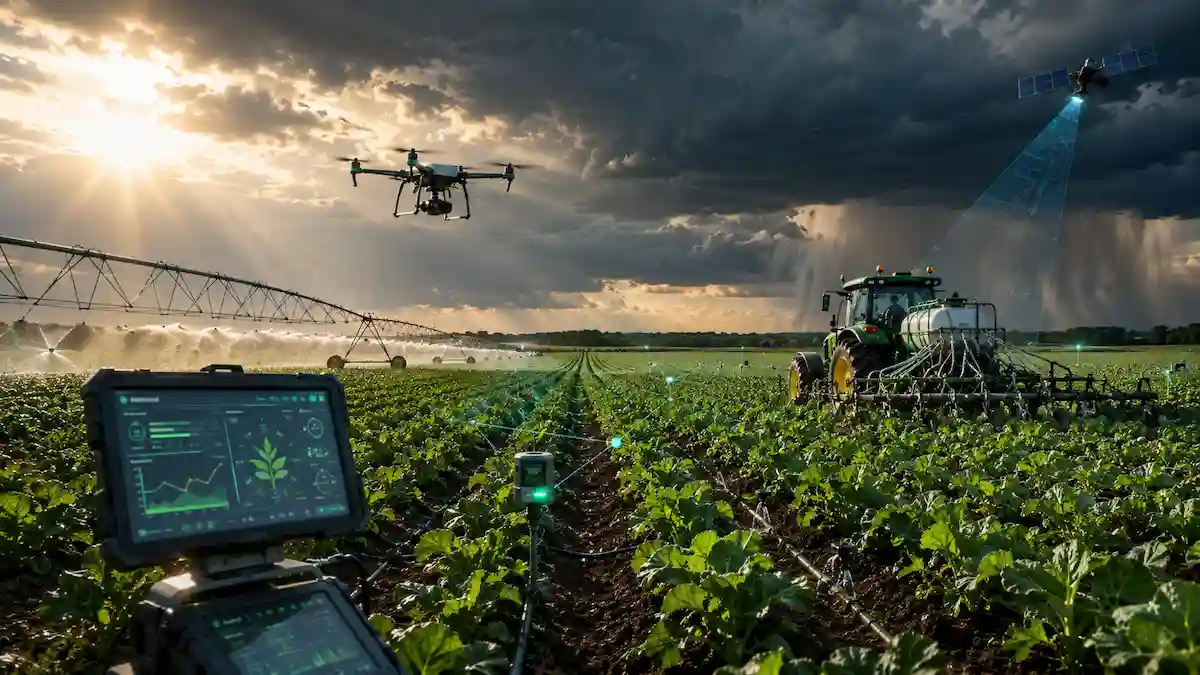
On the ground, this “defense system” usually shows up in five layers:
- predictive data that surfaces risk earlier
- biological inputs that support crop and soil function
- adaptive nutrition that matches crop demand
- water management that reduces root zone stress
- records that help farms learn, season after season
Predictive data is changing when decisions happen
The biggest change in ag data isn’t only that there’s more of it. It’s when it becomes useful.
Satellites, sensors, weather models, soil tests, machinery data, and scouting platforms can reveal field variability before the whole crop starts showing symptoms. That timing matters, because the cost of waiting has gone up. Sometimes a few days is the difference between a manageable stress event and a real hit to yield or quality.
Predictive data also nudges farms away from blanket decisions. Growers adopting precision agriculture technologies are increasingly using satellite imagery, sensors, and field data to improve timing, reduce waste, and strengthen adaptive crop management strategies. Instead of treating every acre the same, growers can split fields into zones and manage them differently, irrigation here, different nutrient rates there, more scouting attention where it’s actually needed, maybe a targeted crop protection pass in a problem area instead of a full field approach.

The value is pretty practical. Fewer blind spots. Better timing. Clearer priorities. Better records. And just to be clear, data doesn’t replace agronomy. It gives agronomists and farm teams a sharper starting point, assuming the data is clean and someone has time to interpret it.
Bayer, field data as a planning and response layer
Bayer’s Climate FieldView is one example of how digital farming tools are being positioned inside a resilience “stack.” Bayer describes FieldView as a platform that helps farmers see what worked, what didn’t, and how to improve operations using digital tools. Bayer also says digital farming applications like FieldView combine farm data, data science, and satellite imagery to support decisions around field conditions and resource use.
In a resilience context, the appeal is straightforward. Platforms like this can help turn field history and in season signals into more informed operational choices, especially when timing windows are tight.
ICL Group is one example of a company working in areas tied to adaptive crop nutrition and digital agronomy. ICL describes Agmatix Digital Crop Advisor as a tool that helps agronomists and growers compare crop nutrition protocols and sustainability KPIs like carbon footprint and nitrogen leaching. ICLeaf is an X ray based leaf nutrient analysis tool that can identify surplus fertilization or nutrient deficiencies.
In a resilience focused discussion, ICL’s relevance shows up when you frame it plainly: precision nutrition, in season nutrient insight, and tools that may help growers match nutrient supply to crop needs under variable conditions.
Biological inputs are becoming part of stress management
Biological inputs are getting more attention because climate stress isn’t only a weather problem. It’s also a plant health and soil function problem.

Biostimulants, microbial products, seed applied technologies, and biological crop protection tools are being explored to support crop vigor, root development, nutrient uptake, and pest or disease management. Still, it’s worth saying out loud: these aren’t miracle fixes. Performance can be inconsistent, and it often depends on crop type, soil conditions, application timing, local climate, and how well the product fits the rest of the program.
Used well, though, biologicals can become a real piece of a broader resilience plan. Many farms are also combining biological inputs with sustainable agriculture practices to improve soil health, water efficiency, and long term farm resilience. The goal usually isn’t to replace every conventional input. It’s to widen the toolbox, so the farm isn’t betting everything on one approach.
Corteva Agriscience, biologicals and seed level protection
Corteva Agriscience connects to this shift through its work in biologicals and seed applied technologies. Corteva describes its biological products as integrated solutions meant to complement existing practices and help keep farms productive and healthy. It also positions its seed applied technologies as targeted protection against pests and diseases, which may reduce the need for later season crop protection applications.
In a resilience focused story, Corteva is a useful example of how input companies are trying to protect crop potential earlier, before stress stacks up.
Adaptive crop nutrition is turning into a resilience lever
Climate volatility changes nutrient management in ways that aren’t subtle. Heavy rain can raise leaching risk. Drought can slow nutrient movement in the soil. Heat stress can shift crop demand. And when fields are too wet to access, application windows can slip, even if the crop doesn’t wait.
That’s why adaptive crop nutrition is becoming one of the most important layers in this defense system.
The priority is aligning nutrient availability with crop demand more precisely. That might mean split applications, fertigation, controlled release fertilizers, variable rate application, tissue testing, soil testing, and digital recommendations, depending on the crop and region.
It’s not simply “use less” or “use more.” It’s better timing, better placement, and better predictability. This is also where sustainability and resilience overlap in a very real way. Stronger nutrient management can support crop performance and reduce avoidable losses to air and water.
Water and nutrients have to be managed together
Water is often the first stress point you can see. But water stress almost never acts alone. It affects nutrient movement, root activity, soil biology, salinity risk, and overall uptake.
That’s why resilient farming keeps linking irrigation and nutrition, instead of treating them like separate departments. Precision irrigation and fertigation let growers apply water and nutrients closer to the root zone, in measured doses, at more appropriate times.

This matters most in places facing water scarcity, high heat, or irregular rainfall, which is increasingly a lot of places.
A resilience plan that separates water decisions from nutrition decisions will miss part of the picture. The stronger approach is integrated; soil moisture, crop stage, nutrient demand, weather risk, and field variability all feed the next move.
Netafim, precision irrigation and fertigation
Netafim fits here through precision irrigation and fertigation. The company describes precision irrigation as applying water and nutrients to the plant at the right time and place, in small measured doses. Its fertigation materials focus on automating irrigation and nutrient delivery while monitoring crops.
In the resilience stack, Netafim represents the water management layer, helping growers connect irrigation decisions more closely with crop nutrition and real field conditions.
Precision equipment makes adaptation executable
A resilience plan only matters if you can actually carry it out.
That’s where machinery, guidance, steering, variable rate systems, displays, and data connectivity start to matter a lot. A prescription map needs compatible hardware. A nutrient plan needs accurate application. A drainage or water plan needs field level execution. A scouting insight needs a workflow that gets the right person to the right spot, fast.
This is the last mile of climate smart agriculture. Predictive data can flag the risk, but equipment and field systems deliver the response.
Trimble, precision workflows for field execution
Trimble is relevant here as a precision agriculture and field workflow company. Trimble describes its agriculture solutions as tools that simplify workflows through connectivity and accuracy, including water management. PTx Trimble materials also point to guidance, steering, planter, sprayer, and retrofit technologies for farm operations.
In a resilience stack, this kind of technology matters because it helps growers turn plans into repeatable field actions, especially when timing windows are narrow and operational efficiency isn’t optional.
The next priority is resilience you can measure
As resilience becomes a bigger priority, it also needs to become more measurable. Not in a “paperwork for paperwork’s sake” way, but as real risk management.
Growers, food companies, lenders, insurers, and regulators are all asking for clearer evidence of what’s happening in the field. That doesn’t mean every farm needs an overly complex reporting system. It does mean records are becoming more important, because memory gets fuzzy and seasons don’t repeat themselves neatly.
Useful resilience metrics might include water use efficiency, nutrient use efficiency, soil organic matter trends, input timing, crop stress indicators, yield stability, field variability, and how quickly a crop or field recovers after an extreme event.
The specifics will differ by crop, region, and business model. The point is learning faster. A farm that can compare decisions across seasons can improve more quickly. A company that can document practices credibly can communicate sustainability progress with more confidence. A supply chain that understands climate exposure can plan more realistically.
Conclusion: sustainability is becoming operational
Resilience isn’t replacing sustainability. It’s making it real.
Agriculture still needs to reduce environmental impact, protect soil and water, and support long term food security. But climate volatility has changed the order of priorities. The farms and agribusinesses that do well will be the ones that connect long term goals to daily decisions, without pretending everything will go smoothly.
Climate smart agriculture is likely to look more and more like a defense system, predictive enough to see risk early, flexible enough to adapt in season, biological enough to support living systems, precise enough to manage inputs responsibly, and measurable enough to improve over time.
For growers and agribusiness leaders, that’s the message. The next phase of sustainable agriculture won’t be defined only by ambition. It’ll be defined by resilience you can actually put into practice.
[ad_2]
Source link

