
[ad_1]
A few months while exploring the rural stretches around Dharwad & Hubballi, a marked spot caught my attention. The title of the spot on Google Maps stated “Yantroddharak Hanuman Temple.” To my knowledge the only Yantrodharaka Hanuman shrine was situated at Chakratirtha at Hampi. Chakratirtha is the spot where river Tungabhadra turns sharply to the north, flows in the northerly direction for about 500 meters and then takes a sharp turn towards east. Since the ancient times, where a river or stream turns to the north or south or where streams merge are considered as holy spots and, shrines dedicated to Shiva are present. Coming back to Chakratirtha, the two main shrines are Yantrodharaka Hanuman and Kodhandarama temples. Then there are countless bas relief sculptures on the rocks along the river bank. Sculptures of Shiva Linga, Nandi, Anantasayana, Hanuman, Garuda, Ganesha, Narasimha and Dashatavatara can be seen on the rocky bank. Talking about Yantrodharaka Hanuman, it’s a rare form of Hanuman in which he is seen seated in a hexagram.

After Hampi visit I found the story of Yantrodhara Anjaneya on Hampi Online website. I’m hereby quoting the story as it is:
Sri Vyasathirtha, a great scholar saint during the reign of King Krishna Deva Raya is believed to be an incarnation of the celestial Shankukarna. The earlier incarnation of Shankukarna was Bhakta Prahlada and the one after Sri Vyasathirtha was that of Sri Raghavendra Swami. Sri Vyasathirtha used to go to very calm spots on the banks of river Tungabhadra and meditate uninterrupted. One day, while he was meditating in a hillock near Chakratirtha, an image of Lord Hanuman kept coming to his mind. This happened only at that particular spot and nowhere else, even in nearby hillocks.
Sri Madhwacharya (believed to be an incarnation of Lord Hanuman) appeared in the dreams of Sri Vyasathirtha and instructed him to install an icon of Lord Anjaneya (Hanuman) next time. The next time Sri Vyasathirtha saw the image in the middle of his meditation, without any delay, he drew the image from his mind on to a rock using an Angara (coal used by Brahmins during Pooja performance). To his surprise, a monkey came to life from the rock and jumped out of the rock and his drawing would disappear. He repeated the process of drawing and every time, a monkey would jump out of the rock and the drawing would disappear. This happened 12 times.
Full of surprise, Sri Vyasathirtha finally decided to bind the image of Lord Hanuman in a Yantra. A small temple was built there and hence the temple has the name Yantroddhara Anjaneya. In the core of the Yantra is the statue of Lord Hanuman in Padmasana position. This is probably the only temple of Lord Hanuman in a sitting position which is generally in a flying or blessing position. The Yantra here is a form of binding which looks like a 6 cornered star. The star is encircled in a circle with flames going outwards giving it the drawing look of a sun. A closed, benzene like ring of 12 monkeys holding each others’ tails can also be found around the star and the sun which forms the outermost structure of the Yantra.
Following this, it is believed Sri Vyasathirtha installed 732 Hanuman temples all over South India. It is, to date, very difficult to get a list of all these.
Of the 732 idols of Hanuman installed by Vyasaraja, one of the known idols is inside the jungles of Uttara Kannaada, at Hanumana Kote near Lalguli village. I was fortunate enough to have visited the place three different times with years in between.
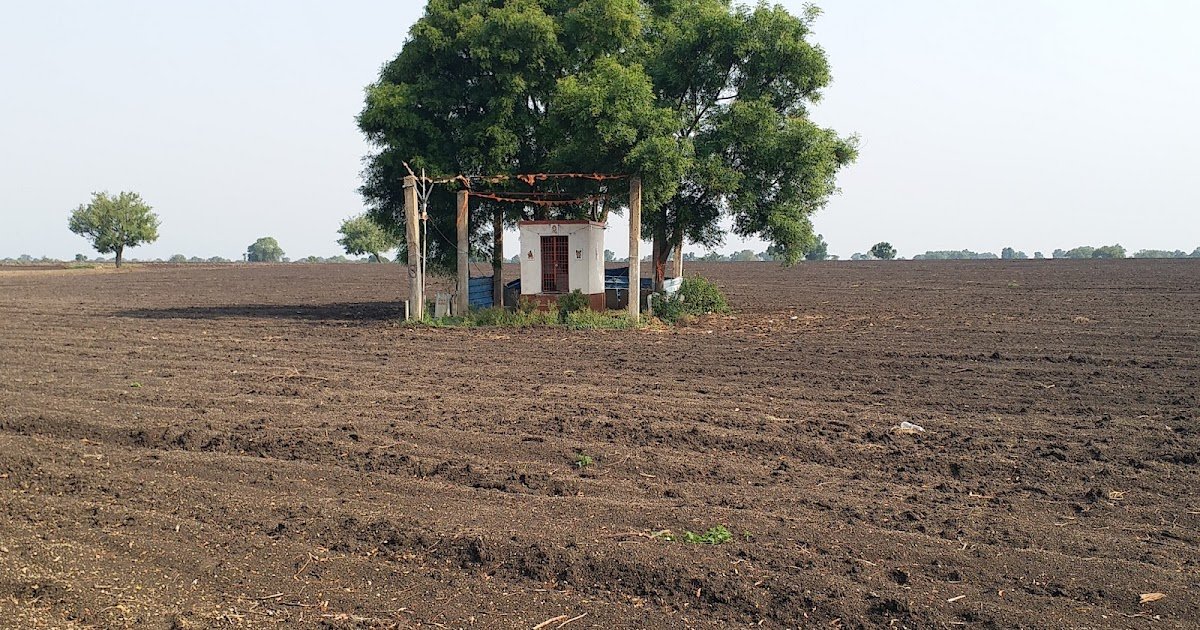
Coming back to the newest discovery, I was eager to see the shrine and came out with a plan. On Saturday May 15th morning, Pushpa and I finished our morning routine, packed breakfast and left home at 8 AM. Our destination was about 16 km away, close to Unkal village. We reached the place by 9 AM. This the sight of Yantrodhara Hanuman Gudi as seen from the road where we parked our car. As you see the place is silent except for the noise of light traffic.

It’s a single chamber structure. The two Neem trees create a nice ambiance around the shrine.

The sanctum and the deity.

And, finally a close-up view of the deity. Having seen Hampi Yantrodhara Hanuman, it was like seeing a replica here.

I was curious about this temple’s history. The only lead wad the phone number found at the site. I called the number which was answered by a person called Mallikarjun. Here’s what learned: this temple was built a few years ago by the owner of this agricultural field. The deity is said to be consecrated by a Vaishnava Swamiji from Uttara Kannada. That’s all for now. I did not press for more details since this was our first conversation. BTW, Mallikarjun is the priest who performs rituals here. In case you wish to visit this temple, you can call up the number seen in the photo above and check his availability.
………
[ad_2]
Source link

