
For decades, the U.S. dollar has occupied a position no other currency could truly challenge. It dominates international trade, global reserves, energy markets, and financial transactions. From oil contracts in the Middle East to debt markets in Asia, the dollar has been at the center of the modern global economy. But in recent years, especially with the rise of BRICS, conversations about “de-dollarization” have become impossible to ignore.
Many now see BRICS not just as an economic grouping, but as a political signal that a growing number of countries are uncomfortable with the current international system. The expansion of the bloc has added even more attention to this idea. With countries like Saudi Arabia, Iran, Egypt, Ethiopia, and the United Arab Emirates joining or aligning with BRICS initiatives, the organization suddenly appears far more ambitious than it did a decade ago. Still, there is a difference between challenging the dominance of the dollar and replacing it altogether. That distinction often gets lost in political rhetoric.

The appeal of de-dollarization is understandable. Many developing nations believe the current financial system gives too much influence to the United States and its Western allies. Institutions such as the International Monetary Fund and the World Bank continue to reflect a global balance of power shaped after World War II, even though the world economy has changed dramatically since then. Countries like China and India now play a much larger role in global growth, trade, and manufacturing than they did when these institutions were created.
The Russia-Ukraine war pushed these concerns even further. When Western countries imposed sweeping sanctions on Moscow and froze Russian foreign reserves, many governments outside Europe and North America paid close attention. Whether they supported the sanctions or not, the message was clear: countries deeply connected to the dollar-based system could become vulnerable during geopolitical conflicts. That realization has encouraged many states to look for alternatives.
China has increased efforts to promote the yuan in international trade, especially in energy deals. Russia and China now conduct a significant portion of their trade without using dollars. India has explored rupee-based settlements with some trading partners, while Gulf countries have shown growing openness to transactions involving currencies other than the dollar. These are not symbolic developments. They reflect genuine attempts by countries to reduce financial dependence on a single global power. At the same time, predictions about the “end of the dollar” are often exaggerated. The dollar’s strength is not based only on American political influence. It is also built on trust, stability, and market depth. Investors across the world continue to see U.S. financial markets as safer and more reliable than most alternatives. Even during moments of global uncertainty, money tends to flow into the dollar rather than away from it.
That reality matters. China may be the world’s second-largest economy, but the yuan still faces important limitations. Beijing maintains strict control over capital flows and financial institutions. Global investors generally prefer systems where rules are predictable and markets operate with greater transparency. A reserve currency depends not only on economic size, but also on confidence.
BRICS itself also faces internal contradictions. The group is united by a desire for greater global influence, but its members do not always share the same geopolitical priorities. India and China cooperate economically while competing strategically. Russia’s international position differs greatly from Brazil’s or South Africa’s. Some newer BRICS members continue to maintain close security and economic ties with the United States despite supporting a more multipolar world order.
This lack of unity makes it difficult for BRICS to present a fully coordinated alternative to the existing financial system. Yet dismissing the bloc entirely would also be a mistake. BRICS does not need to overthrow the dollar to reshape global politics. Even a gradual reduction in dollar dependence could have long-term consequences. More countries are already trading in local currencies, building alternative payment systems, and diversifying reserves through gold purchases and regional agreements. The international financial system may not be heading toward a sudden revolution, but it is clearly evolving. What seems more likely is a future where the dollar remains dominant while other currencies gain stronger regional roles. Instead of one uncontested financial center, the world could move toward a more fragmented but multipolar structure. Such a system would not necessarily eliminate American influence, but it could reduce Washington’s ability to use financial pressure as effectively as it has in the past.
Whether that would create a fairer system is still uncertain. Supporters of de-dollarization argue that a more balanced global economy would give developing nations greater independence and reduce excessive concentration of power. Critics worry that competing financial blocs could increase instability and deepen geopolitical divisions. In many ways, both arguments contain truth.
The current system has provided decades of relative stability for international trade and investment, but it has also left many countries feeling excluded from major economic decisions. BRICS has gained attention largely because it speaks to that frustration. Ultimately, the debate surrounding BRICS and de-dollarization is about more than currency. It is about who shapes the rules of the international order in the coming decades. The United States still holds enormous financial advantages, and the dollar is unlikely to disappear from global dominance anytime soon. But the growing push for alternatives suggests that many countries no longer want a system where economic power is concentrated in one place alone.
The world is not witnessing the collapse of the dollar. What it may be witnessing instead is the slow emergence of a more contested and multipolar economic era.
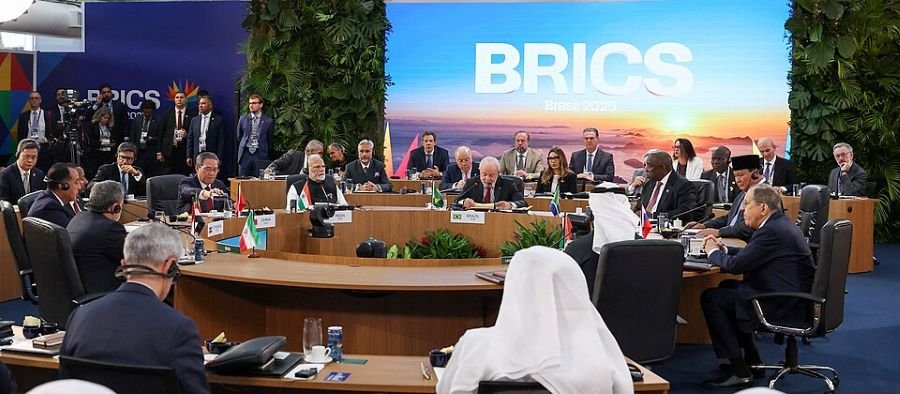
[Photo by Prime Minister’s Office (GODL-India), GODL-India, via Wikimedia Commons]
Dr. Shamuratov Shovkat is a researcher in international trade and economics at Jiangxi Fenglin College of Economy and Trade in Jiujiang, China. The views and opinions expressed in this article are those of the author.


