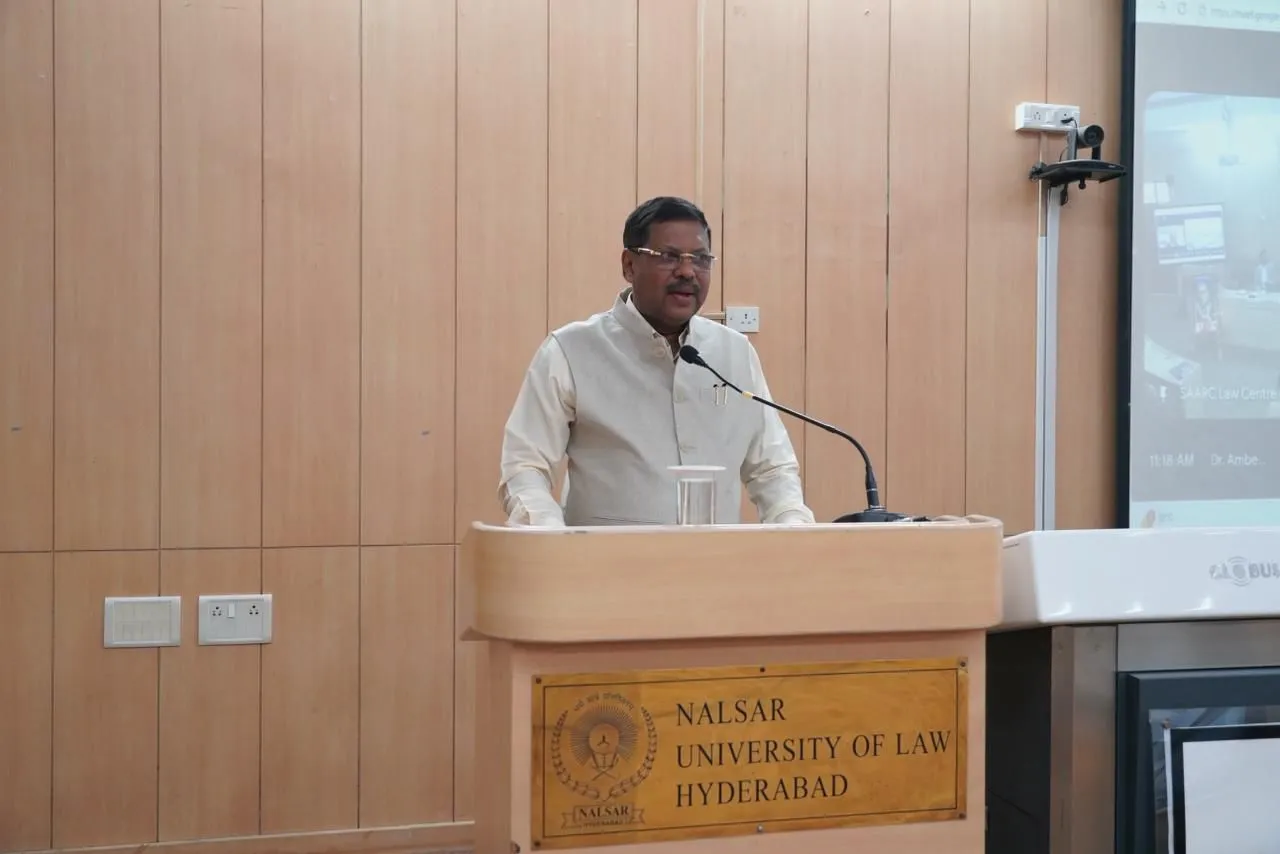


Former Chief Justice of India (CJI) BR Gavai has called for a reimagining of governance that recognises unequal starting points and corrects historical disadvantage, observing that a model of development perpetuating inequality cannot be regarded as sustainable.
Delivering the inaugural Dr Ambedkar Memorial Lecture at NALSAR University of Law in Hyderabad, Justice Gavai described sustainable development as a constitutional principle grounded in social justice, emphasising that governance frameworks must actively reduce vulnerability and redistribute access to resources and opportunities.
The lecture, organised under the aegis of the university’s Dr BR Ambedkar Chair on Constitutional Law and Social Inclusion, marked Justice Gavai’s first visit to the institution after accepting the position of Chair Professor in December 2025. During the visit, he also inaugurated the office space designated for the functioning of the Ambedkar Chair, formally operationalising the institutional infrastructure established to support its academic and research activities.

In his lecture titled ‘Sustainable Development and Substantive Equality: A Constitutional Dialogue,’ Justice Gavai examined whether development could truly be sustainable if it failed to incorporate substantive equality and whether the constitutional promise of equality could be realised without addressing material and structural inequalities.
Referring to Dr Ambedkar’s constitutional vision, Justice Gavai said the Constitution did not conceive of equality as merely formal guarantee, but as a substantive commitment aimed at dismantling entrenched hierarchies. Invoking Dr. Ambedkar’s warning regarding the life of contradictions, he observed that enduring social and economic inequalities continue to impede the realisation of constitutional ideals.

He further highlighted how structural inequalities shape access to resources and opportunities and noted that environmental and developmental crises disproportionately affect marginalised communities. Referring to issues such as drought, agrarian distress and extreme climate conditions, Justice Gavai said vulnerability was socially produced rather than incidental.
Justice Gavai observed that sustainable development must be understood as a constitutional principle grounded in social justice. Development could not be considered sustainable if it perpetuated inequality, and governance frameworks must actively reduce vulnerability, redistribute access and prioritise communities most at risk. According to him, this required moving beyond formally neutral policies towards frameworks that recognise unequal social starting points.
Justice Gavai also highlighted the evolving recognition of both State and corporate responsibility in ensuring environmentally and socially just development. Referring to constitutional jurisprudence, he noted that principles relating to environmental protection and sustainable development had been read into the right to life under Article 21 of the Constitution.

Speaking about the role of universities and academic institutions in translating constitutional ideals into practice. Justice Gavai observed that universities could serve as laboratories of constitutional governance by embedding substantive equality within their administrative structures. In this context, he suggested measures aimed at improving working conditions and welfare mechanisms for contractual and daily wage workers, ensuring access to basic amenities and fostering more inclusive institutional ecosystems.
NALSAR University of Law Vice-Chancellor Srikrishna Deva Rao, along with Vice-Chancellors from various universities, faculty members, students, researchers and members of the academic community attended the event.

