
[ad_1]
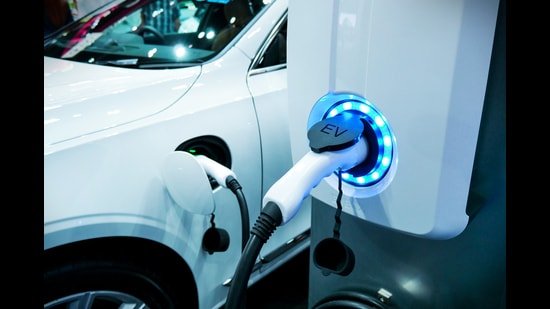
The department of town and country planning (DTCP) has proposed amendments to the Haryana Building Code 2017 to allow the installation of electric vehicle (EV) charging stations across residential and commercial real estate projects in the city and throughout the state, according to a DTCP notice issued on Monday.


The department has also proposed to allow EV charging points in basements and stilt parking areas subject to compliance with fire safety norms, the notice stated.
Officials said that stakeholders, including residents, RWAs, developers, and flat owners, can email their feedback to tcpharyana7@gmail.com by May 26.
“The number of EVs in the city is rising, which necessitates adequate EV charging infrastructure across commercial and residential projects,” a senior DTCP official said.
The notice states that all commercial buildings — including shopping complexes, malls, hotels, and office spaces with parking capacity for at least 10 cars — will be required to install at least one EV charging point for every three parking slots. The notice further stated that all these parking spaces must be EV-ready, with necessary conduits in place for future expansion.
For residential buildings, DTCP has proposed at least one charging point for every five parking slots. These buildings must also ensure EV readiness in their infrastructure.
The proposed amendments also allow for the installation of EV charging stations in basement and stilt parking areas, subject to compliance with fire safety norms.
“The electric charging spots (ECS) may be provided in basement and/or stilt floors subject to adherence to suitable fire safety norms,” stated the notice issued by DTCP director Amit Khatri.
On April 1, the Gurugram fire department refused to issue a no-objection certificate (NOC) to a premium residential society in Sector 81 because of the EV chargers in the basement, which is considered a major fire hazard. The RWA asked the flat owners to remove the EV chargers. The fire department stated in its letterto the developerthat EV charging stations in the basements were not permissible.
When asked about the matter, a senior DTCP official said that earlier there was no policy regarding the installation of EV charging stations in basements, but the proposed amendment will remove the gaps. The amendment proposes allowing charging stations in basements, provided there are adequate safeguards in line with the Haryana Building Code. A final decision will be made after receiving feedback from the stakeholders,” the official said.
Meanwhile, condominium residents have welcomed the proposed amendment, stating that there is a growing need to expand the charging infrastructure both inside and outside residential complexes.
“Our condominium has over 1,000 parking spots, and we have decided to install 150 charging stations. The number of electric vehicles is increasing rapidly, which is a positive move. Allowing EV charging in the basements will also help the residents greatly,” said Sunil Sareen, a member of Emaar Imperial Gardens RWA in Sector 102.
According to Sareen, the cost of setting up EV infrastructure in the society was estimated between ₹7 and 8 lakh for each tower — about ₹25,000 for each resident.
[ad_2]
Source link

