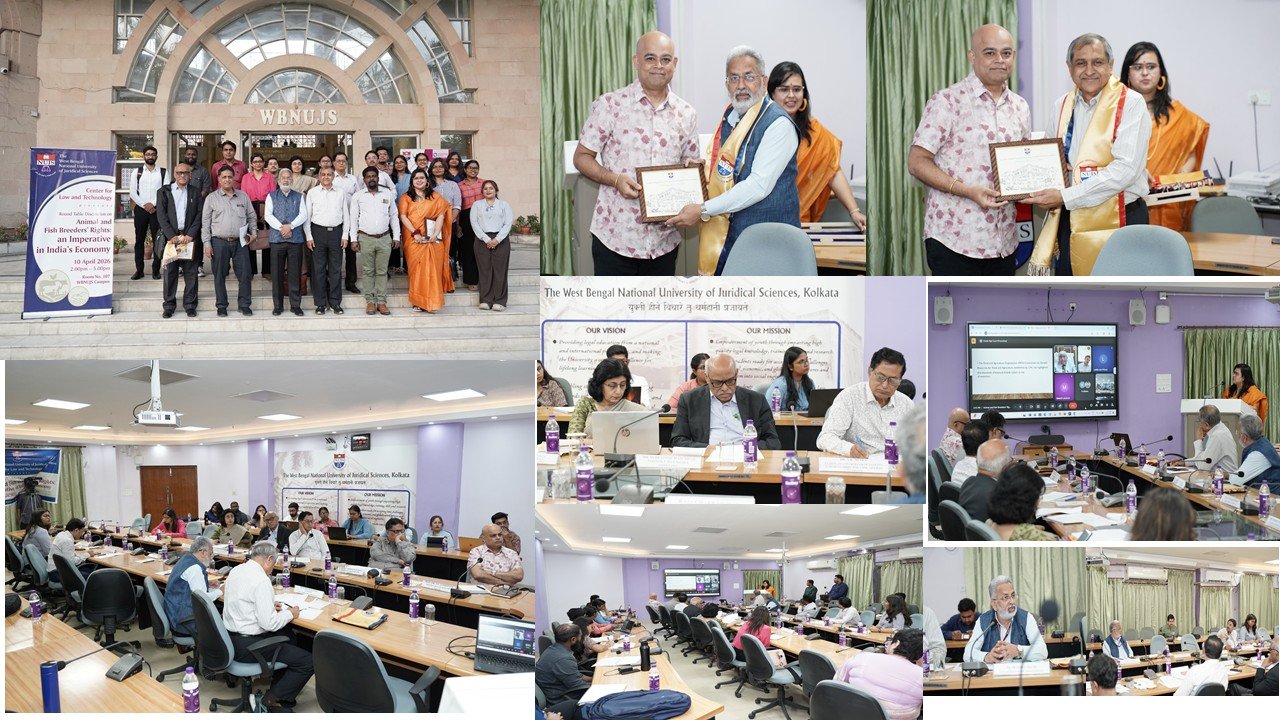

April 10th, 2026, a date that will be etched into the history of the developing intellectual property rights regime in India in relation to biological resources, as the National University of Juridical Sciences, Kolkata, had successfully organized the first session of the Roundtable Discussion on Animal and Fish Breeders’ Rights: An Imperative in India’s Economy, a discussion focused on the urgent need in India for a establishing a legal framework for protecting the human ingenuity in creating new breeds and varieties of animals and fishes, which, in the words of Prof. (Dr.) Prabuddha Ganguli, an Alexander von Humboldt Fellow, renowned IP Expert and the consultant to the World Intellectual Property Organization (WIPO), is “an event of a kind taking place for the first time in India”.
Under the guidance of Prof. (Dr.) Omprakash V. Nandimath, the Hon’ble Vice Chancellor, the National University of Juridical Sciences, Kolkata, the event was organized by Prof. (Dr.) Anirban Mazumder, Dean of Student Affairs, and was chaired by Prof. (Dr.) Prabuddha Ganguli and Dr. Praveen Malik, former Commissioner of Animal Husbandry and presently the CEO, Agrinnovate India Limited.

The event not only brought together legal luminaries such as the Hon’ble Chief Justice, Kerela High Court, Justice Soumen Sen, Mr. Subhatosh Majumdar, Partner S. Majumdar & Co. and Dr. Sanchita Ganguli, Dr, Sushil Kumar Mitra, Former Deputy Controller of Patents & Designs, Mr. Kaushik Banerjee and Ms. Dipanjana Chakrabarty Rudra, De Penning & De Penning, Mr. Himansu Kane, Partner, Kaneb & Co., Mr. Manoj Menda, Patent And Trademark Attorney Law Office of Manoj Menda, Dr. Malathi Lakshmikumaran, and Mr. Atul Kaushik, GDC Fellow, RIS, but was also adorned by scientists, experts and academicians from diverse technical fields including Dr. Hansraj Khanna, Dr. S.K. Dutta, Dr. Saket K. Niranjan, Dr. M.K. Singh, Dr. R.N. Chatterjee, Dr. Rajkumar Ullengala, Dr. Leslie Leo Prince, and Dr. Anuj Chauhan from various government departments such as the ICAR, Veterinary Sciences, Animal Husbandry, Poultry, Dairy, and Prof. (Dr.) K. D. Raju, Pro-Vice Chancellor, Kalinga Institute of Industrial Technology.
The discussion started with the keynote address by the Hon’ble Justice Soumen Sen, who observed that the rights of the livestock keepers not only demand their recognition as creators of breeds and custodians of animal genetic resources, but also the acknowledgment that conservation of ecosystems serves as a prerequisite to the sustainable use of traditional animal breeds, recognition of animal breeds as collective property rooted in indigenous knowledge and culture, participation in breeding decisions and policy making relating to animal genetic resources and establishing of a support system for capacity building and training across the entire value chain.
Referring to the international legal frameworks relating to intellectual property rights protection and biological diversity conservation, Justice Sen noted that while the Convention on Biological Diversity, 1992 and the Nagoya Protocol, 2010, dealt with the sustainable utilization of biological materials and fair and equitable benefit sharing, and the TRIPS agreement mandated the member nations to protect plant varieties through the patents regime or a sui generis system, they remained silent on protecting the breeder’s rights on developed animal and fish varieties. Similarly, the Indian legislative framework is also silent on the breeders’ rights.
While tracing the historical development of the intellectual property law jurisprudence relating to biological resources, Justice Sen referred to various landmark cases, including the famous Diamond v. Chakraborthy case before the U.S. Supreme Court, the Dimminaco case before the Hon’ble Calcutta High Court and the recent developments in this field as observed in the BTS Research International case.
Acknowledging the urgent need to protect animal genetic resources, specifically traditional breeds, and the absence of a legislative framework affording the much needed protection, Justice Sen proposed that a balanced approach must be taken and recommended enacting a dedicated Animal and Fish Breeders’ Act or ensuring protection through a sui generis system, strengthening the Digital Sequence Information (DSI) framework, extending the Traditional Knowledge Digital Library (TKDL) to animal and fish genetic resources and advocating for TRIPS reform for mandatory origin disclosure.
Acknowledging that there is a policy gap in India with respect to protecting the rights of animal and fish breeders, Prof. (Dr.) Unnat P. Pandit, the Controller General of Patents, Designs and Trade Marks, underscored the need for well-informed and interdisciplinary research in this field as a prerequisite to drafting a comprehensive and balanced legislation, carefully evaluating issues such as the genetic impact of cross-breeding, the ecological consequences, and the potential dilution of the breeds having a geographical dilution due to genetic modification.
Highlighting the vulnerability of indigenous animal germplasm to international biopiracy, Dr. Praveen Mallik emphasized upon developing a policy paper for the protection of indigenous animal varieties. He observed that although more than 200 animal breeds have been registered in India, the absence of a registration mechanism for animal varieties is a matter of concern which must be addressed. He further noted that adopting the requirements under the plant variety protection regime, particularly those of uniformity and stability, may pose significant challenges in registering animal varieties, especially the larger ones, due to the amount of time required for fulfilling the stability requirement for such animal variety, thereby creating opportunities for commercial exploitation of the germplasm by private commercial entities. In this context, Dr. Rajkumar Ullengala also proposed that a committee be formed for protecting animal germplasm.
The scientific perspective was further enriched by Dr. Saket K Niranjan, who distinguished between animal breeds and varieties, highlighting that compared to animal breeds, varieties involve a greater degree of human intervention. In this context, he mentioned that while the registration of animal breeds in India is carried out through documentation by the ICAR-NBGR, there is no system for the registration of animal varieties. Even though the ICAR is initiating the animal variety registration process, in the absence of an existing registration system for animal varieties, local varieties can potentially be protected through the People’s Biodiversity Register under the Biological Diversity Act, 2002, at the initiative of the local bodies under the State Biodiversity Boards.
In this context, it must be noted that Dr. R.N. Chatterjee observed that registration of animal varieties must be encouraged since the non-recognition of breeders’ rights over animal varieties is acting as a barrier to the formal export of Indian poultry varieties, despite significant international demand, which is detrimental for the sustenance of an industry contributing around 260 billion rupees to India’s GDP. He points out that whether this concern can be addressed by forming a committee to assess the feasibility of extending the plant variety protection to secure breeders’ rights must be evaluated, while also considering extending the scope of protection to genome-edited animal varieties.
The discussion was further enriched by Dr. Anuj Chauhan, who, citing the example of Terai Buffaloes reared by the Gujjar communities for generations, emphasized the need for protecting the rights of traditional livestock-keeping communities in India. While underscoring that farmers’ rights and breeders’ rights must go hand in hand, Dr. Chauhan advocated for a balanced legislation, protecting not only indigenous animal varieties but also genome-edited ones.
While raising the concern of benefit-sharing, Dr. Leslie Leo Prince emphasized that while livestock keepers’ rights must recognized, they must also be provided benefits under an equitable benefit-sharing mechanism. From the environmental perspective, Dr, Manoj Kumar Singh raised the concern that the ecosystem is often threatened by the use of genetically modified varieties and as such, the indiscriminate use of biotechnological tools should be carefully monitored to prevent environmental harm, while, from an economic point of view, a contrasting perspective was provided by Dr. Manoj M. Sharma, who highlighted that fish consumption in India has increased more than 5% in the last 15 years and underscored that the absence of legal protection for breeders’ innovation in the fisheries industry and the consequent disincentivizing is adversely affecting the growth of the industry and in turn, the economy itself.
Dr. Malathi Lakshmikumaran, pointed out technical challenges in extending plant intellectual property protection standards to the protection of animal varieties. She noted that while the policy paper needs to define how it intends to protect genetically edited and genetically improved breeds, it should also address the challenges of meeting the stability requirement in the context of animal variety protection, since animal genetics are predominantly heterozygous, increasing the risk of genetic variability.
The valuable insights of the legal luminaries enriched the discussion with different perspectives grounded in legal principles, judicial interpretations, and the developing jurisprudence on intellectual property rights in India. Highlighting that the real challenge lies not in farming the procedural rules, but in properly defining the substantive rights of the breeders, Mr. Himanshu Kane noted that application of novelty, distinctiveness, uniformity, and stability criteria in the context of animal varieties will require discussions and deliberations across both scientific and legal research sectors.
While Mr. Subhatosh Majumdar highlighted that the interplay between patents and plant variety protection regime must be carefully addressed in the policy paper on animal and fish breeders’ rights, Mr. Kaushik Banerjee underscored that the success of a law depends on how its objectives have been realized. Noting that while drafting the legislation, defining breeders’ rights must be carefully considered, Mr. Banerjee pointed out that there should be an internationally agreed-upon breed classification list, such as the Locarno classification, that can be revised from time to time. He also cautioned that while drafting the proposed legislation, the functions of the authorities under the existing statutes must be harmonized with the functions of any new authority to be created under the legislation. Further, while acknowledging that the welfare of the breeders should also be considered, Mr. Banerjee concurred with the opinions of the experts, including those of Prof. (Dr.) K.D. Raju and Dr S.K. Dutta, who stressed upon the fact that welfare of the animals and the prevention of abuse by the breeders’ must also be considered while framing the policy.
Observing that creating a right must not come at the expense of public access, Ms. Dipanjana Chakraborty noted that the proposed legislation governing the breeders’ rights must incorporate mechanisms such as compulsory licensing to ensure affordable public access to genetic resources. On the other hand, Mr. Atul Kaushik suggested that rather than protecting animal varieties through the intellectual property framework, which may take a significant amount of time to develop, protection may initially be extended to specific animal husbandry products to facilitate market participation by the breeders.
The multifaceted discussion was indeed a result of brainstorming across multiple research fields. Insights from both technical and legal experts highlighted the need for greater inter-disciplinary research, policy discussion, and framing of a concrete legislative framework dedicated not only to protecting animal germplasm across breeds and varieties but also underscored the need to protect breeders’ rights in their innovations, while taking into account the ecological, economic and ethical concerns relating to the monopolization of animal genetic materials.
The event concluded with the consensus that the way forward lies in developing a well-researched and balanced interdisciplinary framework by marrying the scientific and technical considerations with the legal principles, which encourages innovation while safeguarding biodiversity, protects modern breeders without jeopardizing the rights and practices of the traditional communities, and advances economic development without neglecting ethical responsibility.
[ad_1]
Source link

