



Written by: Jagdish Reddy
Sources: University Extension Programs, Horticulture Research Publications
Last Updated: April 2026
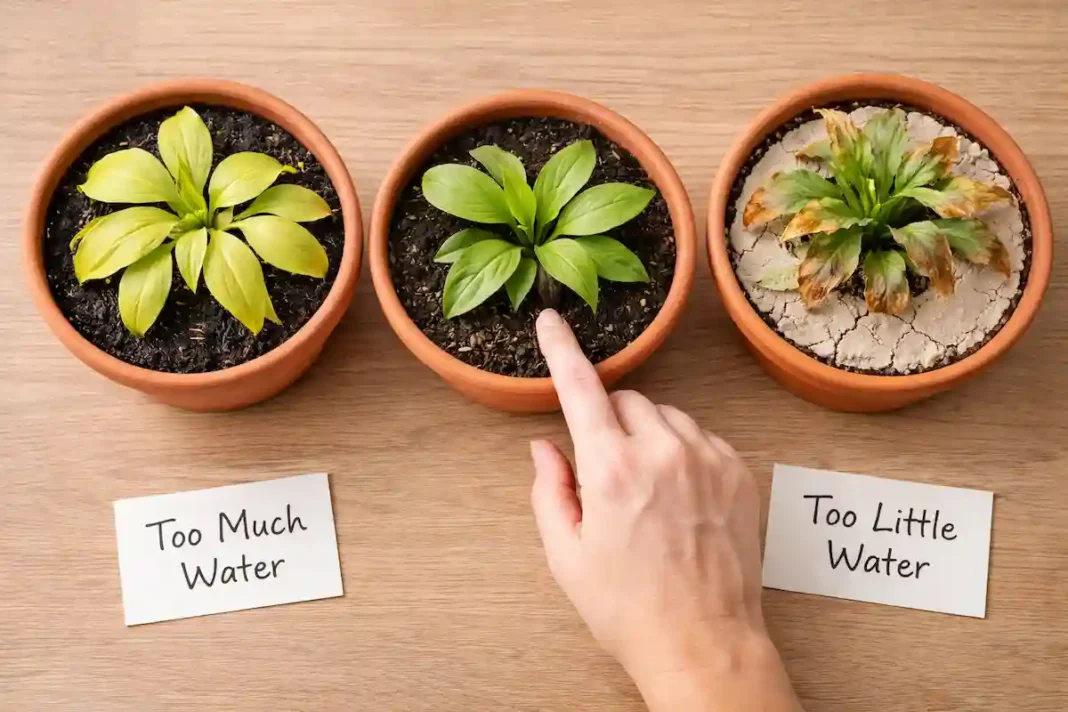
Quick Answer: Overwatered plants have soft, yellowing leaves and soggy soil, while underwatered plants show dry, crispy, or wilting leaves with bone-dry soil. The fastest way to tell the difference is the finger test: push your finger 5 cm (2 inches) into the soil — if it feels wet, hold off watering; if it feels dry, water immediately.


Most guides confuse the symptoms of overwatering and underwatering, leading gardeners to apply the wrong treatment and lose plants that could have been saved. Knowing how to read overwatered vs underwatered plant signs correctly is one of the most practical skills any grower can develop.
A wilting plant could be drowning or dying of thirst. Treating it the wrong way makes things much worse. This simple test works for houseplants, vegetables, herbs, and container gardens worldwide. Whether you grow tomatoes (Solanum lycopersicum) in a tropical greenhouse, herbs on a windowsill, or vegetables in a continental climate garden, overwatered plants symptoms and underwatered plants signs affect growers in every zone.
What You Will Learn
- How to identify overwatered plants symptoms and underwatered plants signs accurately
- How the finger test outperforms moisture meters for daily diagnosis
- What mushy stems and wet wilting really indicate
- Why leaves turn yellow in both watering extremes
- How to prevent root rot before it starts
- How to recover plants from both conditions and how long it takes
What Is the Difference Between Overwatering and Underwatering?
Overwatering means the soil stays wet for too long, cutting off oxygen from the roots. When the growing medium is constantly saturated, roots suffocate, begin to rot, and can no longer absorb water or nutrients — even though plenty of water is present.
Underwatering means the plant is not receiving enough moisture to support normal cell function. Leaves lose their turgor pressure, stems weaken, and the plant begins to shut down non-essential processes to survive. Left too long, cell damage becomes permanent.
Both conditions cause stress. Both can kill. The difference lies in the soil and the texture of the plant tissue.
Overwatered vs Underwatered Plants Symptoms (Quick Comparison)
Overwatered plants have soft, yellow leaves and wet soil, while underwatered plants have dry, crispy leaves and soil that pulls away from the pot. The easiest way to tell is the finger test: if soil 5 cm (2 inches) deep feels wet, do not water; if dry, water immediately.
| Symptom | Overwatered | Underwatered |
|---|---|---|
| Leaf colour | Yellow, pale, or dark green | Yellow, brown edges, or dull green |
| Leaf texture | Soft, limp, puffy | Dry, crispy, leathery |
| Wilting | Soft wilt — leaves collapse without drying | Hard wilt — leaves dry out as they droop |
| Soil | Wet, compacted, dark, possibly smelly | Dry, cracked, pulling away from pot edges |
| Roots | Brown, mushy, rotting | Dry, brittle, shrunken |
| Pot weight | Heavy | Noticeably light |
| Stem base | Soft, dark, may be collapsing | Firm but dry |
Signs of Overwatering: Identifying Mushy Stems and Wet Wilting
Wet wilting is one of the most misread signals in gardening. The plant droops, the gardener adds more water, and the problem accelerates. Unlike drought wilting — where leaves dry out as they droop — wet wilting produces soft, collapsed leaves that still look green or slightly dark.

Wilting is a deceptive symptom because it occurs in both extremes. In an underwatered plant, cells lose turgor pressure and collapse inward. In an overwatered plant, the roots have begun to rot and can no longer absorb water, causing the plant to wilt from thirst even while sitting in saturated soil. Always check soil texture before reaching for the watering can.
Press the stem near the base. An overwatered stem feels soft, spongy, or slippery. In severe cases it turns dark brown or black and may collapse entirely at soil level. This is the clearest sign that root rot has already set in.
From field observation, stem softness is a more reliable overwatering indicator than leaf colour alone. Yellow leaves can appear for many reasons. A soft, dark stem base combined with wet soil confirms overwatering with near certainty.
Preventing Root Rot: How to Tell if Soil Is Holding Too Much Water
Root rot develops when soil holds excess moisture long enough to deprive roots of oxygen. The first sign is not visible above ground — it starts silently in the root zone days before leaves begin to yellow or wilt.
A healthy root system should have no detectable odour and appear firm and white. If your investigation reveals a distinct sour or swamp-like smell coming from the drainage holes, it is a definitive sign of anaerobic bacteria. This occurs when oxygen is forced out of the soil by excess water, requiring an immediate repot into fresh, dry substrate to save the plant.

Press the soil surface firmly. Healthy soil springs back slightly. Waterlogged soil stays compacted and indented. Lift the pot — a pot that feels heavy days after watering is holding more moisture than the roots can use.
Adding 30% perlite to standard potting mix dramatically improves oxygen retention in the root zone. Garden trials across multiple regions confirm this single change reduces root rot incidence more than any other mix adjustment.
Getting the mix right from the start matters — see our guide on the correct soil to compost ratio for garden plants for best drainage results.
Visual Guide: Why Leaves Turn Yellow in Both Watering Extremes
Yellow leaves cause enormous confusion because they appear in both overwatered and underwatered plants. The cause is different in each case, and the texture of the leaf tells you which problem you are dealing with.

In overwatered plants, yellowing happens because root rot cuts off nutrient supply. Nitrogen (N) is the first nutrient affected, causing older lower leaves to turn uniformly yellow and soft. The leaf feels limp and may drop without fully drying out.
In underwatered plants, yellowing typically begins at the leaf edges and tips. The yellow areas quickly turn brown and crispy. The leaf feels papery and dry. Extension observations indicate this edge-first pattern almost always points to drought stress rather than overwatering.
Check the soil immediately when you see yellow leaves. Wet soil with yellow lower leaves points to overwatering. Dry soil with yellow-edged, crispy leaves points to underwatering. One check removes all the guesswork.
If yellowing leaves persist after correcting watering, check our guide on what is wrong with my plant leaves for a broader diagnosis.
The “Two-Inch Rule”: Why the Finger Test Outperforms Moisture Meters
Push your finger straight down into the soil to a depth of 5 cm (2 inches). This is the two-inch rule — simple, free, and more reliable than any tool you can buy.
- Wet or cool and damp — do not water yet
- Barely moist — check again in 24 hours
- Dry and crumbly — water immediately and deeply

While digital moisture meters offer a quick reading, they often produce false data in soils with high peat or clay content. By feeling for cool, damp particles clinging to your skin at a depth of 5 cm (2 inches), you are checking the actual availability of water to the roots — something a metal probe frequently misinterprets based on soil density alone.
Grower trials suggest meters consistently misread in very dry or very compacted soils — the exact conditions where accuracy matters most. In my experience growing vegetables across both clay and sandy soils, gardeners who switch from meter readings to daily finger testing catch watering problems earlier and lose far fewer plants.
To keep the finger test accurate throughout the week, always achieve full soil saturation during each watering session. Water should be applied until it flows freely from the drainage holes at the base of the pot. This flush reaches deep root systems and prevents the buildup of mineral salts that can mimic the appearance of leaf burn caused by underwatering.
The Recovery Timeline: How Long Until a Drowning Plant Bounces Back?
Recovery from a watering imbalance is not an overnight process. Once soil moisture is corrected, most resilient species require 14 to 21 days to stabilise. The plant will stop wilting, but any leaves that have already turned fully yellow or brown are permanently damaged and should be pruned — this allows the plant to focus energy on new, healthy growth.
Moderate root rot with 30–50% root loss typically takes 2 to 4 weeks to show visible new growth. Trim all brown, mushy roots with clean scissors, dust cut ends with cinnamon as a natural antifungal, and repot into fresh well-draining mix with added perlite.
Severe cases with near-total root loss may take 6 to 8 weeks — if they recover at all. Warm conditions above 20°C (68°F) support faster root regeneration. Move recovering plants to bright indirect light with good airflow, and do not fertilise until new root and leaf growth is clearly visible.
For underwatered plants, recovery is generally faster. Most plants showing drought stress perk up within 24 to 48 hours of deep watering. Bottom-water severely dry pots by placing them in 5 cm (2 inches) of water for 20 to 30 minutes, allowing moisture to absorb upward through capillary action.
Before buying fresh mix, find out whether reusing old potting mix is safe after treating a plant for root rot.
Can You Fix an Overwatered Plant Without Repotting?
Yes, mildly overwatered plants can recover without repotting if root rot has not started. Stop watering, improve airflow, and allow soil to dry completely. If the plant shows soft stems, sour smell, or persistent wilting, repotting is required to prevent further root damage.
In mild cases — where root rot has not yet set in — stop watering immediately and move the plant to a warm spot with good airflow. Remove it from any decorative outer pot trapping moisture underneath and allow the soil to dry out completely before watering again.
To speed drying, gently loosen the top 2–3 cm (1 inch) of soil with a stick or pencil to improve surface airflow. Avoid disturbing the root zone. In warm conditions above 22°C (72°F), a mildly overwatered plant can recover without repotting within 7 to 14 days if caught early.
If the stem base feels soft, roots smell sour, or mould has appeared on the soil surface, repotting becomes necessary. At that point, the anaerobic conditions in the existing soil will continue causing damage regardless of how long you wait. Many growers notice that attempting to save the original soil in moderate-to-severe cases simply delays recovery rather than supporting it.
How Often Should You Water Plants?
Most plants should be watered only when the top 5 cm (2 inches) of soil feels dry. In warm conditions, this may be every 3 to 7 days, while in cooler seasons it may extend to 10 to 14 days. Always check soil moisture instead of following a fixed schedule.
How often to water also depends on species, pot size, soil type, and climate. In tropical climates above 25°C (77°F), small containers may need watering every 1 to 2 days in peak summer. In temperate zones during spring or autumn, the same plant may only need water once every 7 to 10 days.
A practical volume guide: apply approximately 250 ml (1 cup / 8 fl oz) per 15 cm (6-inch) pot, scaling up for larger containers. For garden beds, target 2.5 cm (1 inch) of water per week — around 18 litres (4 gallons) per square metre — through rainfall or irrigation.
Use our plant watering calculator to get a quick watering schedule based on your plant type and pot size.
How Pot Size and Drainage Holes Affect Overwatering
Large pots and poor drainage are the leading causes of overwatering. Excess soil holds moisture longer than roots can absorb, creating oxygen-deprived conditions that lead to root rot. Always use pots with drainage holes and size them close to the root ball.
Always choose a pot only slightly larger than the current root ball — typically 2–5 cm (1–2 inches) wider. Moving up too many pot sizes at once creates chronic overwatering conditions, especially in cooler climates where evaporation is slow.
Drainage holes are essential. Without them, water accumulates at the base with nowhere to go. If a decorative pot has no drainage hole, use it as an outer sleeve only and remove standing water within 30 minutes of watering. In my experience, poor drainage at the pot base kills more plants than incorrect watering frequency ever does.
Not sure which soil to use in containers? Read our full breakdown on potting soil versus garden soil before your next repot.
Climate Zone and Watering Frequency
Tropical and subtropical regions (above 25°C / 77°F) — soil stays wet longer due to slow overnight evaporation. Always check soil before watering, not the calendar.
Temperate zones (10–20°C / 50–68°F) — seasonal variation is significant. Spring and autumn require far less water than summer. Temperate gardeners frequently overwater in spring when plants are still in low-growth mode.
Arid and semi-arid zones — underwatering risk is high in open beds. Mulching with 5–8 cm (2–3 inches) of organic material reduces evaporation significantly. Drip irrigation maintains consistent moisture effectively in these zones.
Continental climates — wide seasonal swings mean watering needs change dramatically through the year. Dormant or semi-dormant plants in cooler regions need far less water than actively growing plants.
For precise water volumes by region and crop, use our irrigation water requirement calculator before setting up any watering schedule.
3 Most Important Diagnostic Points at a Glance
- Soft leaves + wet soil = overwatered — stop watering, improve drainage, check roots
- Crispy leaves + dry soil = underwatered — water deeply using the bottom-watering method
- Wilting with wet soil = root rot in progress — act immediately, do not add more water
Common Mistakes That Make Both Problems Worse
- Watering on a fixed daily schedule regardless of soil condition
- Using pots without drainage holes
- Choosing a pot far too large for the current root system
- Assuming wilting always means the plant needs more water
- Ignoring stem texture when diagnosing — soft stems confirm overwatering
- Not checking roots when a plant fails to recover after watering changes
- Continuing summer watering schedules through winter
- Overwatering seedlings — young plants need far less water than mature plants
Key Takeaways
- The two-inch finger test is more reliable than moisture meters for daily diagnosis
- Soft yellow leaves with wet soil = overwatered; crispy yellow-edged leaves with dry soil = underwatered
- Mushy stems and a sour smell from drainage holes confirm root rot — act immediately
- Wilting occurs in both conditions — always check soil texture before watering
- Recovery takes 14 to 21 days for most plants; prune yellowed leaves to redirect energy to new growth
- Mild overwatering can sometimes be corrected without repotting if caught before root rot sets in
- Pot size and drainage holes are the most controllable root rot risk factors
- Always water by soil condition, never by schedule
Signs of Overwatering vs Underwatering Plants (Beginner Checklist)

Use this checklist before every watering decision. Tick what you observe — the column with the most matches confirms your diagnosis.
| What You See or Feel | Overwatered | Underwatered |
|---|---|---|
| Leaves feel soft and limp | ✅ | ❌ |
| Leaves feel dry or crispy | ❌ | ✅ |
| Yellowing across whole leaf | ✅ | ❌ |
| Yellowing at leaf edges only | ❌ | ✅ |
| Soil feels wet 2 inches down | ✅ | ❌ |
| Soil feels dry and crumbly | ❌ | ✅ |
| Pot feels heavy | ✅ | ❌ |
| Pot feels unusually light | ❌ | ✅ |
| Stem base feels soft or mushy | ✅ | ❌ |
| Stem base feels firm | ❌ | ✅ |
| Sour smell from drainage holes | ✅ | ❌ |
| Mould on soil surface | ✅ | ❌ |
| Soil pulling away from pot edges | ❌ | ✅ |
| Plant wilting with wet soil | ✅ | ❌ |
Grower trials suggest running through this checklist takes under one minute and eliminates the guesswork that causes most beginner watering mistakes. If you tick five or more boxes in one column, your diagnosis is reliable. Act on it immediately.
Sources
This guide is based on:
Frequently Asked Questions About Overwatered vs Underwatered Plants
1. Can a plant be both overwatered and underwatered at the same time?
Yes, and it happens more than most gardeners expect. When soil becomes hydrophobic from severe drying, water runs straight through without being absorbed — leaving roots dry even after watering. Root rot from prior overwatering can also leave a plant unable to absorb moisture even when watering returns to normal. Repotting into fresh mix and bottom-watering is the most effective recovery approach in both situations.
2. How long does it take for an overwatered plant to recover?
Most plants begin showing improvement within 7 to 14 days if treated promptly — drainage improved, damaged roots trimmed, and watering reduced. Plants with severe root rot may take 6 to 8 weeks to fully stabilise. Prune any leaves that have turned fully yellow or brown so the plant can redirect energy toward new growth. Conditions above 20°C (68°F) support faster root regeneration.
3. Does the finger test work for all plant types?
The finger test works for most houseplants, vegetables, and herbs. Succulents and cacti need to dry much more deeply — test at 7–10 cm (3–4 inches) and wait until completely dry before watering. Aquatic plants like Zantedeschia (calla lily) prefer consistently moist conditions. Adjust the test depth based on pot size and plant type.
4. Why are my plant’s leaves yellow — overwatered or underwatered?
Check the leaf texture and the soil together. Overwatered leaves feel soft and limp — yellowing spreads across the whole leaf uniformly. Underwatered leaves feel dry and papery — yellowing begins at the edges and tips before turning brown and crispy. Wet soil with soft yellow leaves confirms overwatering. Dry soil with crispy yellow edges confirms drought stress.
5. Can overwatering kill plants faster than underwatering?
In most cases, yes. Underwatered plants enter a stress state that can last days before permanent damage occurs. Overwatering triggers root rot rapidly — especially in warm conditions above 22°C (72°F) — and once the root system collapses, recovery becomes very difficult. Field observations show more houseplants are lost to overwatering than to any other single cause.
6. How do beginners avoid overwatering plants?
The simplest rule: never water by schedule — always water by soil condition. Use the finger test before every watering session. Start with a pot that has drainage holes and a well-draining mix with added perlite. In my experience working with first-time growers, switching from a fixed watering calendar to a soil-check routine eliminates most overwatering problems within the first few weeks.
7. Should I water differently in summer versus winter?
Absolutely. Summer heat and longer days accelerate evaporation and plant growth, increasing water needs significantly. In winter, most plants slow down or go dormant, and cool temperatures slow evaporation. Continuing summer watering schedules through winter is one of the most common beginner mistakes. Reduce frequency sharply in cooler months and always check soil before watering.
8. What is the best soil mix to prevent both problems?
A mix of 60% quality potting compost, 30% perlite, and 10% coarse sand works well for most container plants in temperate and tropical climates. This drains freely after watering but retains enough moisture between sessions. Avoid using pure garden soil in pots — it compacts, drains poorly, and creates chronic overwatering risk regardless of how carefully you water.
Conclusion
Getting watering right is less about following a schedule and more about reading your plants and your soil. The two-inch finger test takes seconds and gives you reliable information every time. Pair it with a check of leaf texture, stem firmness, and pot weight, and you have everything needed to diagnose any problem before it becomes serious.
Pay attention to pot size, drainage holes, and soil mix from the start. These three factors cause more overwatering problems than any other variable — and all three are easy to control.
Both overwatering and underwatering are fixable when caught early. Start with the finger test today on every plant you are unsure about. The results will often surprise you.
Note: Correct watering improves plant health significantly but works best alongside proper drainage, suitable soil mix, appropriate pot sizing, and seasonal adjustments. Results vary by climate zone, soil type, plant species, and growing conditions. Always observe your specific plants and adapt accordingly.