

By Dr Swati Jindal Garg
In the labyrinth of India’s criminal justice system, the figure of the witness occupies a sacred space. Witnesses are the backbone of criminal trials—without credible testimony, courts cannot arrive at truth. Their words form the foundation upon which justice rests.
The Supreme Court has repeatedly emphasized this centrality. In Zahira Habibullah Sheikh vs State of Gujarat (2004), the Court warned: “If the witnesses are not able to depose freely and truthfully in courts of law, it would be a mockery of the trial and justice would be a casualty.”
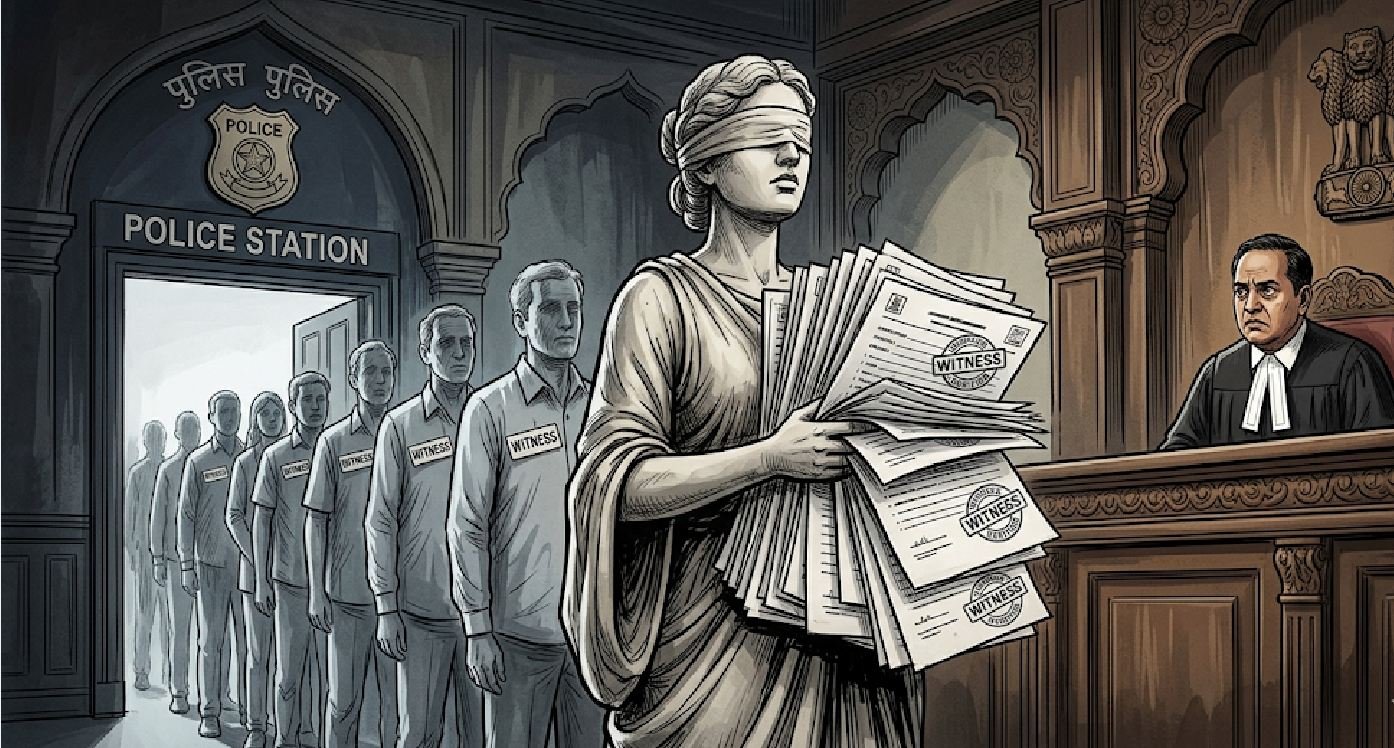
Witnesses are, in essence, the eyes and ears of justice—the bridge between crime and conviction. Yet, when these eyes are blindfolded and these ears are muffled by convenience, coercion, or bureaucratic routine, justice itself begins to falter.
In a recent order in March 2026, the Supreme Court sounded a serious alarm over the troubling practice of “stock witnesses”. By expanding a committee to examine the issue, the Court has not merely flagged a procedural irregularity, but touched the very nerve of constitutional fairness.
THE JUDICIAL ALARM
The Supreme Court bench, comprising Justices Ahsanuddin Amanullah and R Mahadevan, noted with concern that witnesses are sometimes included in FIRs and charge sheets merely “by way of a formality”. The Court observed that many such witnesses later retract their statements—not necessarily because they were threatened, but because they were never present at the scene in the first place. Their names were inserted simply to complete investigative paperwork.
The observation lays bare an uncomfortable truth: in many cases, the criminal process risks becoming a theatre where actors are selected not for their proximity to truth, but for their availability and compliance.
WHO ARE STOCK WITNESSES?
Stock witnesses are rarely accidental participants in the legal process. They are often cultivated. Police stations in some jurisdictions maintain informal lists of individuals who can be summoned when required to serve as panch witnesses, seizure witnesses, or neutral observers in investigations. These individuals appear across multiple cases—narcotics seizures one day, theft investigations the next, and occasionally even in serious crimes. Their frequent presence is not a reflection of civic responsibility. Rather, it reveals systemic shortcuts.
WHY ARE THEY USED?
The persistence of stock witnesses stems from a mix of structural pressures and practical expediency:
- Convenience: Genuine witnesses often hesitate to participate in investigations out of fear or reluctance.
- Control: Stock witnesses are predictable and dependent on police goodwill.
- Formal Compliance: FIRs and charge sheets require witness names; stock witnesses fill the procedural gap.
- Institutional Pressure: Overburdened investigating officers often prioritize speed over accuracy.
Yet, each shortcut chips away at the legitimacy of the justice system.
THE CONSTITUTIONAL QUESTION
At its core, the issue strikes at the heart of Article 21 of the Constitution, which guarantees the right to life and personal liberty—a protection that includes the right to a fair trial. Stock witnesses undermine this guarantee. Their unreliable testimonies frequently result in hostile witnesses, weakened prosecutions, and collapsed trials. The consequences ripple across the system:
- The accused, though eventually acquitted, endures years of litigation.
- The victim sees justice slip away.
- The judicial system loses public credibility.
Justice, it is often said, must not only be done, but must also be seen to be done. Stock witnesses make justice invisible.
THE COMMITTEE’S MANDATE
Recognizing the gravity of the issue, the Supreme Court constituted a seven-member committee chaired by Justice Vivek Agarwal, a sitting judge of the Madhya Pradesh High Court. The committee includes additional solicitor generals, senior advocates, and police officials. It was later expanded to include Senior Advocate Sonia Mathur and other members. Their task is clear: within one month, recommend a standard operating procedure that restores public confidence in investigation and trial processes.
This initiative is not merely administrative. It is a moral intervention aimed at restoring the integrity of criminal justice.
LESSONS FROM OTHER LEGAL SYSTEMS
Globally, criminal justice systems approach the witness question differently—often with greater emphasis on protection and credibility.
- United States—protection over substitution
The US relies heavily on witness protection rather than substitute testimony. The federal Witness Protection Program safeguards individuals through relocation and security, ensuring they testify without fear.
- United Kingdom—judicial scrutiny
British courts examine witness credibility rigorously. Hostile witnesses are not dismissed casually; judges actively evaluate reliability and motive.
- France—magistrate oversight
French investigations operate under close supervision of magistrates, limiting arbitrary inclusion of witnesses.
- China—criminalizing coercion
Chinese law explicitly criminalizes coercion or intimidation of witnesses, establishing legal consequences for misuse.
- International Criminal Court—credibility first
At the International Criminal Court, witness credibility is treated as the cornerstone of justice, supported by strong protection mechanisms. Across jurisdictions, one principle emerges clearly: justice cannot exist without truthful testimony.
THE RISKS INDIA FACES
Currently, India’s judicial system faces multiple risks, some of them being:
- Erosion of trust: Public confidence in police investigations diminishes.
- Compromised rights: Accused persons face trials based on fabricated evidence.
- Victim disillusionment: Genuine victims see justice denied.
- Judicial burden: Courts grapple with hostile witnesses and collapsed prosecutions.
Global lessons suggest that countries prioritizing protection and credibility achieve stronger justice outcomes. India must balance resource constraints with the need for systemic reform.
At present, the Indian Judiciary stands at a crossroad. The Supreme Court’s committee is more than an administrative body; it is a moral intervention. By learning from global practices—protection, scrutiny, oversight, and criminalization of misuse—India can move from a culture of convenience to a culture of credibility.
—The author is an Advocate-on-Record practising in the Supreme Court, Delhi High Court and all district courts and tribunals in Delhi

