
[ad_1]
In a world often defined by religious silos, a quiet corner of Kolkata offers a masterclass in interfaith harmony. Author and content creator Sam Dalrymple spotlighted the city’s historic synagogues — grand monuments to a once-thriving Baghdadi Jewish community — which are today lovingly preserved by local Muslim caretakers. Also read | India’s smallest Jewish community resumes prayers at Kolkata’s synagogue


Sam’s documentation in his April 10 Instagram post, titled, ‘the Indian synagogues run by Muslims’, served as a poignant reminder of a shared past. Speaking about the synagogues of Kolkata (earlier Calcutta), he wrote in his caption, “There has perhaps never been a more important moment to remember the sacred spaces shared peacefully by both Muslims and Jews.“
He shared that at its peak in the 19th century, Kolkata was home to over 5,000 Jews, serving as the ‘pivot of one of the most consequential trading networks in Asia’, connecting merchant families from Rangoon to Shanghai. Today, while only 17 Jews remain, their sacred spaces endure through the dedication of the city’s Muslim community, Sam added.
Architectural alchemy: inside the synagogues
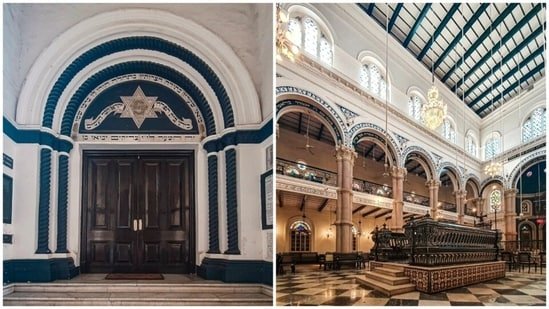
The photographs shared by Sam reveal an architectural style that is quintessentially Baghdadi-Calcutta — a fusion of Middle Eastern liturgy, Victorian colonial grandeur, and local Indian craftsmanship. Synagogues like Maghen David and Beth El in Kolkata resemble grand European cathedrals from the outside, with red-brick facades and towering spires.
Internally, the decor shifts toward a high-Victorian elegance: a marble plaque in Beth El credits Elias Shalome Gubbay with replacing ‘heavy pillars’ with ‘elegant iron columns’. These slim, teal-and-gold painted pillars allowed for massive, light-filled halls. The floors are almost universally laid with black-and-white marble checkerboard tiles, a classic colonial touch that provides a sharp, geometric contrast to the ornate ceiling work.
Symbols of faith and trade
The celestial decor tells the story of a community that was as global as it was devout: the Hekhal (Ark) is often housed in a semi-circular apse painted a deep, midnight blue and speckled with gold stars to represent the heavens. Perhaps one of the most striking decorative elements in the photos Sam shared is the presence of a large, yellow-glazed Chinese ceramic jar. This is not merely an ornament; it is physical evidence of the vast trading empire of the Baghdadi Jews, which stretched across the South China Sea.
Archways are adorned with intricate Hebrew inscriptions. One prominent entrance features a Star of David centred within a rope-style moulding. To manage the stifling heat in Kolkata, the synagogues incorporated practical Indian elements into their sacred decor. Massive old-fashioned electric ceiling fans hang on long rods from the high timber-beamed ceilings, and planter style wooden benches with woven cane seats offer breathable seating for the congregation.
A legacy paved in jewels
In his post, Sam highlighted that the community’s history is as glittering as the decor of these synagogues in Kolkata. It began with Shalom Obadiah Cohen, an Aleppo-born jeweler who arrived in 1798, Sam shared in his post. Cohen was so esteemed that he served as the court jeweller for the Nawabs of Lucknow and, according to local tradition, was once asked to value the legendary Koh-i-Noor diamond, he added.
While the opium and indigo trade that built these grand halls has long since faded, the survival of these buildings is a testament to a unique social contract, Sam said. As he noted, it says everything about the character of the city that when the Jewish community dwindled, it was their Muslim neighbours who stepped in to ensure the ‘sacred spaces’ remained standing.
“The city’s subsequent Jewish network, built on opium and indigo, helped shape the modern map of Asia and although there are only 17 Jews left in the city today, I think it says something that it was the local Muslim community who opted to care for the city’s synagogues after the Jewish community left,” Sam concluded in his caption.
Note to readers: This report is based on user-generated content from social media. HT.com has not independently verified the claims and does not endorse them.
This article is for informational purposes only.
[ad_2]
Source link

