
[ad_1]
Written by: AgriFarming Editorial Team
Reviewed by: Horticulture Editors
Topic: Vegetable Garden Layout Planning
Last updated: April 2026


Planning a vegetable garden sounds simple until you’re staring at an empty patch of ground with a handful of seeds and no clear picture of how it all fits together. Tomatoes need room to sprawl. Carrots demand loose, deep soil. Squash will swallow a bed whole if you give it half a chance.
A thoughtful layout makes the difference between a garden that produces abundantly and one that turns into a tangled mess by midsummer. This guide walks you through every decision — from bed size and orientation to exact plant spacing and companion combinations — so you can plan with confidence before you put a single seed in the ground.
Whether you’re growing in a compact urban balcony, a suburban backyard, or a rural plot, the principles here apply to gardens everywhere.
A well-planned vegetable garden layout improves yields, reduces pest problems, and makes maintenance easier throughout the growing season.
Why Layout Planning Matters Before You Plant
Most gardening problems trace back to poor planning, not poor soil or bad weather. Plants placed too close together compete for nutrients and light, creating the damp, crowded conditions that invite disease. Beds oriented the wrong way cast shade over shorter crops. Paths that are too narrow make harvesting a struggle.
Planning on paper — or better yet, in a digital garden planner — lets you catch these problems before they cost you a growing season. You can experiment with arrangements, test plant combinations, and calculate exactly how many plants fit in your available space without spending a cent.
The goal is a layout that works with your space’s natural conditions: sunlight direction, prevailing winds, water access, and the crops that actually suit your climate. A good vegetable garden design balances spacing, sunlight and access — get those three right and most other problems take care of themselves.
Step 1: Understand Your Space Before Anything Else

Before drawing a single line, observe your garden area for a few days. Notice where the sun hits longest. Most vegetables need at least 6 full hours of direct sunlight daily — fruiting crops like tomatoes, peppers, and cucumbers need even more. Leafy greens and root vegetables tolerate light shade better than most.
Mark any permanent obstacles: trees, fences, walls, or structures that cast shade or block air movement. These will define where your beds go and which crops make sense in each zone.
Also note water access. You want beds within easy reach of a tap or rain barrel. Carrying water long distances gets old quickly, and inconsistent watering is one of the most common causes of poor yields.
Sunlight and Bed Orientation
Orient your beds so the long axis runs north to south. This ensures all plants receive even sun exposure throughout the day rather than having one side permanently shaded. Place your tallest crops — climbing beans, staked tomatoes, sweetcorn, sunflowers — at the northern end of the bed (or the southern end if you’re gardening in the southern hemisphere) so they don’t block light for shorter plants.
Step 2: Choose the Right Bed Style for Your Situation

There is no single “best” bed type. Each style suits different conditions, budgets, and gardening goals.
Raised Beds
Raised beds are the most popular option for home vegetable gardeners worldwide for good reason. You control the soil completely, drainage is excellent, and the defined borders make spacing and layout planning straightforward. They warm up faster in spring and are easier on your back.
The standard raised bed size is 1.2 m wide x 2.4 m long (4 ft x 8 ft). The 1.2 m width is deliberate — it lets you reach the center from either side without ever stepping into the bed, which protects your soil structure. Length is flexible; adjust it to fit your space.
Depth matters too. Most vegetables need at least 30 cm (12 in) of soil depth. Deep-rooted crops like carrots, parsnips, and beetroot do better with 40-45 cm (16-18 in).
Before filling your raised bed, use this raised bed soil calculator to work out exactly how much soil, compost and material you need.
In-Ground Row Planting
Traditional row planting suits larger plots where you have room to work between rows with a hoe or small tiller. Rows typically run across the slope to minimize erosion. This method works well for crops grown in quantity — potatoes, sweetcorn, onions, garlic — where you’re harvesting bulk rather than variety.
Standard row spacing: leave 45-90 cm (18-36 in) between rows depending on crop size. This feels like wasted space, but it’s necessary for air circulation and tool access.
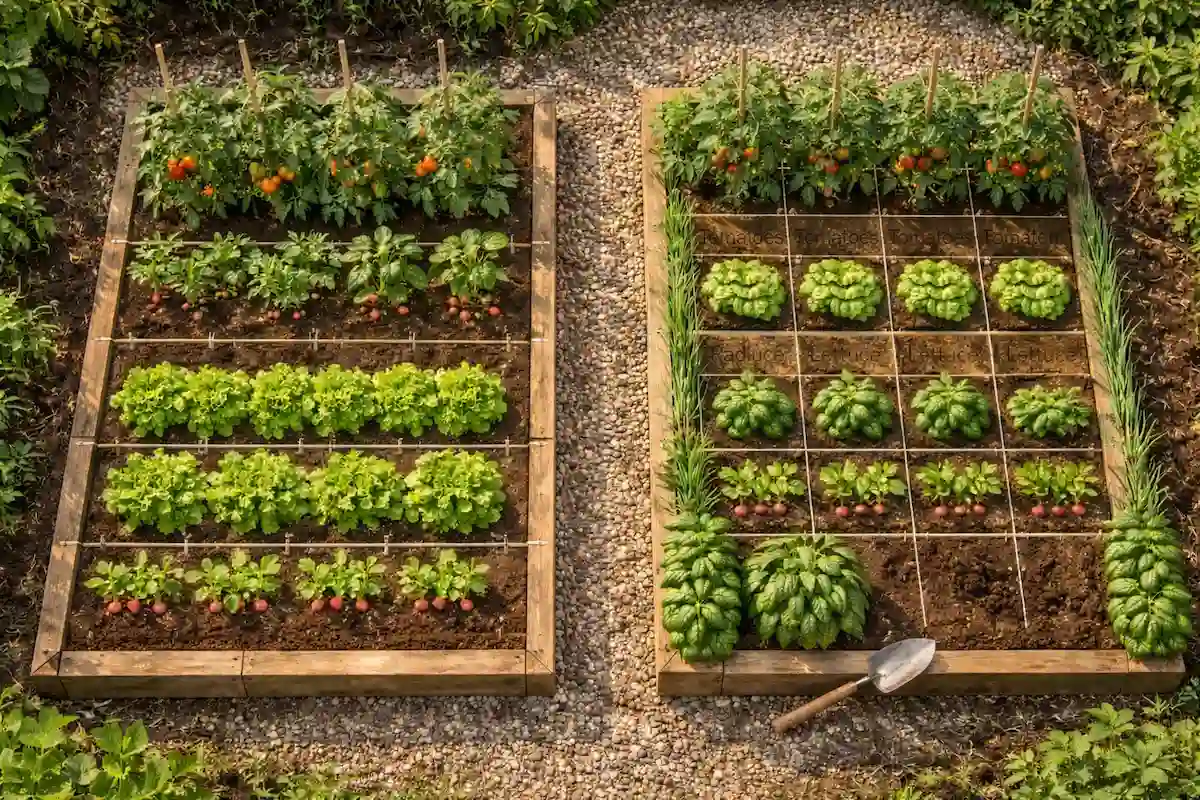
Developed to maximize yield in small spaces, square foot gardening divides a bed into a grid of 30 cm x 30 cm (1 ft x 1 ft) squares. Each square holds a set number of plants based on their spacing requirements. One tomato plant per square. Sixteen carrots per square. Nine spinach plants per square.
This method is highly efficient and easy to manage, making it one of the best approaches for beginners and urban gardeners with limited space.
Container and Balcony Gardens
No ground? No problem. Many vegetables thrive in containers. The key is matching container depth to root depth and grouping containers so watering is manageable. Tomatoes, peppers, herbs, lettuce, radishes, and dwarf beans all perform well in pots.
Step 3: Vegetable Garden Plant Spacing Guide

Overcrowding is the single most common mistake in home vegetable gardens. This is where most new gardeners go wrong — and many discover it only after their first crowded, low-yielding season. Plants need space not just to grow, but to allow air circulation that prevents fungal disease, and root space to access water and nutrients without competition.
Below are practical spacing guidelines for the most common vegetable categories, given in both metric and imperial measurements.
Leafy Greens
| Crop | Spacing (metric) | Spacing (imperial) | Plants per sq ft (sq foot grid) |
|---|---|---|---|
| Lettuce | 20-25 cm apart | 8-10 in apart | 4 |
| Spinach | 15 cm apart | 6 in apart | 9 |
| Kale / Silverbeet | 45-60 cm apart | 18-24 in apart | 1 |
| Asian greens (bok choy) | 20 cm apart | 8 in apart | 4 |
| Arugula / Rocket | 10-15 cm apart | 4-6 in apart | 9 |
Root Vegetables
| Crop | Spacing (metric) | Spacing (imperial) | Plants per sq ft |
|---|---|---|---|
| Carrots | 5-8 cm apart | 2-3 in apart | 16 |
| Beetroot / Beets | 10 cm apart | 4 in apart | 9 |
| Radishes | 5-8 cm apart | 2-3 in apart | 16 |
| Turnips / Swede | 15-20 cm apart | 6-8 in apart | 4-9 |
| Potatoes | 30-35 cm apart, rows 75 cm | 12-14 in apart, rows 30 in | 1 (large container) |
Fruiting Vegetables
| Crop | Spacing (metric) | Spacing (imperial) | Notes |
|---|---|---|---|
| Tomatoes (indeterminate) | 60-90 cm apart | 24-36 in apart | Needs staking or cage |
| Tomatoes (determinate/bush) | 45-60 cm apart | 18-24 in apart | More compact habit |
| Peppers / Capsicum / Chillies | 45-60 cm apart | 18-24 in apart | Benefits from wind shelter |
| Aubergine / Eggplant / Brinjal | 60-75 cm apart | 24-30 in apart | Needs warmth and full sun |
| Cucumbers | 30-45 cm apart | 12-18 in apart | Trellis to save space |
| Zucchini / Courgette | 60-90 cm apart | 24-36 in apart | One plant feeds a family |
| Pumpkin / Winter squash | 90-120 cm apart | 36-48 in apart | Needs significant space |
Legumes and Climbers
| Crop | Spacing (metric) | Spacing (imperial) | Notes |
|---|---|---|---|
| Climbing beans / Runner beans | 15-20 cm apart | 6-8 in apart | Needs trellis or cane support |
| Dwarf / Bush beans | 10-15 cm apart | 4-6 in apart | No support needed |
| Peas | 5-8 cm apart | 2-3 in apart | Trellis or netting support |
| Broad beans / Fava beans | 20-25 cm apart | 8-10 in apart | Stake in exposed locations |
Alliums and Brassicas
| Crop | Spacing (metric) | Spacing (imperial) |
|---|---|---|
| Onions | 10 cm apart, rows 30 cm | 4 in apart, rows 12 in |
| Garlic | 10-15 cm apart | 4-6 in apart |
| Leeks | 15 cm apart | 6 in apart |
| Cabbage | 45-60 cm apart | 18-24 in apart |
| Broccoli / Cauliflower | 45-60 cm apart | 18-24 in apart |
| Brussels sprouts | 60-75 cm apart | 24-30 in apart |
Quick rule of thumb: When in doubt, check your seed packet. Variety matters — a dwarf tomato and a beefsteak tomato need very different spacing even though they’re the same species. These spacing ranges match common seed packet recommendations from suppliers worldwide. You only make the overcrowding mistake once.
Once spacing is confirmed, our seed rate calculator helps estimate exactly how many seeds you need for your planned bed area.
Use our plant population calculator to find exactly how many plants fit your bed dimensions before buying seeds.
Spacing recommendations in this guide are consistent with RHS vegetable spacing guidelines, a reliable reference for home gardeners worldwide.
Step 4: Group Plants Strategically
Random placement wastes space and creates maintenance headaches. Grouping plants by shared needs makes your garden easier to water, feed, and manage.
Group by Water Needs
Thirsty crops — cucumbers, celery, lettuce, coriander — should be grouped together so you’re not overwatering drought-tolerant neighbours like rosemary, thyme, or established garlic. This is especially important in gardens using drip irrigation or soaker hoses, where you’re setting water zones rather than hand-watering individual plants.
Our plant watering calculator helps estimate water requirements before setting up your irrigation zones.
Group by Height
A practical height hierarchy for a north-south oriented bed (adjust if you’re in the southern hemisphere):
- North end (tallest): Staked tomatoes, climbing beans on trellis, sweetcorn, sunflowers
- Middle zone: Peppers, aubergine, bush beans, kale, broccoli
- South end (shortest): Lettuce, herbs, radishes, spring onions, low-growing strawberries
Succession Planting in the Same Bed
Plan for the full growing season, not just the first harvest. Fast-maturing crops like radishes (3-4 weeks), salad leaves (4-6 weeks), and spring onions (8 weeks) can fill gaps between slower crops. When your early peas finish in summer, that space can immediately be replanted with autumn brassicas or a second sowing of beans.
Track this in your garden planner so you’re not left with empty beds and no seedlings ready to fill them.
Step 5: Companion Planting — What to Grow Together (and What to Keep Apart)
Companion planting is the practice of growing certain plants near each other because they genuinely benefit one another — through pest deterrence, improved pollination, nitrogen fixation, or soil improvement. Some combinations, on the other hand, actively suppress each other’s growth.

Proven Beneficial Combinations
- Tomatoes + Basil: Basil is widely reported to repel aphids and whitefly while improving flavour. A classic pairing in gardens across Europe, Asia, and the Americas.
- Beans + Sweetcorn + Squash (The Three Sisters): A traditional polyculture method. Beans fix nitrogen into the soil, sweetcorn provides a climbing pole, and squash covers the ground to suppress weeds and retain moisture. Grows well in warm to tropical climates worldwide.
- Carrots + Onions / Leeks: The strong scent of alliums deters carrot fly, while carrots are said to deter onion fly. Interplanting them in alternating rows is a simple, low-cost pest management strategy.
- Brassicas + Nasturtiums: Nasturtiums act as a trap crop, attracting aphids away from cabbage and broccoli. Easy to grow, edible, and effective.
- Cucumbers + Dill: Dill attracts beneficial insects that prey on cucumber beetles and aphids.
- Lettuce + Tall crops (tomatoes, sweetcorn): Lettuce bolts in intense heat. Planting it in the partial shade of taller neighbours extends the harvest window in hot climates.
Combinations to Avoid
- Tomatoes + Fennel: Fennel is allelopathic — it releases chemicals that inhibit the growth of most vegetables, especially tomatoes. Keep fennel in its own container or at the far edge of the garden.
- Onions + Beans / Peas: Alliums suppress the growth of legumes. Keep these families separated.
- Brassicas + Strawberries: Both are said to inhibit each other when grown in close proximity.
- Potatoes + Tomatoes: Both are in the Solanaceae family and share diseases, particularly blight. Planting them together concentrates risk; keep them on opposite ends of the garden.
Step 6: Plan Your Pathways and Access
Paths are not wasted space — they’re how your garden functions. Adequate access lets you harvest, prune, weed, and water without compacting your growing beds.
Minimum pathway width: 60 cm (2 ft) for walking. If you use a wheelbarrow regularly, allow 75-90 cm (30-36 in). Main central paths in larger gardens should be at least 90 cm (3 ft) wide.
Surface options vary by climate and preference — compacted gravel, wood chip mulch, stepping stones, brick pavers, or mown grass all work. In wet climates, a stable surface prevents the path from turning to mud during harvest when you need it most.
Drawing your garden layout by hand works, but a digital planner saves time and prevents mistakes. A good garden planner tool lets you:
- Enter your bed dimensions and see exactly how many plants fit
- View spacing requirements for each crop automatically
- Try different arrangements before committing
- Plan succession plantings across the season
- Save and revisit your layout year after year
The Garden Planner Tool is free to use and covers 78 crops — vegetables, herbs, and fruits — with accurate spacing data built in. This vegetable garden layout planner helps you organize beds efficiently, with crop-specific spacing built in so you’re never guessing. You can lock the tool to a specific plant to plan a single bed, or browse the full crop library to design an entire kitchen garden from scratch.
Once you’ve mapped your beds, print or save the layout and keep it in the garden. Referring back to it during the season helps with succession planning, crop rotation notes, and troubleshooting.
Crop Rotation: Why Your Layout Should Change Each Year
Planting the same crops in the same beds year after year depletes specific nutrients and allows soil-borne diseases and pests to build up. Crop rotation is the simple practice of moving plant families around your beds on a seasonal or annual cycle.
A basic four-bed rotation:
- Bed 1 — Legumes (beans, peas): Fix nitrogen into the soil
- Bed 2 — Brassicas (cabbage, broccoli, kale): Follow legumes to use the fixed nitrogen
- Bed 3 — Root vegetables (carrots, beetroot, parsnips): Prefer lower-nitrogen soils
- Bed 4 — Fruiting crops (tomatoes, peppers, squash): Heavy feeders that benefit from compost addition
Each year, shift everything one bed clockwise. This simple system prevents clubroot in brassicas, carrot fly build-up, and tomato blight from taking hold in the soil.
When you plan your garden layout, number your beds and note which family is growing in each. Your planner becomes your rotation record as well.
Common Layout Mistakes and How to Avoid Them
Planting too much of one thing. Three zucchini plants will produce more than most families can eat. One or two is usually plenty. Most gardeners try to plant too much in year one — it feels like more is better until you’re overwhelmed with courgettes in August. Diversify the space with more crop types instead. Many first-time growers also underestimate how large squash plants become; that “small” pumpkin seedling will cover a square metre of bed within six weeks.
Ignoring vertical space. Climbing crops — beans, cucumbers, peas — grown on a trellis yield the same amount in a fraction of the ground area. A single vertical trellis running along the back of a bed doubles your effective growing space.
No plan for tall plants shading short ones. Always map heights before planting. A row of sweetcorn on the south side of your bed will cast full shade over everything behind it for half the day.
Pathways too narrow to use comfortably. You’ll avoid harvesting from beds you can’t easily reach, and plants get damaged when you squeeze past them. Build the paths you actually need, not the smallest you can get away with.
Forgetting to plan for support structures. Tomato cages, bean poles, and cucumber trellises need to go into the ground before or at planting time, not after the plants are already established. Mark these on your layout plan.
Vegetable Garden Layout Example (Beginner 4 x 8 ft Bed)
Here is a practical example of how a single 1.2 m x 2.4 m (4 x 8 ft) raised bed can be planted for a beginner using the square-foot grid method. This layout balances variety, productivity, and ease of care — everything a first-time vegetable gardener needs from one bed.
The bed is divided into 32 squares of 30 cm x 30 cm (1 ft x 1 ft). Here is one sensible arrangement:
| Zone | Crop | Squares Used | Plants per Square |
|---|---|---|---|
| North end (back) | Staked tomatoes | 2 | 1 per square |
| North end (back) | Climbing beans on trellis | 4 | 8 per square |
| Middle | Peppers / capsicum | 4 | 1 per square |
| Middle | Carrots | 4 | 16 per square |
| Middle | Spinach | 4 | 9 per square |
| South end (front) | Lettuce | 4 | 4 per square |
| South end (front) | Radishes | 4 | 16 per square |
| South end (front) | Basil (companion for tomatoes) | 2 | 4 per square |
| Edge strip | Spring onions | 4 | 9 per square |

This single bed gives you salad greens, a root crop, a fruiting crop, a climbing crop, herbs, and a quick-maturing filler (radishes) that will free up space for a second planting within 4 weeks. It is a realistic, productive starting point for any gardener regardless of climate.
For a second beginner bed, focus on brassicas and root vegetables — cabbage, broccoli, beetroot, and turnips — and rotate it with this bed the following season.
Experienced gardeners often sketch their layouts before the season starts to avoid spacing problems later. Even a rough pencil drawing on paper catches most placement errors before they happen in the ground.
Frequently Asked Questions About Vegetable Garden Layout
1. What is a vegetable garden layout?
A vegetable garden layout is the planned arrangement of beds, crops, spacing and pathways designed to maximise sunlight, airflow and productivity. A good layout accounts for plant height, water needs, companion planting, and access for maintenance and harvesting.
2. What is the best layout for a vegetable garden?
The best layout depends on your space. For small gardens, a 1.2 m x 2.4 m (4 x 8 ft) raised bed using square-foot planting is the most efficient option. For larger plots, a row layout with defined paths works well. Orient beds north-to-south so taller plants don’t shade shorter ones, and always leave adequate walkway space between beds.
3. How do I plan a vegetable garden for beginners?
Start with one or two small raised beds rather than a large plot. Choose 5-8 crops you regularly eat. Group plants by height and water needs. Leave at least 60 cm (2 ft) of walking space between beds. Use a free garden planner to map your layout before you dig or sow anything.
4. How far apart should vegetables be planted?
Spacing varies significantly by crop type. Leafy greens need 15-25 cm (6-10 in), root vegetables like carrots need 5-10 cm (2-4 in), tomatoes need 45-90 cm (18-36 in), and large spreading crops like squash need 90-120 cm (36-48 in). Always check the seed packet for the specific variety you’re growing, as spacing can differ even within the same species.
5. What size should a raised vegetable bed be?
The standard raised bed is 1.2 m (4 ft) wide so you can reach the centre from either side without stepping in. Length is flexible — 2.4 m (8 ft) is common but adapt to your available space. Depth should be at least 30 cm (12 in) for most vegetables, and 40-45 cm (16-18 in) for deep-rooted crops like carrots and parsnips.
6. Can I use a free tool to plan my vegetable garden layout?
Yes. The Garden Planner Tool is free and supports 78 crops. Enter your bed size, select your crops, and it generates a spacing-accurate planting layout. You can use the shortcode version to focus on one specific plant or explore the full library to plan a complete kitchen garden.
7. How many vegetables can I grow in a 4 x 8 ft raised bed?
Using square-foot planting, a 1.2 m x 2.4 m (4 x 8 ft) bed holds 32 grid squares. You might fit 1 tomato plant, 2 peppers, 4 lettuce, 16 carrots, 9 spinach plants, and a strip of herbs in the same bed — a productive variety harvest from a compact space. The exact number depends entirely on which crops you choose and their individual spacing requirements.
Final Thought
Planning your vegetable garden layout before planting is one of the easiest ways to avoid mistakes and grow a healthier, more productive garden.
This guide reflects practical vegetable garden planning methods commonly used by home gardeners worldwide.
[ad_2]
Source link

