
[ad_1]
INTRODUCTION

Pakistan, the Islamic Republic of Pakistan is a non-secular country before it was a secular state. After the adoption of the constitution in 1956, it became an Islamic republic with Islam as its state religion.
Pakistan contains the religious majority of Shia, Ismaili, and Bohra communities and Christians, Hindus, Ahmadis, scheduled castes and others are officially and constitutionally recognized as religious minorities.
Discrimination, forced conversion, forced marriage, and violence against minorities take place commonly in Pakistan. There is a mention of the protection of the rights of religious minorities and the eradication of violence against them in Pakistan but in reality, communal violence and attack over religious matters can be seen daily. As we know that what is mentioned on paper can’t be preached directly.
DO THE RIGHTS OF MINORITIES ARE PROTECTED IN PAKISTAN?
The constitution of Pakistan provides equal status and rights to all citizens without any caste, race, religion, colour or creed. Article 20 to 25 of the constitution of Pakistan deals with the fundamental rights of every citizen in which article 25[1] says equality for all.
Article 5 also describes the adequate provisions to freely Profess and Practice Religion but the paperwork in reality doesn’t work. Minorities are facing many issues within the country. Forced conversion, rape and forced marriages of Hindu women have recently become controversial in Pakistan.
The women whether they belong to the Hindu, Christian or Hazara minorities in Pakistan are experiencing powerlessness in ways that they are shaped by multiple factors such as their religious affiliation, by their gender, by their class, by their geographic positioning and in some cases by their ethnicity and their caste as well. The United States Commission
on international religious freedom labels Pakistan as a country of particular concern. In 2020, there was a sharp rise in targeted killings, blasphemy cases and hate speech targeting religious minorities. In 2020 alone, there were 30 Christians including seven on death row-jailed in Pakistan on charges of blasphemy. Like this, the violence against minorities will never end. This may come to an end to some extent if the country becomes secular by not upholding any official religion.
QUESTION ON HUMAN RIGHTS
Human rights watch in its world report 2021 has said that the Pakistan government intensified its crackdown on the media that political opponents and civil society in 2020 while failing to stem violence against women and minorities.
The report also said about Pakistan’s continuing assault on political opponents and free expression put the country on an increasingly dangerous course. Pakistan’s blasphemy law provisions have provided a pretext for violence against religious minorities and have left them vulnerable to arbitrary arrest and prosecution.
The death penalty is mandatory for blasphemy and 40 people remained on death row as of late 2020. The threat to human rights and bodily integrity is the highest in the state itself. As the blasphemy law of Pakistan describes the death penalty which is immensely violating human rights. The discrimination against minorities and providing them equal recognition and opportunities as majority religious communities have led to the violation of the human rights of minority religious communities.
PROTESTS DONE BY MINORITIES
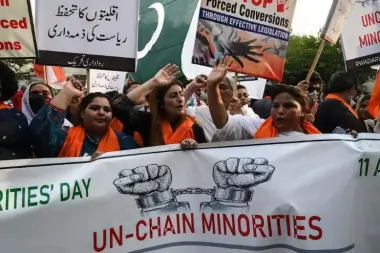
A protest is done in Karachi against the abduction and forced conversion of young girls from minority communities. Many people joined the march which includes men, women and even transgender also. The speakers allege police officials had refused to file any complaint against the abduction.
The protest not only highlighted the issue of abduction or forced conversion but also the poverty, hunger, gender based discrimination and discrimination based on religion.
CONCLUSION
The problem faced by minorities should be dealt with effectively through practical and implementable initiatives. This can be done through civil society efforts, public awareness drives, capacity building, the provision of legal aid, and the incorporation of these findings in donor and government strategies.
Constitutional safeguards and legal precedents alone will not be enough to alleviate the suffering of minorities in Pakistan. The concern of minority communities’ reflects a giant discrimination within a society. Such issues can be solved by a concerted effort across government, judiciary, and civil society.
REFERENCES
• https://www.senate.gov.pk/uploads/documents/1598276327_813.pdf
•https://minorityrights.org/country/pakistan/#:~:text=Christians%2C%20Hindus%2C%20Ahmadis %2C%20Scheduled,Ahmadis%20are%20now%20not%20recognized
• https://www.opindia.com/2023/01/pakistan-abuser-human-rights-held-accountable-un-unhrc must-keep-in-mind/
•https://m.timesofindia.com/world/pakistan/us-report-reveals-troubling-human-rights-abuses in-pakistan/amp_articleshow/82048602.cms
[ad_2]
Source link

