
[ad_1]
Dr Sofia Stolk is an Assistant Professor at VU Amsterdam and a research fellow at the Asser Institute, whose work explores how international law is seen, staged, and experienced through visual media. Dr. Renske Vos is an Assistant Professor at VU Amsterdam, working at the intersection of socio-legal studies of international law and governance. Together, they co-direct the Legal Sightseeing project, which studies how international law appears to, and is encountered by the public, raising questions on “international law’s images, stories and audiences”. In this interview, Adithi and Abhijeet from Team JFIEL ask about their insights on their latest open-access book, Legal Sightseeing and International Law, a culmination of nearly a decade of collaboration, their teaching, and the making of the project.

Adithi: Thank you both for joining us this afternoon! It feels so special that a significant part of your work, including and beyond just the legal sightseeing project, has been shaped through collaboration with each other. I was wondering if you could take us back to how you first began working together, and what that journey has felt like and developed over the years?
Dr. Stolk: That’s a really nice question. I’m so glad that you asked this. Friendships are a really underestimated part of academia, but they are actually so important to our work. Renske and I met at VU Amsterdam. I can remember the first time you [Renske] walked into my office. We were both doing our PhDs then, although Renske was still partially based in Edinburgh. We immediately had this recognition—of how we share the same ways of thinking. I remember thinking that it was unique that you share such a way of looking at the world with someone. When we work together, it has always felt so organic and natural. For instance, we never have to use track changes in our texts, we just write directly into a shared document. In so many parts of the book, we can almost not distinguish who wrote which part. People often confuse the two of us, since we are very much in sync. So this is not surprising!
Dr. Vos: I was just thinking that it has been nine years to the project, and we are only better friends than when we started. I consider myself so very lucky that we met. There is an illusion of individuality in academia, which is untrue. Friendships are a far bigger part of academic work than we sometimes admit. Many successful projects are projects of co-creation, collegiality and friendship. We need these ties. For the Legal Sightseeing project specifically, it also forms a part of the broader underlying, methodological points of this research. We hope to harness the potential of co-creation, group and participatory work.
Adithi: I really like what you said about friendships and collaborations shaping our work. Nine years on the project is remarkable! Can you walk us through the making of this project from when you started thinking and imagining it to it becoming the book we see today? I’m particularly curious about whether there was a moment when you encountered a site or an image that made you realise that international law needed to be studied in this different way?
Dr. Vos: It has been a longer journey, of course. Around the time we started, or a little before, we were already working on themes such as the theatrics of international law, its seen and unseen properties, the physical and architectural spaces of, in my case, the EU. We were also taking great inspiration from work by colleagues around that time. We were very inspired, for example, by Jessie Hohmann and Daniel Joyce’s edited volume on International Law’s Objects, or the work at the time, in Liverpool, by Christine Schwöbel-Patel and Robert Knox on Aesthetics and Counter-Aesthetics of International Justice. There are so many other projects, and they manifested in these influences.
But of course, [smiles] there was one specific moment that stood out to us–and that is the ice cream at the Peace Palace. So both Sofia and I actually live in The Hague! The city markets itself as the city of peace and justice, and as the seat of the International Criminal Court and the International Court of Justice. Indeed, living in The Hague, you cannot help but notice this kind of international ethos—like the Peace Marathon or International Institution Open Day for instance. Every time we would cycle past the Peace Palace, we would notice a group of people taking their selfies, going into the gift shop, coming out, eating ice cream. That has been the point from where this project has spun. We were fascinated, asking each other: what might be going on here? It made us think about how, we too, are here eating this ice cream, you know—we’re not beyond this in any way. It made us ask, what are we doing, when we are here? What does this encounter produce? How is international law presented here?
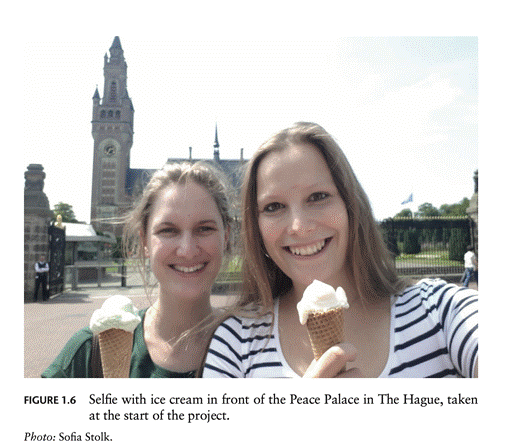
Picture excerpted from their recent book
And then for a long time, it was mostly that—this sort of curiosity, and maybe a bit of a running joke between us. We developed the term ‘Legal Sightseeing’ very early on, and began to notice these kinds of encounters and interactions everywhere. We started documenting it through our photo blog, which is still running, and now also through our Instagram page. We started to build a kind of living archive of these instances. That also allowed us to invite colleagues, friends, and family into the project, to show through these photos what we meant. We noticed an academic interest that made us realise that we could build on this through various research projects. It also became a platform for showcasing the work of others, either co-created with us or shared as part of the project. Eventually, the book brought a lot of projects under this umbrella together, and we realised, well, we were more consistent than we thought!
Adithi: You speak of this project being born through curiosity—and it makes me think of a line from your LinkedIn post Dr. Stolk—where you described your parents as your ‘first and most avid legal sightseeing supporters.’ The book itself is also dedicated to your parents. It’s such a moving image. We would love to hear a little more about how your early worlds, your families, your childhoods, might have shaped the way you each come to law, and to international law in particular.
Dr Stolk: Ah!Wow! What a wonderful question, and I think it is essential. Both Renske and I come from very warm families that have surrounded us with art. I was brought up with a fondness of looking around and appreciating our surroundings, to see the little things. My father was an artist. So, art was a natural way of looking at the world. As children, we always went along with him to his studio. For some people, it’s sometimes strange to combine art and international law. But I don’t know differently because that’s my world—and that’s how I look at the world. I think Renske and I share this sort of intuition, because there were similarities in our upbringing. We watched similar television programmes, went to similar museums, and on similar holidays, always camping in France. You know? Perhaps, we have a shared memory of what a childhood looks like. But I’m so proud and so happy that all of our parents have been so involved, not only in our childhoods, but also in our work. That’s really quite special.
I see it quite often with colleagues as well. So Christine Schwöbel-Patel’s brother is a poet and he was also involved in a project. Rose Parfitt’s dad is an artist and she also speaks of him often, and very fondly. We have met, through the project, a lot of people who like to have their parents involved. Renske’s parents are in the pictures too, doing the legal sightseeing, it’s a strength that this project is tangible and accessible. They still send photos from their holidays of legal sites they encounter. My dad has previously joined us as an artist, helping organise workshops and shape our artistic methodology (like when he took us around Sofia, Bulgaria, to collect legal sightings). My mom is our biggest supporter; she reads everything, whether she fully gets it or not. I think that’s what I’m most proud of: how warm Legal Sightseeing feels, and how much that comes from the people around us.
Dr. Vos: I totally second that. I didn’t just grow up with a strong appreciation for the arts, but also, through my mother, with a real attentiveness to human interactions and the value of small things, and through my father, a deep curiosity about politics and the world. Both of my parents share a love for travel, and from an early age, my brother and I were exposed to that. When we talk about the interaction between international law and “the public, they are that public. We don’t want to speak about it over their heads, we are part of that public too. That’s why we find it important to present research in a way that is accessible: something people can pick up, engage with, recognise, and form their own thoughts about. Our parents understand this work, and that matters to us. I do not want to call it a test, but it is a reminder, if you really understand something, you should be able to express it in a way that others can access. And that’s what we aim for.
Adithi: Absolutely! I love what Dr. Stolk also said earlier about the book coming across as warm. As I read the book, I realised it was the first time I have read what seems like a textbook, and I have felt so many things! I giggled, and teared up and laughed…It was such a strange feeling, to feel like such a part of the book as I read it. At moments, I wondered how you might see me seeing some of these pictures. How you might read my encounter with your work. One of the pictures that stays in my head when I think of the book, is of the little boy looking at a lego model of the Peace Palace in Legoland. Who would you say has been the most interesting sightsee-er for you? Who has been the most interesting to engage with?
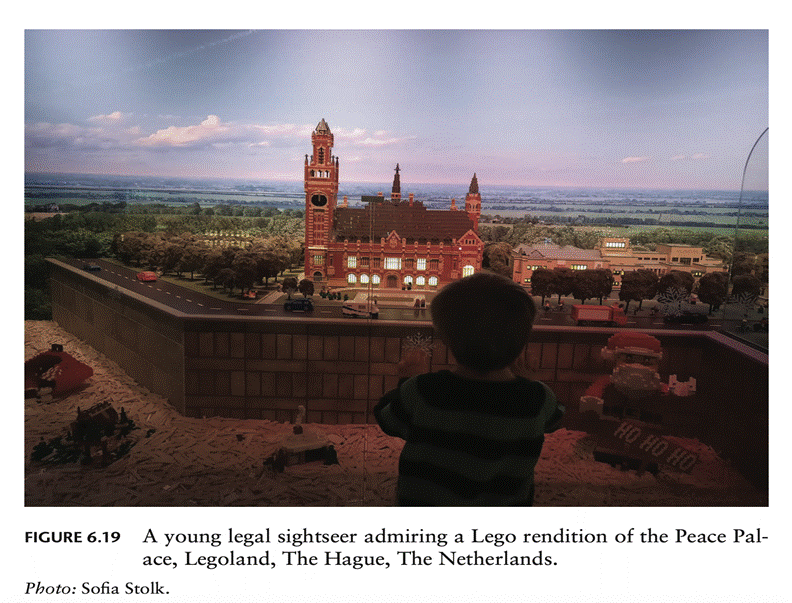
Adithi’s favourite picture from the book
Dr. Stolk: [Laughs] It’s just beautiful how you phrased your experience interacting with the book. This is the biggest compliment you could give us! Thank you. So, the little boy in the picture is my son. It’s all family in the book. I think the best sightseers are; well, that there are so many of them, and they are all so different yet so similar! In the ice cream chapter, for example, we included interviews with people there, and that’s just gold. People are so fascinating, with different purposes and experiences. Our colleagues Hanna Zwienenberg and Bent Bos also conducted some of the interviews, and reading them felt very vivid. I was giggling, and it felt like being there. You have people casually talking about ice cream, others wondering, ‘What is this strange palace? Does a king live here?’ or you notice someone just passing by on the way to an internship interview. We love that! The contrasts, the humour, the unexpected encounters. It’s also what we aim to capture in the photos: that sense of curiosity and imagination. Like the images of elderly tourists in Bulgaria looking at a political statue, you can almost hear the conversation in your head. It really invites you to wonder what they’re thinking. I would be interested in hearing all of your favourites. Who is your favourite Renske?
Dr. Vos: Oh, the diversity is really the treasure, but I do have a particular soft spot for when people are totally dressed for the occasion and really go all out for their photo shoot. There is an image of a couple in front of the Chiang Kai-shek Memorial Hall in Taipei. She is posing and he is on his stomach on the floor just trying to get the shot, you know? I just love that. I love their engagement with this place they are in. They really are just seizing the moment in which they get to be there. This is not without meaning or sincerity. In fact, it comes with a sincere curiosity for their surroundings and the place they inhabit.
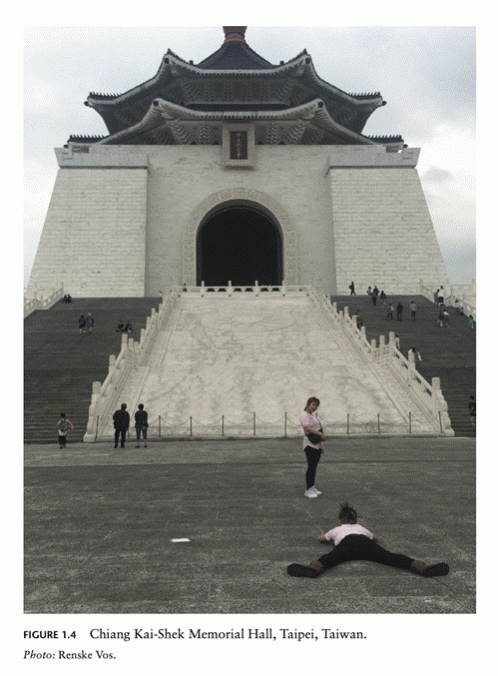
One of Dr. Vos’ most interesting Legal Sightseers
Abhijeet: I was wondering about your engagements with sceptics, so to say, of Legal Sightseeing. In the book, you alluded to the challenge of advancing unconventional approaches to thinking about international law in legal circles. I was curious what this experience has been like, and conversely, how it felt to see people resonate with the project, perhaps finding in it a vocabulary to describe experiences or intuitions about international law that they perhaps didn’t have the language for before. Because I think it’s been helpful for me and Adithi in those respects. You also discussed, receiving questions like: “Is this really law?”, and rethinking of this as, “Could this too be about law?” I would be interested to hear your reflections over the years.
Dr. Vos: You put that so well Abhijeet. Christine and Rob in their introduction to their book captured well that there was perhaps more scepticism and pushback a decade ago. Now, however, the atmosphere is certainly more welcome. There is so much really creative research, and there are many authors working in this space and exploring new possibilities. It brings with it the question of, is it law? We have not yet given a single legal sightseeing presentation without someone asking us this question! It is not necessarily dismissive of our project either. We have learnt over the years to not be triggered or defensive by that question. We perceive it as an invitation, and coming from a place of genuine curiosity. The asker is themselves trying to understand: this is new, let me puzzle this out to see where it tries to sit in my view. We try to tackle this question in the second chapter of the book where we suggest taking an external perspective to international law. It hopefully opens up for someone, a new mode of thinking through their own project.
Dr. Stolk: I think a new question that we also struggled with a bit, and it hasn’t got better, of course, is the whole discourse on how “international law is dead”. Things going on at the moment don’t make international law look particularly useful. And in this light, we find ourselves asking, what is our research doing? It’s a slightly different way of approaching the question. In recent years, many people have invoked ideas like imagination or imaginaries, perhaps also as a way of coping with the ‘death’ of international law through reimagination.
Our work has always been about imagination, but also about making it tangible; not just conceptual. What does it mean to practice imagining? For us, that includes thinking about how international law can be reclaimed by people, and who those people are. It’s not about making a traditional human rights claim or giving voice in that sense, but it is about giving voice differently. Our focus offers a complementary perspective, and I actually appreciate when people ask, “Is this law?” because it pushes us to keep asking what law is, which is a question we, as legal practitioners, should never stop asking. It’s also a plea for a certain lightheartedness, not naivety, but an openness to exploring where lightness can exist in scholarship. Our critique, in a way, is about who gets to ask which questions, and how different questions lead to different answers. And one of the questions we like being asked is: “When will you start?” That’s my favourite. Even after almost a decade of legal sightseeing, it still feels like we’re just beginning, and that’s a feeling I want to hold on to.
Adithi: On seeing differently and lightheartedness, can we speak a little more about your co-creators? In your chapter on White Terror, you speak of your students as co-creators, and teaching as a form of research. I am curious about how legal sightseeing travels into the classroom. Have you had to navigate tensions, between creative methodology and the more traditional, doctrinal expectations of international legal academia? How do you do it?
Dr. Vos: As to that chapter, I was a visiting professor at NTU in Taipei, working with a really sharp and enthusiastic group of students. When I introduced legal sightseeing, they immediately engaged and the idea emerged to visit the national human rights museum. We designed an exercise together, where they became co-researchers, exploring the museum’s narrative and asking whether, and how, international law appears within it. What I really value is the diversity of perspectives students bring. Everyone responds differently; there’s no single ‘right’ way to see. That multiplicity is something you simply can’t achieve on your own, and it’s incredibly valuable. Students are in so many ways so informed, and they come up with such clever things!
Dr. Stolk: I think some of these activities can be built into almost any kind of teaching, including doctrinal courses. Legal sightseeing doesn’t exclude doctrinal work, it can complement it. We experiment with exercises like film projects, collaging, frottage and visual analysis. They may seem unconventional, but they help shift perspectives and deepen legal thinking. They help doctrinal thinking by making us pause and ask what matters in a case, what is seen, and for whom. More broadly, teaching is not just about transmitting legal knowledge. It’s about helping students become thinkers, arguers, and people who can see through others’ eyes. And we learn from students as well. Allowing ourselves to see familiar things through their perspectives helps us re-see what we think we already know. This is a great skill for any good lawyer. We also receive blog pieces for legal sightseeing by students who go someplace and write these fantastic essays. They see so much, and it is so enriching to read. This has been very important to us!
Adithi: I have certainly learnt so much! I came across your post introducing the book at a time when I was very conflicted in employing creative methodology in my own research. Indeed, Abhijeet and I have had many conversations about this. As I read your book, one of its opening chapters begins with a line that made me tear up when I read it. You say, “to a reader, who may have picked up this book holding some odd project of their own somewhere in mind: when will you start?” Perhaps that is a good place for us to end. So, where do you see this project going next, and what would you like readers and students to take forward from it?
Dr. Stolk: That makes me tear up Adithi. I mean, this is the point! This is the point of the book. It is an invitation. This is the biggest compliment, that it creates a space for someone to do similar research, or it acts as a stepping stone, or even if it can just be there and inspire people. That is what we aim for. This book is as much yours as it is ours. And that you take this away, is what we can dream and hope for!
Dr. Vos: The invitation is open. We look forward to seeing how people will pick this up, and run with it in their own ways–similar or dissimilar. If it can give someone the encouragement to go and do their own thing, it would make us so so happy. Sofia and I will certainly be continuing to do the same. And to anyone joining us, please reach out.
Abhijeet: Thank you so much for all the inspiration. I also relate to Adithi in the sentiment that, because there are creative labours of love like this out there, which we can resonate with, and which we can be inspired by—we manage to find the energy to think outside the box and not be inhibited by what has come before. So thank you so much again for joining us. I don’t think I can get back to work now, but I must!
Dr. Stolk: I know, so you should go out and eat ice cream. That’s the whole point!
Picture Credit: Taylor & Francis Group
[ad_2]
Source link

