
[ad_1]
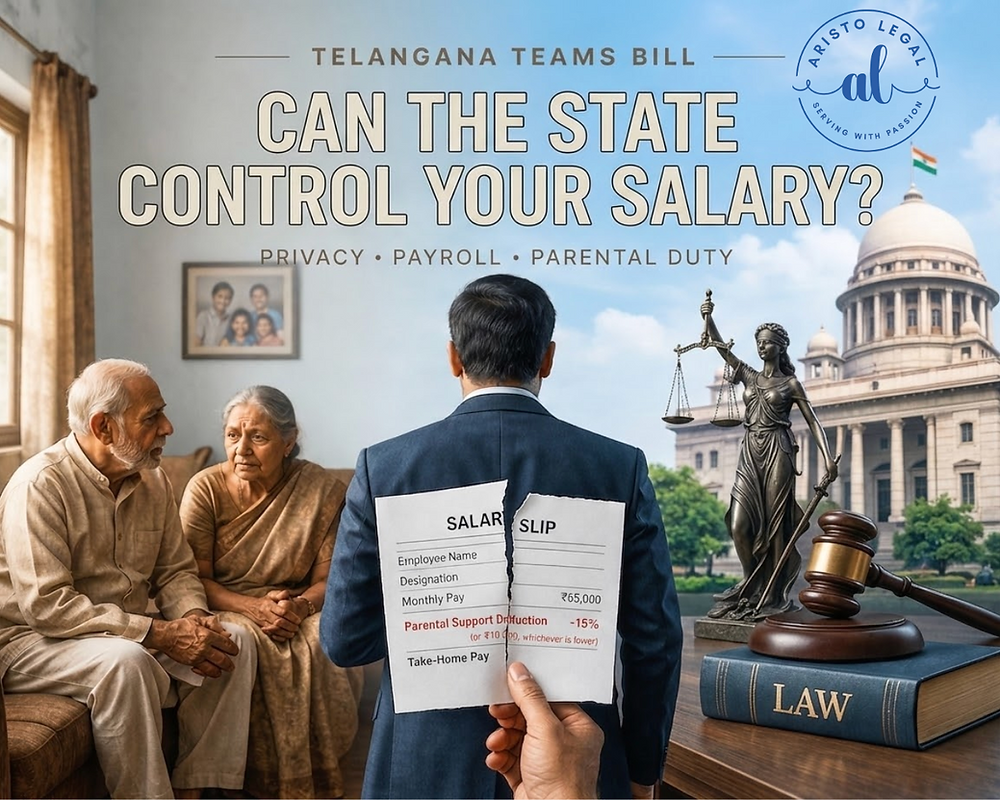
Breaking news: On March 29, 2026, the Telangana Legislative Assembly passed the Telangana Employees Accountability and Monitoring of Parental Support Bill, 2026 — widely referred to as the TEAMS Bill. The legislation allows authorities to order a salary deduction of up to 15% (or INR 10,000, whichever is lower) from employees in both the public and private sectors who are found to have neglected financially dependent parents, with the deducted amount transferred directly to the parents.

During Assembly debates, Chief Minister Revanth Reddy reportedly cited high-profile elder neglect disputes including the widely discussed case involving Raymond Group patriarch Vijaypat Singhania as symbolic of a growing social problem the state sought to address.
While the Assembly has approved the Bill, it has not yet become law. The proposal still awaits:
before it can be formally notified in the State Gazette. Only after this notification will the provisions discussed here become legally enforceable.
The bill has nevertheless ignited nationwide debate. Most headlines focus on its most striking feature: government-mandated salary deductions. Yet beneath that headline lies a deeper constitutional and institutional shift.
If implemented in its current form, the legislation could reshape not only elder-care enforcement but also the relationship between employees, employers, and the state.
Notably, this represents one of the first attempts in India to bring private-sector payroll systems into direct state enforcement of a moral and familial obligation — effectively extending regulatory oversight into the private sphere of family relationships.
This article examines the untold legal questions surrounding privacy, salary control, and employee rights under the TEAMS Bill.
1. From Family Responsibility to State Enforcement
India already recognises children’s responsibility toward parents under the Maintenance and Welfare of Parents and Senior Citizens Act, 2007, which allows parents to seek maintenance through tribunals.
The Telangana bill moves significantly further.
Instead of relying only on court orders, it introduces:
-
Administrative monitoring mechanisms
-
Employer participation in enforcement
-
Direct salary deductions through official directives
This transforms what was traditionally a private legal obligation into a state-monitored regulatory framework.
The central legal question becomes: Where should the boundary lie between family morality and government enforcement?
2. Privacy Concerns: How Much Can the State Know?
One of the most contentious aspects of the TEAMS Bill is the depth of financial surveillance required for enforcement. To adjudicate “neglect,” the state must peer into the private economic life of the household. This triggers four critical constitutional questions:
-
Will employees be forced to disclose entire salary structures—including bonuses, ESOPs, and allowances—to establish the “15% threshold”?
-
To what extent can authorities demand access to personal bank statements to “verify” whether informal support was previously provided?
-
In the absence of a trial, what constitutes “proof” of financial abandonment? Will the state rely on hearsay, or will it mandate a forensic audit of family expenses?
-
Under the Digital Personal Data Protection (DPDP) Act, 2023, who is the designated fiduciary for this sensitive financial data, and what are the liabilities for a breach?
The Supreme Court’s ruling in Justice K.S. Puttaswamy vs Union of India (2017) established privacy as a fundamental right. Any intrusion must satisfy three constitutional tests:
-
Legality
-
Legitimate state purpose
-
Proportionality
Whether ongoing monitoring of family financial arrangements meets these standards may ultimately become a constitutional question.
3. Employer Liability: Are Companies Becoming Enforcement Agencies?
Perhaps the most unconventional feature of the TEAMS Bill is the role assigned to employers.
Organisations may be required to:
-
Implement salary deductions
-
Respond to government directives
-
Verify employment details
-
Coordinate with district authorities
This effectively turns HR departments into intermediaries in family welfare disputes.
The Employment Contract Conflict
A significant but under-discussed risk is the potential for breach-of-contract disputes.
Many companies — especially multinational firms — operate under strict employment agreements that include:
-
Fixed compensation structures
-
Confidentiality clauses regarding salary information
-
International payroll compliance standards
If a state authority orders deductions or disclosure of employment data, employers could face a legal dilemma:
-
Comply with government directives, or
-
Risk breaching private contractual obligations with employees.
This creates a novel legal tension between state authority and private contract law, potentially exposing companies to litigation from employees claiming contractual violations.
4. Salary Control and Property Rights
Under Indian law, salary is not merely a corporate benefit; it is “earned income” and constitutes a protected property right under Article 300A of the Constitution. The TEAMS Bill’s mechanism for mandatory, non-consensual deductions raises several high-stakes legal questions:
-
Can a state authority redirect private earned income through an administrative directive without a full judicial determination?
-
What specific legal “filters” exist to prevent the Bill from being weaponised in existing family property disputes or used as a tool for retaliatory claims?
-
The Bill proposes a Senior Citizen Commission as an oversight and grievance body. However, a critical ambiguity remains: Will the law allow for an automatic “stay” on deductions during an appeal, or will a “deduct-first, appeal-later” approach create irreversible financial hardship for the employee?
The “Multiple Children” Dilemma
A significant implementation gap arises in households with more than one child.
-
The Question of Proportion: If a parent has three earning children, does the state mandate a 15% deduction from each child, effectively creating a 45% total transfer? Or is the 15% obligation (or the INR 10,000 cap) divided proportionally among the siblings?
Without clear arithmetic for “apportionment,” the law risks being enforced inconsistently, potentially placing the entire financial burden on the sibling with the most “traceable” salaried income while others in the informal sector remain untouched.
Unlike traditional maintenance orders—which follow a deliberative tribunal process—this administrative shortcut may face immediate judicial scrutiny if the standards for calculation and due process remain opaque.
5. Constitutional Asymmetries: Gender and Social Equity
The TEAMS Bill operates on the assumption of a linear family structure, yet modern Indian households are socio-economically complex. Without granular guidelines, the law risks creating “Inequality of Burden” in three distinct areas:
-
Under the 2007 Central Act, married daughters are equally responsible for parental maintenance. However, the TEAMS Bill applies to “salary.” In a patriarchal socio-economic setup, will a married daughter supporting her in-laws and children be further burdened by a mandatory 15% deduction for her biological parents? Does the law account for “Double Dependency”?
-
By tethering enforcement solely to “Salary,” the Bill ignores high-income siblings in the informal/cash economy. This creates a disproportionate burden on the formal workforce—a potential violation of Article 14 (Right to Equality).
-
For migrant or gig workers with performance-linked pay, a fixed 15% “Gross Salary” deduction may ignore monthly fluctuations, potentially pushing vulnerable employees below subsistence levels during low-earning periods.
Without careful implementation guidelines, enforcement could unintentionally create unequal burdens.
Conclusion – A Landmark Legal Experiment
The Telangana Employees Accountability and Monitoring of Parental Support Bill, 2026 is far more than a social welfare measure. It represents a bold, high-stakes legal experiment at the intersection of family ethics, employment regulation, and constitutional rights. While its objective—protecting elderly parents—commands widespread moral sympathy, its enforcement model introduces systemic questions regarding privacy, due process, and the limits of individual autonomy.
The Implementation Minefield
Even if the Bill proves legally defensible, its success hinges on navigating significant operational hurdles. From the unresolved “Multiple-Children” calculation dilemma to the potential for retaliatory claims and the exposure of sensitive financial data, the Bill is fraught with administrative complexity. The lack of clarity on how this mandate interacts with existing employment contracts suggests that “administrative capacity”—rather than legislative intent—will ultimately determine whether this law provides relief or merely fuels a new wave of litigation.
The Road Ahead
The Bill now awaits the Legislative Council’s approval and the Governor’s assent. Its subsequent notification in the Official State Gazette will mark more than just its legal birth; it will likely signal the commencement of significant constitutional challenges before the High Court.
If it survives judicial scrutiny, Telangana may well pioneer a national template for state-enforced family accountability. Yet, this “Social Security 2.0” comes with a measurable trade-off: expanded state visibility into private family arrangements and a reduction in financial autonomy.
As the Bill moves toward potential implementation, one enduring question remains at the heart of the debate: Can the law truly legislate love—or are we simply learning how to tax neglect?
[ad_2]
Source link

