
[ad_1]
INTRODUCTION
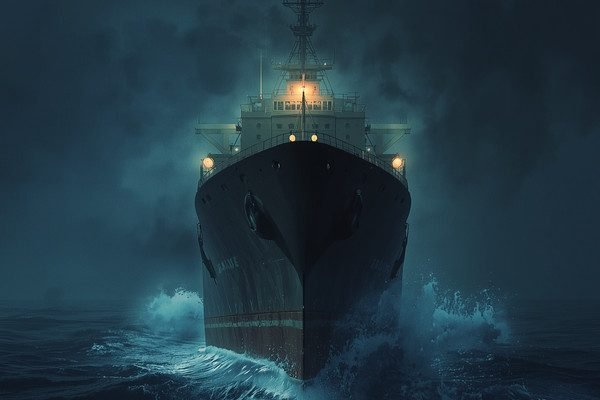
“Imagine a 300-meter-long tanker carrying crude oil navigating the icy, turbulent waters close to Iceland. It has denied claims of registration, flying two different flags and technically, no country on earth has the right or the responsibility –to govern what happens on board[1].Welcome to the world of the stateless ship[2].”

In the grey turbulent waters of the North Atlantic, a vessel’s flag is far more than a piece of coloured cloth; it is a “sovereign shield.” Under the centuries-old doctrine of maritime law, a ship is considered a floating piece of its home country’s territory[3]. The world watched in the state of geopolitical whiplash as the tanker Marinera, formerly the sanctioned Bella 1, tried to outrun a U.S. naval blockade[4].
What started out as a routine enforcement operation off the coast of South America swiftly turned into one of the decade’s biggest maritime legal disputes.[5] In a desperate attempt to claim “sovereign immunity” and avoid seizure, the ship’s crew did the unimaginable as it fled: they painted a Russian tricolour over its hull and changed the ship’s name mid-voyage.[6] In that moment, the Marinera ceased to be just a tanker carrying sanctioned oil; it became a legal anomaly—a “zombie ship” drifting into the dangerous vacuum of statelessness.[7]
A BRIEF INTRODUCTION OF MARINERA CASE CONTROVERSY
The Marinera controversy is a prime example of “shadow fleet” operations clashing with international maritime law. It serves as a modern test case for UNCLOS Article 92 regarding the status of stateless ships.
The ship was originally known as the Bella 1.Since June 2024, Shadow Fleet Connection, a Very Large Crude Carrier (VLCC), has been sanctioned by the U.S. Treasury.[8] It was allegedly a member of a “shadow fleet” that transported sanctioned oil from Iran and Venezuela to fund groups like Hezbollah and the IRGC.[9] As part of Operation Southern Spear, a U.S. maritime embargo off Venezuela, the U.S. Coast Guard (USCGC Munro) began a weeks-long pursuit of the ship in December 2025.[10]The legal challenge revolves around the ship’s activities during the pursuit as during the start of the chase, the ship claimed to be flagged to Guyana. When Guyana’s register was unable to confirm the ship’s registration, the United States classified it as “stateless”.[11] After classifying the ship as “stateless” or “falsely flagged,” the US transitioned from a surveillance strategy to an aggressive kinetic enforcement strategy. The USCGC Munro, a Legend-class cutter, oversaw the operation. While the ship was in international waters close to Iceland, special operations forces carried out a high-stakes, non-consensual helicopter boarding.[12] In order to ensure that no Russian naval assets, including a nearby submarine, interfered with the boarding, the UK’s Ministry of Defence crucially supported air surveillance.[13] A federal court warrant alleging the ship was a member of a “shadow fleet” was used by the United States to justify the seizure.[14]
WHEN DOES A SHIP BECOMES STATELESS SHIP?
In international law, the term “stateless ship” (legally referred to as a “ship without nationality”) describes a vessel that does not possess the legal right to fly the flag of any country.[15] Under the United Nations Convention on the Law of the Sea (UNCLOS), a ship becomes stateless through several specific triggers.[16] The most basic form of statelessness occurs when a ship is not registered in any national shipping registry.[17] When the owner has never registered the ship with a flag state or the previous flag state has revoked or cancelled the ship’s registration (often due to the ship’s involvement in illegal activities), and no new registration has been obtained.
Article 92 (UNCLOS) mentions that a ship is assimilated to be a ship without nationality if it uses more than one flag for convenience.[18] If a ship flies two or more flags and uses them interchangeably to avoid inspections or taxes, it cannot claim the protection of any of those countries.[19] Also in cases of fraudulent use where the ship is flying a flag that the ship is not entitled to fly.
Unauthorized Mid-Voyage Flag Change is yet another circumstance under UNCLOS Article 92(1) where a ship is strictly prohibited from changing its flag while at sea or during a port of call, unless there is a “real transfer of ownership.”[20] Which is what happened in the Marinera Scenario where the ship claimed to be flagged to Guyana at the beginning of the pursuit and the crew attempted to swap the flags mid-voyage to escape the sanctions of the international law (changing from a Guyanese flag to a Russian flag while fleeing) thus, rendering the ship stateless.[21]
Statelessness can also be determined through communication between law enforcement and the purported flag state, for example: Under laws like the U.S. Maritime Drug Law Enforcement Act, if a flag state is contacted and fails to affirmatively confirm the vessel’s registration within a reasonable timeframe, the ship may be treated as stateless.[22]
A ship may also be deemed stateless under the maritime law if it fails to show “National Character” such as if it refuses to show any flag when requested by a warship or the crew refuses to state the ship’s nationality or the ship possesses no documentation (Registry Certificate) to prove its nationality.[23]
The “Right of Visit” under UNCLOS (Article 110)
In international maritime law, a ship’s status is established by the idea of “Flag State Jurisdiction.” [24]When a ship becomes stateless, it effectively exits the protection of this system.
A navy is typically not allowed to board a foreign trade ship on the open seas.[25] However, Article 110 makes a substantial exception for statelessness.[26] The Authority to Step in: Any warship may board a ship if there is “reasonable ground for suspecting” that it lacks nationality.[27] The navy may review the ship’s documents. If suspicion continues, it can proceed to an examination on board the ship.[28]
EXTENT OF THE APPLICABILTY AND ITS LEGAL IMPLICATIONS
A case study of what occurs when the strict UNCLOS architecture collides with the “Wild West” of the shadow fleet is the Marinera debate.[29]The decision boils down to three key conclusions that fundamentally alter our understanding of maritime jurisdiction.[30] The Marinera seizure demonstrates that “Assertive States” are gaining in actuality, making the scholarly disagreement over Article 110 more than just a theoretical argument.
Although some academics contend that Article 110 merely permits a “flag visit” to verify documents, the US and UK uphold the “Substitution Theory.” Any country can “substitute” its own authority in the event that a ship has no Flag State to answer for it.[31] For the Marinera, losing their nationality was only one aspect of becoming stateless; another was losing their ability to travel freely.[32]
The crew’s attempt to paint a Russian flag and rename the vessel mid-pursuit was the Marinera’s fatal legal error.[33] Mid-voyage flag switching to evade law enforcement is clearly defined as “fraudulent re-flagging” in UNCLOS (Article 92).[34] The ship is immediately declared stateless by maritime law. The Marinera demonstrated that the treaty’s criterion for a “real transfer of ownership” cannot be superseded by a digital registration or a new coat of paint.
On one hand, the U.S. is attempting to prevent “legal laundering” where criminal ships use flag-swapping to hide. On the other hand, Russia and critics argue the U.S. is destroying the very framework that keeps global trade safe by treating the high seas as an extension of its own federal courts.[35] The result is a dangerous paradox: In the effort to enforce international rules, the enforcers are being accused of breaking them.[36]
CONCLUSION
The Marinera incident serves as a definitive answer to the academic split: Statelessness is not a legal loophole; it is a legal trap. For the maritime community, the result is clear: without a genuine link to a responsible Flag State, a vessel has no rights, no protection, and nowhere to hide.
This case is a stress test for the United Nations Convention on the Law of the Sea (UNCLOS). Neutral legal experts argue that the U.S. is weaponizing its domestic laws to act as a “global policeman.” They warn that if any nation can unilaterally decide which flags are “valid” and which are “false,” the legal framework that protects all international shipping will crumble.
The warnings from China and legal experts cannot be disregarded, even while the United States contends that this is required to stop terrorism and illegal trade. The “Freedom of Navigation” principle will essentially cease to exist if China, Russia, or other emerging nations start to do the same, detaining ships they believe violate their own laws. A future where a ship is “legal” in one hemisphere and “stateless” in another could soon be the reality for shipping corporations.
The world community appears to be at a turning point in which it could either update the UNCLOS by establishing a transparent, worldwide digital registry that prevents “shadow flagging or “Accept the Standoff” by permitting the firepower of the closest warship to determine legal rights in the high seas.
Author(s) Name: Mansi Verma (University of Lucknow)
References:
[1] Panagiotis Saviolakis and Michalis Pazarzis, ‘The Role of Ships Without Nationality in the Irregular Maritime Migration’ (2024) 21(1) Journal of Maritime Research 253, 254.
[2] United Nations Convention on the Law of the Sea (opened for signature 10 December 1982, entered into force 16 November 1994) 1833 UNTS 3 (UNCLOS) art 91.
[3] ibid art 92.
[4] ‘The Marinera Seizure: Tracking the Shadow Fleet’s Rise’ (Windward, 12 January 2026) https://windward.ai/knowledge-base/inside-the-marinera-seizure-enforcement-operation/ accessed 17 January 2026.
[5] ‘US Launches Operation Southern Spear to Dismantle Narco-Terrorist Networks’ (India Today, 14 November 2025) https://www.indiatoday.in/world/us-news/story/us-launches-operation-southern-spear-to-dismantle-narco-terrorist-networks-glbs-2819413-2025-11-14 accessed 17 January 2026.
[6] UNCLOS (n 2) art 92(1).
[7] Saviolakis and Pazarzis (n 1) 256.
[8] US Department of the Treasury, ‘Treasury Sanctions Global Shadow Fleet Supporting IRGC and Hezbollah’ (Press Release, 14 June 2024).
[9] ibid.
[10] ‘US Coast Guard Intercepts Sanctioned Tanker in Operation Southern Spear’ (Maritime Executive, 28 December 2025).
[11] UNCLOS (n 2) art 91.
[12] ‘US Special Forces Board Stateless Tanker near Iceland’ (The Guardian, 8 January 2026).
[13] Ministry of Defence, ‘UK Support to US Maritime Enforcement Operation’ (Press Release, 7 January 2026).
[14] United States v Ibarguen-Mosquera 633 F 3d 1339 (11th Cir 2011) (as cited for the principle of enforcing domestic warrants on stateless vessels).
[15] Saviolakis and Pazarzis (n 1) 253, 254.
[16] UNCLOS (n 4) art 92.
[17] Saviolakis and Pazarzis (n 1) 255.
[18] UNCLOS (n 2) art 92(2).
[19] ibid.
[20] ibid art 92(1).
[21] Saviolakis and Pazarzis ( n 1) 253, 256.
[22] Maritime Drug Law Enforcement Act, 46 USC §§ 70502(d)(1)(C).
[23] Saviolakis and Pazarzis (n 1) 255.
[24] UNCLOS (n 2) art 91.
[25] ibid art 92(1).
[26] ibid art 110.
[27] ibid art 110(1)(d).
[28] ibid art 110(2).
[29] ibid.
[30] ‘The Marinera Seizure’ (n 4).
[31] Efthymios Papastavridis, The Interception of Vessels on the High Seas: Contemporary Challenges to the Legal Order of the Oceans (Hart Publishing 2013) 64.
[32]ibid.
[33] United States v Ibarguen-Mosquera 633 F 3d 1339 (11th Cir 2011).
[34] ‘UK Support to US Maritime Enforcement’ (n 13).
[35] Ministry of Foreign Affairs of the Russian Federation, ‘Statement on the Illegal Seizure of the Vessel Marinera’ (7 January 2026).
[36] Saviolakis and Pazarzis (n 2) 260.
[ad_2]
Source link

