


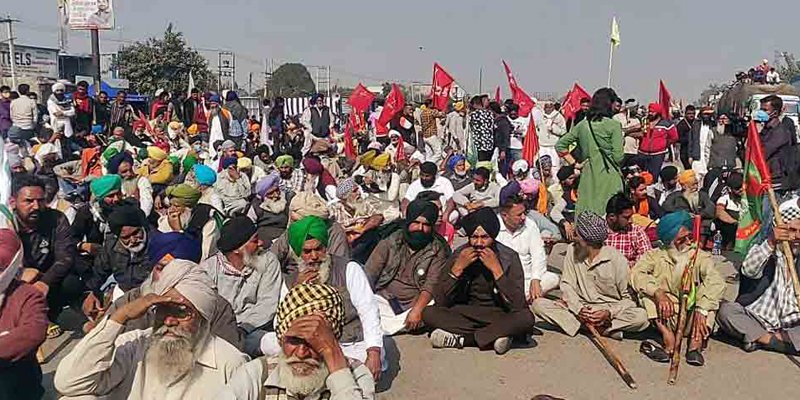

After the Parliament passed thee laws related to agriculture, there has been an uproar across India. Lakhs of farmers (from more than 30 different farmers’ union groups) are gathered at different Delhi border points to protest against the laws; the agitation is likely to intensify if the government doesn’t recall the three laws which farmers call – Black Laws.
What Does the
Government Say?
The three farm laws implemented by the government are projected as one of the most significant reforms in the Indian agriculture sector that will eliminate middlemen.

Previously,
farmers could sell only at the mandis of APMC – Agricultural Produce Marketing
Committee; however, with the Farmers’ Produce Trade and Commerce (Promotion and
Facilitation) Act, 2020 coming into force, farmers are able to sell their
produce outside APMC mandis, anywhere throughout the country.
What Are the
Three Laws the Nation is Talking About?
- Farmers’
Produce Trade and Commerce (Promotion and Facilitation) - Farmers
(Empowerment and Protection) Agreement on Price Assurance and Farm Services - Essential
Commodities (Amendment) Law
Let’s now discuss some of the advantages and disadvantages of the three laws in brief.
1. The
Farmer’s Produce Trade and Commerce (Promotion and Facilitation) Law, 2020
Advantages:
- Farmers will
get the freedom to sell their produce at a place they choose, outside APMC
mandis. - The concept
of ‘One Nation, One Market’ promotes interstate trading, eliminating all trade
barriers. - Encouraging
farmers to engage in trade using electronic trading platforms, allowing them to
save marketing and transportation costs. - A dispute
resolution mechanism is also introduced, under which farmers can avoid pending
court litigation.
Disadvantages:
- The ‘mandi
fees’ that state governments collect is a big source of revenue. As the farmers
will be allowed to sell beyond APMC markets, the states will lose considerable
revenue. - As this rule
eliminates the role of middlemen, commission agents’ business will be shut, and
the farmers can sell directly to registered traders. - The rule will
put an end to the MSP based procurement system followed in India for
decades. - It will
destroy the traditional mandi system.
2. The
Farmer’s (Empowerment and Protection) Agreement of Price Assurance and Farm
Services Law, 2020
Advantages:
- Farmers can
enter into a commercial agreement with retailers, wholesalers, exporters, and
food product manufacturers, etc., eliminating their fear of exploitation and
allowing access to the global market. - This rule now
allows buyer-enterprises to invest in technology and infrastructure to foster
agriculture sector and boost food grain production. This will help farmers to
reduce farming costs and increase income. - Once the
contract terms are finalised, the buyer shall provide farmers with the means
needed to yield a good crop. - The contract
will strictly be for agriculture produce and not for the land used for it.
Hence, the farmers will remain the owner of their land can utilise loan, credit
facilities from financial institutions whenever needed.
Disadvantages:
- The
corporates and traders are likely to have the upper hand and can be smart
players, whereas, farmers usually have negotiation skills too weak to lock a
profitable deal. - The small and
marginal farmers may not benefit from this rule, as they may be deprived of
sponsors. - In case of
disputes, corporates, exporters, and sponsors will have an advantage edge. - This law
grants independence to corporates and not to farmers as the MSP is not
mentioned anywhere in the law papers; this is one big reason behind the
on-going protest.
3. The
Essential Commodities (Amendment) Law, 2020
Advantages:
- This law
allows private investment in the agriculture sector to provide farmers with a
massive pool of funds, facilitating production. - It will help
both farmers and consumers to ensure price stability. - Government
has removed onions, potatoes, cereals, pulses, oil seeds, etc. from the list of
essential commodities and eliminated stock holding limits. - It will
encourage investments from the private sector in cold storage, leading to
supply chain modernisation. - With the
removal of stock limits, farmers can attract a large market to invest in
infrastructure and transportation as now there are fewer government
restrictions.
Disadvantages:
- Since there
are no limits for stocking commodities, big companies can charge highly
exorbitant prices, leading to farmers’ exploitation. - The price
limits the government has set for “extraordinary circumstances” are too high
and likely not to be implemented ever.
Farmers Union
from Punjab, which is also a part of “Delhi Chalo” march, are protesting
against the three farm laws passed by the Centre. The core motive of the march
is to voice their demands, seeking the Centre’s surrender before the farmers.
The government has deployed heavy security forces at Delhi-Haryana border areas
which are the prime locations of the protest.
The
“Delhi Chalo” March: Why are Farmers Angry?
- Farmers are refusing to accept all three new legislations. Farmers believe that with mandi system getting dismantle, they will not get assured procurement of their crops at suitable MSP.
- They demand that the government should guarantee MSP in writing; otherwise, the free hand given to private corporate houses will result in their exploitation.
- Commission agents, commonly called ‘Arthiyas’, and farmers want to remain in the friendly bond that has been in place for decades. Each Arthiya, on an average, deals with around 300 farmers, taking care of their financial loans, ensuring fair prices and timely procurement for their corps.
- Farmers believe the new laws will break their relationship with Arthiyas and corporates will not be as sympathetic towards them as these agents have been in times of need.
Farmers’
Demands
- Reversal of
all three laws. - Keep the
mandi system in place. - Their loans
should be cleared. - A law should
be brought for MSP to be at least 50% more than the weighted average cost of
production; make ‘not paying the set MSP’ a punishable crime. - A law should
be implemented that ensures payment from the buyers through middlemen. This has
always been the norm in order to make sure banks don’t deduct any money form
the farmers’ accounts in the name of loan recovery.
Conclusion
The laws have
created mistrust in farmers towards the government that is highlighting the
positive aspects of the laws as the opportunity to modernise the agriculture
sector in India. However, the government should take the responsibility to
consider farmers’ and states’ opinions before passing such laws.
Besides, the
primary thing that the government should focus on in the first place for the
betterment of farmers is strengthening the APMC mandis and eliminating
loopholes in them.
At Apni Kheti, we always support farmers and their interests, for which we frequently post informative articles that help them become aware of the latest agriculture laws and trends. To learn more about farming, farm equipment, seeds, plant diseases, pesticides, etc., and to get the latest news and updates from the agriculture world, download the Apni Kheti app now.
For more information about Agriculture and Livestock, download Apni Kheti app –
Android,