
[ad_1]

They say changing consumer preferences and price accessibility are reshaping the market.
Chaitanya V Cotha notes that lab-grown diamonds are broadening the category by making diamond jewellery more accessible to a wider range of buyers.
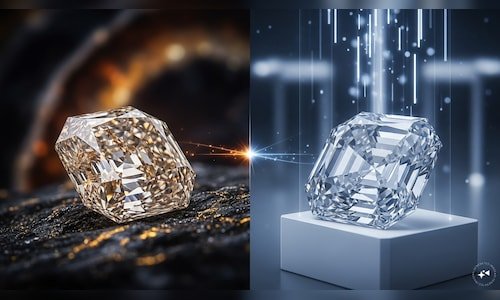
Unlike mined diamonds, which form naturally over millions of years, lab-grown diamonds are created in controlled laboratory environments but share the same chemical composition and physical characteristics.
“Lab-grown diamonds are not a disruption. They are an evolution of what a diamond can mean in the 21st century,” Cotha said.
According to him, lab-grown diamonds lower the entry barrier for consumers who previously found natural diamonds unaffordable.
A one-carat F-VVS natural diamond can cost around ₹7.5 lakh, while a comparable lab-grown stone may be priced at roughly ₹45,000, highlighting the significant price difference.
Younger buyers are considering sustainability, traceability, and responsible sourcing in their purchasing decisions, trends that have contributed to the growth of lab-grown diamonds. The controlled production process also allows greater consistency and scalability, enabling more experimentation in design and cuts.
However, natural diamonds are expected to continue dominating the luxury segment, valued for their rarity and geological origin.
C Vinod Hayagriv said natural diamonds are likely to retain long-term demand due to their rarity and heritage value, though the industry will need to focus on transparency and consumer education.
He compared the trend to the ruby market, where both natural and synthetic stones have grown in parallel rather than one replacing the other.
Global natural ruby production has risen steadily over the past decade despite geological limitations and stricter mining regulations:
- 2016 Global Production: ~15 million carats
- 2026 Estimated Production: ~29.4 million carats
- Total Growth (10 Years): ~95%–110%
- Annual Growth Rate (CAGR): ~5.1%–5.9%
Synthetic ruby production, meanwhile, has expanded even faster, driven by affordability and consistency, while opening new consumer segments:
- Total Volume Growth: ~110%–125% since 2016
- Annual Growth Rate (CAGR): ~7.3%–7.7%
- Market Share Shift: 2016 – niche presence; 2026 – ~39% of global ruby carats
Hayagriv said a similar pattern could emerge in diamonds, with lab-grown stones widening the consumer base while natural diamonds continue to appeal to collectors and luxury buyers.
He estimates that the natural diamond market could still grow at around 5–10% annually over the next decade, even as lab-grown diamonds gain traction globally. The industry may consist of two parallel segments — one defined by rarity and heritage, and the other by affordability and technological innovation.
First Published: Mar 17, 2026 4:42 PM IST
[ad_2]
Source link

