
[ad_1]


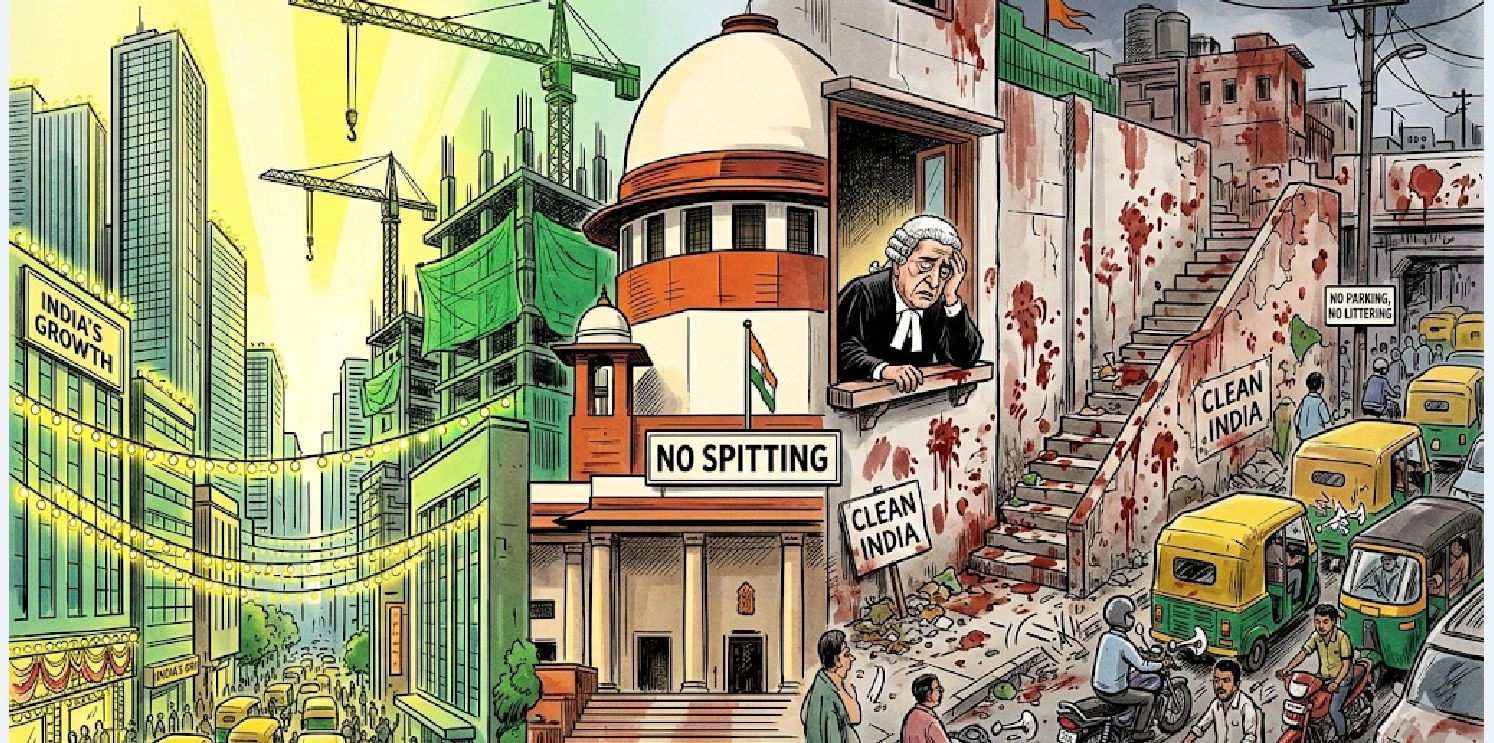
The latest issue of the eminent British newsmagazine, The Economist, has a column on “India’s Changing Hues”. Yellow signifies its economic transformation, referring to the LED lights that have replaced tubelights as seen in flashy weddings, residential apartments and signage. Then it mentions dark green, the colour of the netting that drapes under-construction buildings, a sign of the country’s construction and infrastructure boom, and finally, saffron, signifying the changing political and social reconfiguration. It could have added the other ubiquitous colour—reddish brown—representing the paan and gutka stains that the Supreme Court was so concerned about recently. The apex court communication, issued by the administrative branch, came after instances of spitting inside the Court complex led to blockages in drainage systems and hygiene concerns.
India may be the fastest growing large economy, but such progress has not been matched by awareness among its citizens about the total disregard of their civic duties and obligations. Traffic chaos in every major city because of drivers violating traffic rules, garbage piles in every corner, and the spitting of paan and gutka residue on public spaces, never in their own homes.
It’s not just home, actually. A recent report said that London spends £30,000 every year just to clean paan stains. These are mostly tourists and residents of south Asian descent who are presumably educated and affluent and in a foreign country where, it seems, bad and unhygienic habits are hard to break. In response, individuals caught spitting gutka or paan in public may face fines of up to £100 (approximately Rs 12,000). Locals and social media users have expressed frustration over the “horrendous” and unhygienic conditions attributed to the habits of South Asian communities, with many calling for stricter enforcement against public spitting.
The Supreme Court can literally clean up such violations in its own premises, but in courts across the country, it is common to see lawyers and litigants chewing paan or gutka and splattering walls and public spaces with that now familiar reddish-brown stain.
There is no specific law against such acts, made more popular by Bollywood’s biggest male stars who endorse gutka makers through surrogate advertising because of the huge endorsement fee involved. Even a fitness addict like Tiger Shroff endorses Pan Bahar and a highly respected actor like Amitabh Bachchan was lured into surrogate ads for paan masala. When asked, he replied: “If a business is doing someone some good, we shouldn’t ask ourselves why we’re associated with it. Yes, I get paid for this, but it employs so many people.” Bachchan terminated the contract when he realized it was a surrogate advertisement for a tobacco-based product.
Sadly, legal restrictions and lax laws contribute to the problem. The only law that concerns such actions by the general public is Article 21 which rules that the right to a clean and healthy environment is part of the right to life. There is also Article 51A (g) which mandates the protection of the natural environment. Other laws, such as the Bombay Police Act (1951) and the Tamil Nadu Prohibition of Smoking and Spitting Act (2002), are meant to punish lack of civic sense, but are rarely enforced. Weak enforcement adds to the problem since breaking rules carries no real cost.
The only exception is Kerala where civic sense prevails. The Kerala Police Act includes substantial penalties for making public places dirty by spitting. In Kerala, even pillion riders wear helmets and car passengers wear seatbelts. There are AI-enabled traffic cameras everywhere which contributes to the cleanliness of the state. There is hardly any garbage on the street since it carries a hefty fine. Even higher if garbage is thrown into a water body. Everybody pays the local municipality Rs 50 a month for their plastic collection service, whether you use it or not. No one urinates publicly because of strict laws and effective enforcement.
Other states in India have tried, with limited success, to enforce civic duties. In 2013, the Patna High Court, in response to a PIL filed against improper garbage disposal and growth of trash mountains, demonstrated this need for both a systemic and an
individual change. The Court observed that there is a lack of civic sense being practised by both the government and the citizens. It directed the urban development authority and municipal corporation to launch campaigns to educate both officials and citizens regarding their roles in sanitation and public hygiene.
A recent research paper which critically analysed the performance of governmental initiatives such as the Swachh Bharat Abhiyan, Smart Cities Mission, and e-governance tools like MyGov and Swachhata App found a yawning gap between objectives and outcomes. The research also revealed contrasting trends of collective responsibility and civic indifference across different strata of society. The problem is that there is no real legal definition of what civic sense entails, merely a common understanding that it is an individual and collective responsibility, rarely enforced or practiced.
In Section 7 of the Karnataka Education Act, 1983, the government prescribed curricula also included “promotion of civic sense’, followed by “inculcation of the sense of the following duties of citizens, enshrined in the Constitution…” making a reference to Article 51A. However, using education as means to “promote” civic sense may be an inadequate approach, as it only functions on the assumption that people are unaware of the issue or concern and need to be educated about it.
This was validated in the Civic Survey by a leading media group in March 2025. The report covered 20 states and two Union territories and ranked the states on a matrix of Civic Behaviour, Public Safety, Gender Attitude and Diversity & Discrimination. The report concluded that: “Civic Behaviour (within the citizens) reflects a blend of contradictions, where individuals acknowledge the importance of public responsibility but often struggle to uphold those values when faced with personal gain or convenience.”
Courts have noted that while the Constitution provides fundamental rights, it also implies, through Article 51A, a duty to maintain public hygiene and respect shared spaces. Lower Courts have observed that citizens frequently blame the government for poor infrastructure while simultaneously showing indifference to their own roles in keeping public areas clean, such as littering, improper garbage disposal, or illegal parking.
The Madurai Bench of Madras High Court remarked that it is “extremely difficult to enforce these kinds of discipline through court orders” and that adherence to the rule of law should be an inherent, orderly behaviour. A division bench of Justices M Sathyanarayanan and P Rajamanickam observed that the Court had come across many incidents where even the affluent and the educated were not willing to follow rules, causing much inconvenience to pedestrians and road users. While hearing a case on haphazard parking, the High Court remarked that adherence to the rule of law and orderly behaviour seems to be a “distant dream”. The Court concluded that it was difficult to enforce order through judgments alone, and that adherence to the rule of law must come from within.
In the capital, civic agencies told the Delhi High Court that they could not clean areas like Dwarka if residents lacked the civic sense to maintain cleanliness. While acknowledging the need for better sanitation, the agencies argued they can only provide remedial measures, placing responsibility on citizens to stop littering. The DDA and municipal corporations claimed that despite cleaning efforts, garbage immediately reappears due to a lack of civic sense among residents. To combat this, the High Court later directed the South Delhi Municipal Corporation to introduce colour-coded waste segregation and suggested implementing penalties for non-cooperation by housing societies.
In 2024, in a case concerning lack of parking spaces, the Delhi High Court declined to interfere, noting that the issue was a “broader urban challenge” rather than a specific illegal act, implying that the problem stems from the high volume of private vehicles and the behaviour of residents in crowded localities.
While dealing with the issue of regulating installation of idols during Ganesh Chathurthi celebrations, the Madras High Court recently observed that: “Civic sense must begin from one’s home and work place.”
The bench, comprising Chief Justice Sanjay Kishan Kaul and Justice M Sathyanarayanan, was passing orders on a public interest litigation filed by activist K R “Traffic” Ramaswamy. In his petition, Ramaswamy had said Ganesh idols were allowed to be erected in the middle of roads and organisers were allowed to steal electricity during celebrations. Officials were issuing permission though no rules allowed it, he said.
India’s much-heralded rise on the global stage must necessarily be accompanied by a rise in civic consciousness. If the Supreme Court feels it must intervene to protect its washbasins and drainage systems from collateral damage, it needs to widen its diktat to a wider constituency.
—The writer is former Senior Managing Editor, India Legal magazine
[ad_2]
Source link

