
[ad_1]
Applicable when employers provide food, accommodation, uniforms, grain, or other non-cash benefits.

The Explanation to Section 2(y) states:
If an employer gives any remuneration in kind (instead of cash),
the value of such in-kind benefits up to 15% of total wages payable
shall be counted as wages.
Any value beyond 15% is not counted as part of wages.
This is important for wage calculations such as:
-
Minimum wages
-
Bonus eligibility
-
Gratuity
-
PF
-
Overtime
-
Wage claims
Historically, in agriculture, mining, construction, domestic work, plantations, and hospitality, employers often paid workers partly in grain, meals, accommodation, uniforms, or other non-monetary benefits.
This raised two problems:
(a) Risk of underpaying cash wages
Employers sometimes showed high “in-kind benefits” to reduce cash salary.
(b) Difficulty comparing wages
Cash + kind wages made it confusing to determine compliance with minimum wages.
Therefore, Parliament created a uniform cap:
✔ Only 15% of total wages (value of kind benefits) can be counted
✔ Everything above 15% must be ignored for legal wage calculation
This ensures employers cannot say:
“We gave food worth ₹7,000 so we will pay only ₹5,000 cash.”
The law prevents such exploitation.
1️⃣ Find cash wages paid
2️⃣ Add value of the in-kind benefit
3️⃣ Compute 15% of the cash wage payable
4️⃣ Only that portion (≤ 15%) can be treated as wages
5️⃣ Ignore the rest
-
Cash wage payable = ₹20,000
-
Employer provides free meals = ₹4,000 value
15% of ₹20,000 = ₹3,000
So:
-
Only ₹3,000 can be counted as wages
-
The remaining ₹1,000 is ignored
Legal Wage = ₹20,000 + 3,000 = ₹23,000
15% of ₹18,000 = ₹2,700
So:
-
Wage includes accommodation only up to ₹2,700
-
Remaining ₹3,300 is ignored
Legal Wage = ₹18,000 + 2,700 = ₹20,700
Employer CANNOT count full ₹6,000 toward statutory wages.
15% of 15,000 = ₹2,250
Given value (1,500) < limit (2,250)
➡ Entire ₹1,500 can be counted as wages.
Legal Wage = ₹15,000 + ₹1,500 = ₹16,500
15% of ₹12,000 = ₹1,800
So:
-
Only ₹1,800 counts as wages
-
Remaining ₹1,700 ignored
Legal Wage = ₹12,000 + 1,800 = ₹13,800
Even though the employer provides grain worth ₹3,500, legally only ₹1,800 counts toward wages.
✔ Interpretation 1 — Cash wage must be primary
The law ensures employees receive majority of wages in cash, not kind.
✔ Interpretation 2 — Protection from disguised underpayment
Employers cannot reduce cash wages by inflating in-kind benefits.
✔ Interpretation 3 — Uniform treatment across industries
Whether it’s:
-
IT company giving free meals
-
Hotel giving accommodation
-
Plantation giving grain
-
Factory giving uniform
-
Construction site giving tools
→ Only 15% can ever count as wages.
✔ Interpretation 4 — Professional valuation required
Employers must assign a fair monetary value to kind benefits:
-
Based on cost to employer
-
Or market value, whichever is reasonable
✔ Interpretation 5 — Important for minimum wage compliance
If employer pays minimum wage partly in kind:
If not → non-compliance.
A hotel employs a housekeeping worker:
-
Minimum wage in State = ₹14,000
-
Cash wage paid = ₹12,000
-
Accommodation provided = ₹4,000
15% of ₹12,000 = ₹1,800
Eligible in-kind wage = ₹1,800
Total legal wage = ₹12,000 + ₹1,800 = ₹13,800
➡ Shortfall = ₹200
➡ Employer is in violation of minimum wages.
This shows that high-value accommodation cannot substitute proper cash wages.
-
Labour Codes are being implemented
-
Wage inflation is rising
-
Government is pushing for digital wage payments
-
Industries with migrant labour heavily use in-kind benefits
The 15% rule preserves:
✔ Transparency
✔ Fair pay
✔ Traceability
✔ Prevention of exploitation
The 15% in-kind rule ensures:
-
Cash remains the primary mode of wage payment
-
Employees are not deprived of real, liquid income
-
Employers cannot manipulate wage structures
-
Statutory wage obligations remain meaningful and enforceable
It brings clarity and fairness to industries where in-kind benefits are common, ensuring wages are not disguised or diluted.

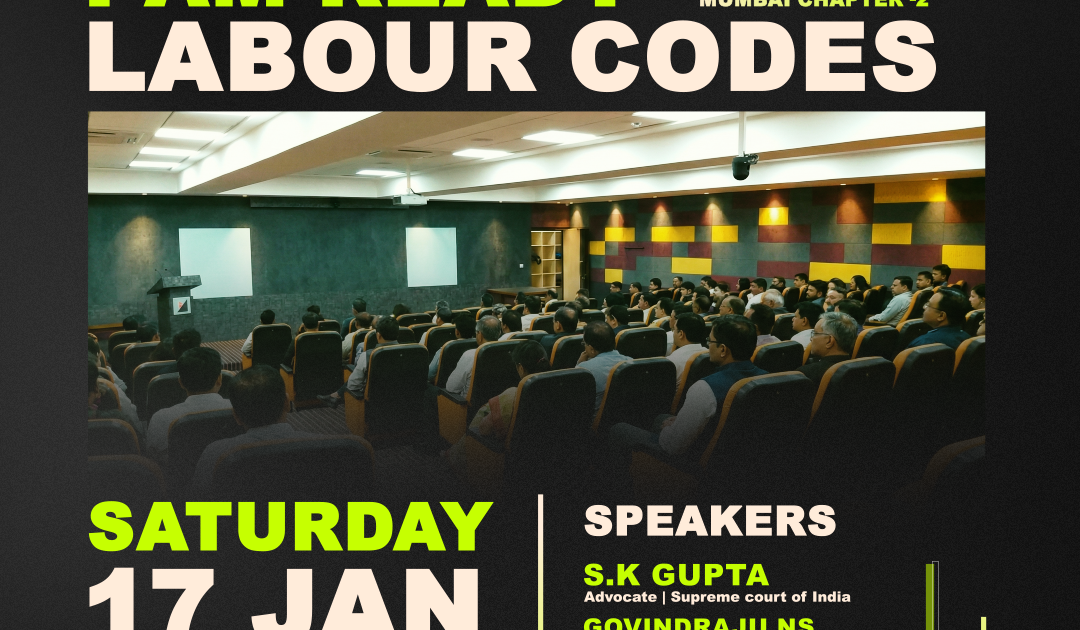
📢 Seminar Announcement | Mumbai
Seminar on India’s New Labour Codes
“I Am Ready” – Mumbai Chapter 2
🗓 Date: 17 January 2026
🕙 Time: 10:00 AM – 5:00 PM
📍 Venue: Thakur College of Engineering & Technology
We are pleased to announce a full-day, in-depth seminar on India’s Four New Labour Codes, curated to support employers, HR leaders, compliance professionals, IR practitioners, and consultants in navigating the 2025–26 compliance transition.
This practitioner-led programme focuses on statutory interpretation, implementation mechanics, and risk mitigation, with practical case studies drawn from live industry scenarios.
%20z5.png)
🎙 Distinguished Speakers
-
Adv. S. K. Gupta
Senior Advocate, Supreme Court of India -
GovindRaju NS
Author & Labour Law Advisor -
Rahul Kunwar
Founder, Compliance Monk -
Aasheesh Prajapati
Founder & CEO, IndiThinkk Services (Moderator)
🔍 What You Will Gain
-
Clear and authoritative interpretation of the Four Labour Codes
-
Employer obligations under the Codes: Wages, IR, Social Security, and OSH
-
Implementation strategies and compliance readiness for FY 2025–26
-
Case studies on wage structuring, social security coverage, IR transitions
-
Live interaction & Q&A with subject-matter experts
-
Peer learning with senior HR, IR, compliance leaders, and business owners
👥 Expected Participation
175+ professionals, including:
HR Heads • IR Managers • Compliance Officers • Business Owners • Labour Law Consultants
🔗 Agenda & Registration
👉 Register here:
https://indithinkk.com/index.php/2025/12/12/17th-jan-2026-seminar-i-am-ready-labour-codes/
📌 Seats are limited. Early confirmation is strongly recommended.
#LabourCodes #HRCompliance #IndustrialRelations #EmploymentLaw #HRLeadership #Compliance2025 #MumbaiEvents #ComplianceMonk
%20z2.png)
%20z4.png)
%20z1.png)
%20z3.png)
[ad_2]
Source link

