
[ad_1]
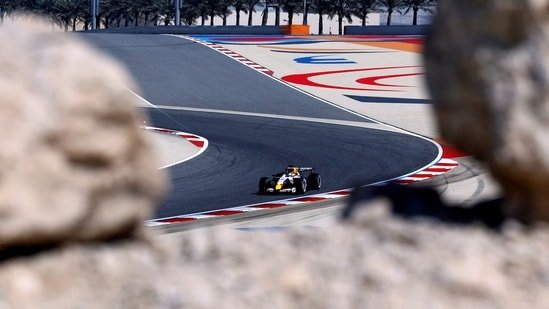
The upcoming Bahrain and Saudi Arabian Grand Prixes won’t go ahead as per the original schedule due to the ongoing crisis in West Asia, the Formula 1 organisers confirmed on Sunday. A full cancellation has not been announced, and stakeholders say they will look to schedule the races later this year. But going by the packed F1 calendar, it looks difficult that we would see some action in two of the most popular tracks in the world.

The Bahrain and Saudi Arabian GP were slated to go ahead on April 12 and 19, but as soon as the tensions escalated between the USA-Israel and Iran, one knew that the postponement of the races is just a matter of time.
The cancellation of these two races doesn’t augur well for the sport, as a commercial hit is inevitable. According to the BBC, more than 100 million pounds will be lost as Bahrain and Saudi Arabia pay two of the circuit’s biggest hosting fees. If the races don’t go ahead, the F1 calendar will also drop to 22 races from the 24-race schedule.
The hosting fees are split between the 11 F1 teams and the global body, and hence everyone involved is set to loose significant amount of money.
The F1 teams take around half of the overall profits as prize money in a single calendar year, so a loss of several million dollars is on the cards.
Earlier, speaking at the Australian Grand Prix, Haas boss Ayao Komatsu had stated that the financial impact of the cancellation has not been fully figured out yet, but that would be hard to ignore.
“Even in the best case, it’s not negligible,” he said. “The worst case, I wouldn’t say a significant impact, but a notable impact,” he added.
The cancellation of the Bahrain and Saudi GP also means there will be 33 days without racing between the Japanese Grand Prix (March 29) and the Miami GP (May 4). There is already a three-week gap between the Miami GP and the Canada GP, so there would be just one race in seven weeks. The organisers have already confirmed that no replacements would be sought for Bahrain and Saudi Arabia.
The cancellation was inevitable
The West Asia conflict had already disrupted the F1 calendar in 2026, as many personnel had their journeys to the Australian Grand Prix disrupted due to travel restrictions in the Middle East. The entire airspace was disrupted due to the war, and at that time, one knew that the races in Bahrain and Saudi Arabia would be cancelled.
The teams had to find alternative routes to Melbourne. It is worth noting that the Bahraini capital, Manama, hosts a US naval base in the residential district of Juffair, which is home to many F1 personnel during the race weekend.
The unplanned extended gap between the races will now give all teams a chance to regroup. A chance has also been given to consider tweaks to the new rules, which have come under heavy criticism for playing with the sanctity of the sport.
The new engines currently feature a 50-50 split between internal combustion and electrical power, which has led to concerns that the driver is being taken out of the mix and that the sport is decided by who has the better, faster car.
[ad_2]
Source link

