

[ad_1]
If your money plant is not growing, you are not alone. This is one of the most searched complaints among Indian plant parents, whether you keep pothos on a shelf in Hyderabad, hang it near a window in Mumbai, or grow it in a dim Delhi apartment. The reassuring part is that money plant growth problems almost always have a clear cause, and most of them are fixable within days.
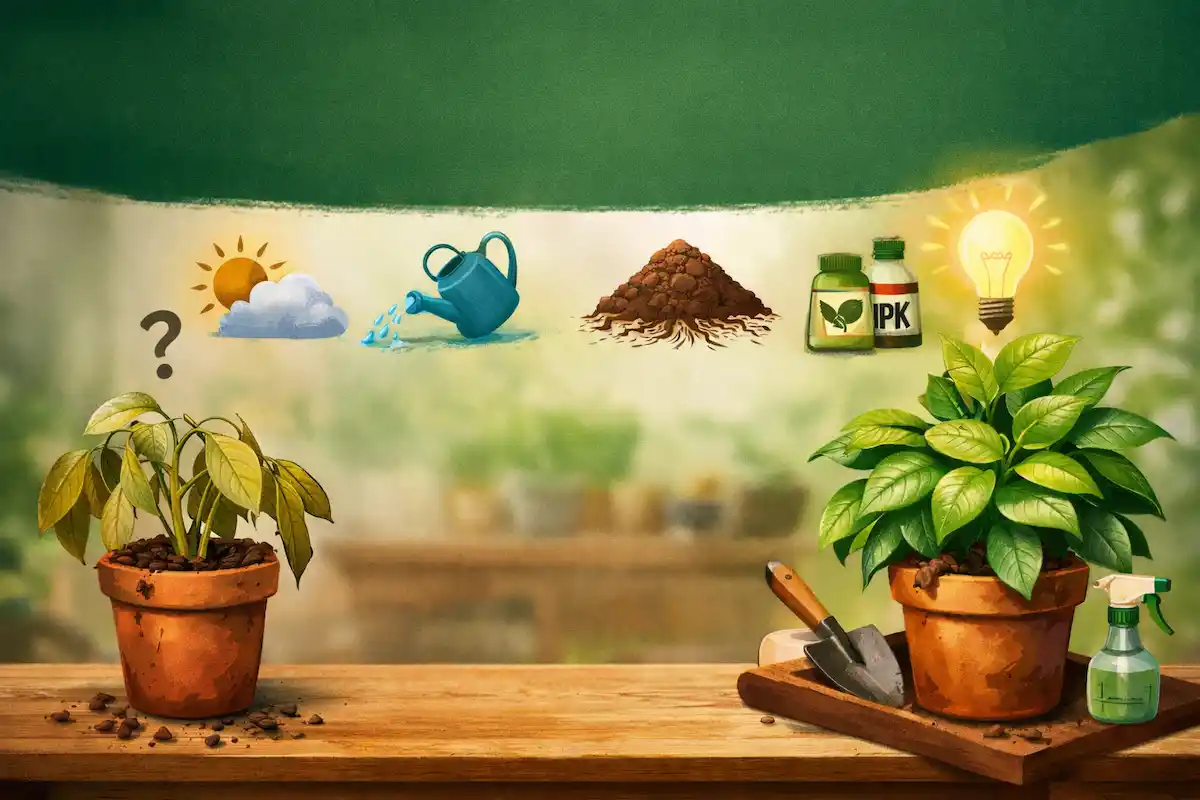
A money plant stopped growing usually traces back to one or more of six root causes: wrong light, watering mistakes, poor soil, pot problems, nutrient gaps, or seasonal slowdown. Before you change anything, understand that slow growing pothos is often just the plant signaling something specific needs attention.
In most Indian apartments, simply moving the plant closer to a window solves the issue without needing fertilizer or repotting. This guide walks you through every reason money plant growing slowly happens, the biology behind it, and exactly how to fix it.
Whether you are dealing with money plant growth issues after repotting, yellowing leaves, or a plant that refuses to push out new growth despite looking otherwise healthy, every answer is here, arranged so you can diagnose and act fast.
Money Plant Not Growing? Quick Answer

Money plant stops growing mainly because of insufficient indirect light, overwatering leading to root rot, being rootbound in a small pot, or nutrient deficiency. Fix it by moving it to a bright spot away from direct sun, letting soil dry between waterings, repotting when roots circle the bottom, and feeding with a balanced liquid fertilizer once a month during summer.
Why your money plant stopped growing (quick causes overview)
| Cause | Quick Fix | Time to See Results |
| Low indirect light | Move 1 to 2 ft from a bright window | 2 to 3 weeks |
| Overwatering / root rot | Let soil dry, trim black roots | 3 to 4 weeks |
| Rootbound pot | Repot to 2-inch larger pot | 2 to 4 weeks |
| Nutrient deficiency | Liquid NPK fertilizer (20:20:20) | 2 to 3 weeks |
| Temperature stress (AC rooms) | Keep away from direct AC vents | 1 to 2 weeks |
| Hard tap water | Switch to filtered or RO water | 2 to 3 weeks |
| Seasonal dormancy (winter) | Reduce watering, wait for spring | Natural cycle |
Fastest ways to fix slow money plant growth naturally
The three changes that produce results fastest: move to brighter indirect light, fix watering frequency based on soil feel rather than schedule, and prune long bare vines above a node. Many indoor gardeners see growth improve within three to four weeks after correcting just the watering routine alone.
How long money plant takes to start growing again
Once you fix the underlying problem, most money plants push out a visible new leaf within 3 to 6 weeks. If you have corrected light and watering but still see no growth after 8 weeks, check the roots for rot or look for pest damage on leaf undersides.
Signs your money plant will recover soon
- The newest leaf unfurls even slightly
- Existing leaves stay firm and green, not yellowing
- New white root tips appear at the drainage hole
- Vines start extending from nodes
How to Diagnose Why Your Money Plant Is Not Growing (2-Minute Plant Health Check)
Before you change anything, spend two minutes checking these four things. Most money plant care problems become obvious once you slow down and actually look at the plant.
How to check money plant leaves for growth problems
Yellow leaves point to overwatering or nitrogen deficiency. Brown, crispy tips usually mean underwatering, low humidity, or hard water mineral buildup. Pale green or washed-out color signals too much direct sun or light deficiency. Small, widely spaced leaves on long vines (leggy growth) means the plant is stretching toward light it cannot find.
How to check roots for root rot or root bound problems
Slide the plant gently out of its pot. Healthy roots are white or light tan and firm. Black, mushy, or foul-smelling roots mean rot. Roots tightly circling the bottom or pushing through drainage holes mean the plant is rootbound. Either condition will halt pothos plant growth completely. I’ve seen this happen most often in apartments where pots sit in saucers and the water is never emptied.
How to test soil moisture correctly for money plant care
Push your finger two inches into the soil. If it feels wet or cold, do not water. Money plants want the top two inches of soil to dry out completely before the next watering. A moisture meter takes the guesswork out entirely and costs under 200 rupees at most garden stores.
How to check sunlight using the indoor shadow test
Hold your hand about 30 cm above a white surface near where your plant sits. A sharp, clear shadow means bright indirect light. A soft, blurry shadow means medium light. No visible shadow means light is too low for healthy growth. Most Indian apartments facing east or north fall into the medium to low range, which is why money plant not growing indoors is so common here.
Quick money plant problem diagnosis table (problem to cause to fix)
| Symptom | Most Likely Cause | Fix |
| Yellow leaves, no new growth | Overwatering or nitrogen deficiency | Reduce watering; add liquid nitrogen fertilizer |
| Brown, crispy leaf tips | Low humidity, hard water, or underwatering | Mist leaves; switch to RO water |
| Thin, weak stems | Insufficient light or over-fertilizing | Move closer to window; skip fertilizer for 4 weeks |
| No new leaves for 6+ weeks | Rootbound, nutrient depleted, or low light | Check roots, fertilize, improve light |
| Black, mushy roots | Root rot from overwatering | Trim affected roots; repot in fresh dry mix |
| Growth stopped after repotting | Transplant shock | Wait 4 weeks; water only when top soil is dry |
| Leggy vines, small leaves | Stretching toward insufficient light | Move to brighter indirect light; prune long vines |
Money Plant Not Growing? 12 Common Reasons You Must Check First

Wrong sunlight conditions causing money plant slow growth

Money plants generally do best with about 4 to 6 hours of bright indirect light each day. A spot that gets direct afternoon sun through an unshaded west window will scorch leaves. A spot deep inside a room with no window nearby will produce leggy, slow growth.
The ideal location in most Indian homes is within 1 to 2 metres of an east-facing or north-facing window. South-facing windows work well if you use a sheer curtain to filter the intensity. In most Indian apartments, simply repositioning the plant is the single change that produces the fastest visible result. In many homes, this one move is enough.
Overwatering causing root rot and growth stopping
From what most indoor growers observe, overwatering is the leading cause of money plant failure in Indian homes. It prevents root oxygen exchange, and without oxygen, roots cannot absorb nutrients, so the plant stops growing entirely. That alone explains many stalled plants in Indian homes. In a humid Indian summer or monsoon, money plants in soil may need water only once every 10 to 12 days. In AC rooms where humidity drops, check the soil before every watering rather than following a fixed schedule.
Many indoor gardeners notice growth improves noticeably within a month after correcting watering alone. Interestingly, this single correction fixes growth issues for many beginners without any other changes needed.
Underwatering causing dry roots and stunted growth
The opposite problem exists too. When soil stays bone dry for extended periods, roots shrink and cannot pull nutrients. Leaves curl slightly at edges, and new growth stalls. Water thoroughly until it drains from the bottom, then wait until the top two inches dry out completely before watering again.
Poor soil drainage affecting pothos plant growth
Garden soil compacts in pots and suffocates roots. It also holds too much water. This surprises many beginners who assume garden soil works everywhere. Money plants do best in a loose, well-draining mix. A practical home recipe: 50 percent regular potting mix, 30 percent cocopeat, 20 percent perlite or river sand. This gives roots room to breathe and prevents waterlogging even during monsoon.
Nutrient deficiency causing money plant growth problems
Potting soil exhausts its nutrients within 6 to 8 months. After that, the plant is effectively living on empty. A balanced liquid fertilizer with equal parts nitrogen, phosphorus, and potassium (labeled 20:20:20) used once a month from March through September is enough for healthy growth. Avoid fertilizing in winter when the plant naturally slows down. This is where many beginners accidentally overcorrect, adding more fertilizer when the plant actually just needs rest.
Small pot causing root bound money plant
When roots have no room to expand, growth stops. Check for roots circling the base of the pot or emerging from drainage holes. A rootbound money plant needs repotting into a container 2 inches wider. Do not go too large, as excess soil holds moisture and can cause the slow root suffocation that looks deceptively like underwatering.
Indoor temperature stress affecting growth
Money plants prefer temperatures between 18 and 30 degrees Celsius. In Indian cities, the main problem is not cold but the sudden chill from air conditioning. Direct AC airflow dehydrates leaves faster than roots can replace moisture, pushing the plant into a stress state that shuts down growth. Keep plants at least 1.5 metres away from AC vents.
Pest infestation stopping money plant development
Spider mites, mealybugs, and fungus gnats are the most common pests. Mites leave fine webbing under leaves. Mealybugs appear as small white cotton patches at leaf joints. Fungus gnats in the soil indicate overwatering. Any active infestation diverts the plant’s energy toward defense rather than growth. Wipe leaves with a diluted neem oil solution weekly as prevention.
Hard water damage in Indian homes
Tap water in cities like Hyderabad, Bengaluru, and Delhi is often hard, meaning it carries high calcium and magnesium mineral content. Over time, these minerals build up in the soil and block nutrient absorption. Switching to RO water, collected rainwater, or letting tap water sit overnight to allow chlorine to evaporate can make a visible difference within a few weeks.
Lack of pruning causing leggy money plant
Without pruning, a money plant sends energy along existing long vines rather than producing new stems and leaves. Cutting just above a node, the small bump where a leaf meets the stem, triggers the plant to branch. Regular light pruning every 4 to 6 weeks keeps the plant compact and actively growing. Most growers are surprised how quickly new shoots appear after their first proper pruning session. Most first-time growers do not expect results this fast.
Seasonal dormancy slowing pothos growth
From October to February across most of India, money plants slow down naturally. This is not a problem to fix. Reduce watering frequency, skip fertilizer completely, and hold off on repotting until March. Growth resumes as temperatures rise.
Repotting shock causing temporary growth pause
Any repotted plant takes 2 to 4 weeks to settle before resuming active growth. Roots need time to explore new soil. Avoid fertilizing for 4 weeks after repotting. Water once the top soil dries and keep the plant in its usual spot without moving it.
Money Plant Growing Slowly Indoors? Hidden Mistakes Most People Make
Keeping money plant too far from sunlight indoors
The most common placement mistake in Indian homes is putting the money plant on a shelf or table in the center of a room, 3 to 4 metres from the nearest window. At that distance, light intensity drops to roughly 10 to 15 percent of what it is at the window. The plant survives but barely grows.
Using decorative pots without drainage holes
Ceramic and terracotta decorative pots often have no drainage hole. Water collects at the bottom and creates an anaerobic zone where roots suffocate. Either drill a drainage hole or use a plain nursery pot inside the decorative one, and always empty the outer pot after watering.
Over fertilizing indoor money plants
More fertilizer does not mean faster growth. Over-fertilizing burns roots and creates salt buildup that locks out water and nutrients. One diluted application per month during growing season is the maximum. If you see white crusty deposits on the soil surface, flush the pot thoroughly with water to wash out excess salts.
Dust accumulation reducing photosynthesis
In Indian cities where dust accumulates quickly, money plant leaves get a visible grey coating within weeks. Dust blocks light from reaching the chlorophyll and noticeably reduces energy production. Wiping leaves with a damp cloth every 2 to 3 weeks alone can improve growth speed. It is a small habit that most beginners skip and most experienced growers never miss.
Ignoring early root bound warning signs
Roots peeking from drainage holes or water draining too fast (because roots fill the pot with no soil left to absorb it) are early rootbound signs. Catching these early means a simple repot, not an emergency rescue.
Moving money plant too often
Each time you move a plant to a spot with different light, temperature, or airflow, it takes 1 to 2 weeks to acclimatize. Frequent moves create constant low-level stress that suppresses growth. Find one good spot and leave it.
Signs Your Money Plant Is Dying vs Just Growing Slowly

This confusion trips up a lot of plant parents. A dormant money plant and a dying one can look quite similar at first glance. The difference comes down to the condition of existing leaves and roots, not just the absence of new growth.
| Observation | Just Growing Slowly (Normal) | Actually Dying (Act Within 48 Hours) |
| Leaf color | Firm green, maybe slightly pale but stable | Yellowing spreading leaf to leaf, or brown patches |
| Leaf texture | Crisp and turgid when touched | Soft, wilted, or papery dry |
| Stem condition | Firm green or brown woody stem | Mushy, black, or collapsing at the base |
| Root condition | White or tan, firm roots | Black, slimy, or foul-smelling roots |
| Leaf drop rate | No drop or one occasional old leaf | Multiple leaves dropping within days |
| New growth | No new leaves but plant looks stable | Old healthy leaves also yellowing and falling |
| Soil smell | Earthy, neutral smell | Sour or rotting smell from soil |
If your plant matches the middle column, it is in a slow phase and needs a care adjustment. If it matches two or more items in the right column, act fast. Remove from the pot, trim all black roots, let remaining roots air dry for an hour, and repot in completely fresh soil. From what most indoor growers in India observe, a money plant that is truly dying almost always traces back to root rot from overwatering, and catching it early makes all the difference.
How to Fix a Money Plant That Is Not Growing (Step-by-Step Recovery Guide)
Step 1: Fix sunlight to make money plant grow faster indoors
Move the plant to a spot within 1 to 2 metres of an east or north-facing window. If your home has no such window, a south-facing window with a sheer curtain filter works well. Rotate the pot 90 degrees every week so all sides receive even light exposure. In very dark apartments, a basic grow light running for 8 to 10 hours daily can replace natural light effectively.
Step 2: Correct watering schedule for pothos plant care

Water only when the top 2 inches of soil are dry. In summer, this is roughly every 7 to 10 days. During monsoon humidity, it may stretch to 12 to 15 days. In winter, water once every 2 to 3 weeks. Always water deeply so water exits from the drainage hole, then empty the tray beneath the pot after 30 minutes.
Step 3: Improve soil mix for faster root growth
If the existing soil is compact or soggy, repot into a fresh mix. Combine equal parts cocopeat and standard potting mix, then add about 20 percent perlite for drainage. This mix holds just enough moisture while giving roots the air they actually need to function. Roots need oxygen just as much as water, and a loose mix is how you deliver both.
If you want to go deeper on this, we have a full breakdown of the best soil mix for money plant with exact ratios and locally available ingredients in India.
Step 4: Best fertilizers to boost money plant growth naturally
For fastest recovery, use a liquid balanced fertilizer diluted to half strength, applied once every 3 to 4 weeks from March through September. For a natural option, use rice water (the milky water left after washing raw rice) every 2 weeks during growing season. Banana peel liquid fertilizer adds potassium that strengthens stems and improves stress resistance.
Step 5: How to repot money plant correctly
Choose a pot only 2 inches larger in diameter than the current one. Fill the bottom third with fresh mix. Remove the plant gently, shake off old soil, trim any black or mushy roots with clean scissors, and place in the new pot. Fill around the sides, water lightly, and do not fertilize for 4 weeks.
Step 6: How pruning encourages new money plant growth
Identify long, bare vines with few leaves. Cut just above a node using clean scissors. The cut stimulates 2 to 3 new shoots from that point. Prune up to one-third of the plant at once. Never prune during winter dormancy as the plant cannot redirect energy effectively in that slow phase.
How to Make Money Plant Grow Faster Naturally (Proven Tips)
Organic fertilizers that help money plant grow faster

The three most effective homemade fertilizers for money plants are rice water, banana peel liquid, and diluted Epsom salt solution. Each targets a different nutrient need and together they cover most of what the plant requires during active growth.
Banana peel fertilizer for pothos growth
Soak two to three banana peels in one liter of water for 48 hours. Strain and use the liquid to water your plant once every two weeks. Banana peels are high in potassium, which supports root strength and stress resistance in actively growing vines.
Rice water fertilizer for indoor plants
The starchy, milky water from washing raw rice contains nitrogen, phosphorus, and beneficial trace minerals. Use it at room temperature instead of regular water once a week during growing season. Plants in rice-water treated pots typically show noticeably greener leaves within 3 to 4 weeks.
Epsom salt for money plant growth
One teaspoon of Epsom salt dissolved in one liter of water, used once a month, adds magnesium sulfate that directly supports chlorophyll production. This is particularly useful for money plants showing pale or slightly yellowing leaves despite adequate watering. Do not use more than once a month as excess magnesium can interfere with calcium uptake.
Node pruning technique for faster growth
When you prune just above a leaf node, the plant produces new growth from that cut point. Combine this with rooting the cuttings in water. New cuttings root within 10 to 15 days in Indian room temperatures, and once potted, they grow faster than established older plants because they have fresh root space to expand into. The Epipremnum aureum growth rate from fresh rooted cuttings in spring is noticeably faster than from old established plants.
Rotating plant for balanced growth
Rotating the pot 90 degrees each week ensures all sides of the plant receive equal light. Plants that sit in one position too long develop lopsided growth with dense leaves on one side and sparse growth on the other.
Cleaning leaves to improve growth speed
Clean leaves capture more light per square centimetre. In a dusty Indian city environment, this simple habit is one of the most underrated growth accelerators available.
Expert Tips Indoor Gardeners Use to Boost Money Plant Growth
Beyond the standard care advice, experienced indoor gardeners have a few consistent habits that separate thriving money plants from ones that just survive. These are not complicated techniques. They are small, deliberate choices that compound over time.
Why node cutting increases branching
When you cut a vine just above a node, the plant produces a hormonal response at that point. Instead of sending energy to the tip of one long vine, it redirects resources to produce multiple new shoots. Epipremnum aureum growth rate visibly increases within 3 to 4 weeks of a proper node prune. The detail most beginners miss: cut at a 45-degree angle just 5 to 10 mm above the node, not through it.
When experts fertilize pothos
Experienced growers do not fertilize on a fixed calendar. They fertilize based on what the plant is actively doing. If the plant is pushing new leaves, it gets a half-strength liquid feed. If it is in a slow phase or recovering from repotting, fertilizing is paused entirely. This responsive approach prevents the over-fertilizing trap that beginners fall into when they assume more nutrients always means more growth. Pothos growth rate indoors is directly linked to feeding only during active growth windows, not year-round.
Why experienced growers avoid large pots
If your home is like most Indian flats, nursery staff often recommend the next pot size up when you repot. Experienced growers go only 2 inches larger. Excess soil around roots stays wet too long in Indian humidity, especially during monsoon, and creates conditions for slow root suffocation that looks a lot like underwatering from the outside. Money plant node growth happens fastest when roots have just enough room to expand without sitting in a waterlogged void.
Best Growing Conditions for Money Plant (Complete Indoor Care Guide)
| Care Factor | Ideal Condition | Indian Context Note |
| Sunlight | Bright indirect, 4 to 6 hours daily | East or north window works best |
| Temperature | 18 to 30 degrees Celsius | Avoid direct AC airflow below 18 C |
| Humidity | 50 to 70 percent | Mist leaves in dry AC rooms |
| Watering | When top 2 inches of soil dry | Every 7 to 15 days depending on season |
| Soil | Well-draining cocopeat plus perlite mix | Never use plain garden soil in pots |
| Fertilizer | Liquid NPK, half strength, once a month | March to September only |
| Pot size | 2 inches wider than root ball | Terracotta preferred for drainage |
| Water type | RO, filtered, or overnight tap water | Hard tap water causes mineral buildup |
Ideal sunlight requirement for money plant indoors
4 to 6 hours of bright indirect sunlight daily is ideal. Below 3 hours and growth becomes very slow. Above 6 hours of direct sun causes leaf scorch. An east-facing window provides gentle morning sun that is strong enough to fuel growth without burning leaves.
Best temperature range for pothos growth
18 to 30 degrees Celsius is the active growth range. Below 15 degrees the plant enters a near-dormant state and above 38 degrees with direct sun causes heat stress. Most Indian homes stay within the ideal range for 7 to 8 months of the year, which is why money plant is such a reliable indoor plant here.
Best water for money plant (tap vs RO vs rainwater)
Rainwater is ideal as it is naturally soft and slightly acidic. RO water is the next best option available in most Indian homes. If using tap water, let it sit in an open container overnight to allow chlorine to evaporate and temperature to equalize. Never water with ice-cold water as it shocks roots.
Money Plant Not Growing in Water? Causes and Solutions for Water Propagation

Dirty water preventing money plant growth
In water propagation, algae and bacteria build up rapidly in warm Indian temperatures. Change the water completely every 5 to 7 days. Keep the container in indirect light, not direct sun, as sunlight accelerates algae growth and depletes oxygen from the water.
Lack of nutrients in water propagation
Plain water has no nutrients. After the first 4 weeks once roots have formed, add a few drops of liquid fertilizer to the water every 2 weeks. This makes a significant difference in how fast the plant transitions from establishing roots to producing new leaves.
How often to change water for money plant
Change water every 5 to 7 days in summer and monsoon. In cooler months, every 7 to 10 days is usually sufficient. Always use water at room temperature and rinse the container before refilling to prevent biofilm buildup.
Weak cuttings that fail to grow
A cutting must have at least one healthy node submerged in water. Cuttings taken from leggy, weak vines with poor leaf development rarely root well. Take cuttings from healthy, actively growing sections of the plant with at least 2 to 3 nodes.
Tips to grow money plant faster in water
- Use a dark or opaque container to reduce algae growth
- Keep water at room temperature, never refrigerator-cold
- Change water every 5 to 7 days
- Add 2 to 3 drops of liquid fertilizer every two weeks after roots appear
- Place in bright indirect light, not direct sun
Signs Your Money Plant Is Healthy But Not Growing (Often Misunderstood)
Natural slow growth phases explained
Money plants are not year-round growers. They have active growth phases (spring through early autumn) and rest phases (mid-autumn through winter). A plant with firm green leaves, no yellowing, no pest signs, and healthy roots is doing fine even if it has produced no new leaves for several weeks between October and February.
Dormancy vs unhealthy plant symptoms
| Dormancy (Normal) | Unhealthy Plant (Needs Action) |
| Leaves stay green and firm | Leaves yellowing or browning |
| No new leaves for weeks in winter | Existing leaves dropping off |
| Growth slows in winter months | Growth stopped in peak summer |
| Plant looks stable overall | Stems becoming soft or mushy |
| Roots look white or tan | Roots black or foul-smelling |
Growth pause after propagation
A newly propagated cutting that has just been moved from water to soil will pause for 2 to 4 weeks as it adapts to soil conditions. This is normal and expected. Keep watering light and resist the urge to fertilize early.
When slow growth is normal
Slow growth is normal in winter, immediately after repotting, in the first month after propagation, and when the plant is adjusting to a new location. In all these cases, the plant is not failing. It is stabilizing.
Scientific Reasons Money Plant Stops Growing (Plant Biology Explained)
How photosynthesis affects money plant growth
Epipremnum aureum uses chlorophyll in its leaves to convert light, water, and carbon dioxide into glucose. This glucose is the fuel for all cell division and new growth. When light is insufficient, glucose production drops and the plant enters conservation mode where it stops producing new cells entirely. This is why light is the first variable to fix when money plant not growing indoors is the issue.
Root oxygen and growth relationship
Roots need oxygen just as much as water, and they get it from air pockets in the soil. When soil is waterlogged, those air pockets disappear. Roots switch to anaerobic respiration, which produces alcohol as a byproduct. That alcohol is toxic to root cells, which is how overwatering causes the black, mushy rot most indoor plant owners eventually encounter.
Nutrient transport inside Epipremnum aureum
Nutrients dissolved in water move from roots upward through the plant via the xylem — this is basically how the plant transports everything it needs to grow. If roots are damaged, dry, or surrounded by mineral-blocked soil (as happens with hard tap water over time), this transport breaks down. Leaves turn yellow not because they are unhealthy themselves but because they are not receiving what the roots cannot deliver.
If you want to read more on the plant biology side, the Royal Horticultural Society growing guide for Epipremnum aureum covers the species in detail from a horticultural research perspective.
How chlorophyll impacts leaf development
Chlorophyll production requires both magnesium and nitrogen. A deficiency in either turns leaves from rich green to pale yellow-green, a condition called chlorosis. Once chlorophyll levels drop, each leaf produces less energy, and the plant prioritizes survival of existing tissue over producing new leaves.
Best Fertilizers for Money Plant Growth (Natural vs Chemical Guide)
NPK fertilizer explained for pothos growth
Put simply, NPK is just nitrogen, phosphorus, and potassium — the three things plants actually run on. Nitrogen drives leafy green growth. Phosphorus supports root development and energy transfer. Potassium strengthens stems and improves stress resistance. A balanced 20:20:20 liquid fertilizer covers all three.
For money plants that are struggling with slow growth, a slightly nitrogen-heavy formulation like 30:10:10 during the first two months of recovery can accelerate leaf production.
Organic fertilizers safe for indoor plants
Rice water, banana peel liquid, and diluted cow dung solution (jeevamrit, available at many Indian nurseries and agri stores) are all safe and effective for indoor money plants. They release nutrients slowly and do not risk burning roots the way concentrated chemical fertilizers can when overused.
How often to fertilize money plant safely
Once a month at half strength during the growing season (March to September). Never in winter. Never more than once every 3 weeks regardless of what the label says, as money plants in pots cannot flush salts as easily as outdoor plants.
Signs of fertilizer burn
Brown leaf tips that appeared shortly after fertilizing, white crusty salt deposits on soil surface, and suddenly wilting leaves despite adequate water are all signs of fertilizer burn. Flush the pot generously with plain water three times in a row to leach out excess salts.
Homemade fertilizers for money plant
| Fertilizer | How to Make | How Often | Primary Benefit |
| Rice water | Soak raw rice, use milky water | Weekly in growing season | Nitrogen, phosphorus, trace minerals |
| Banana peel liquid | Soak 2-3 peels in 1L water for 48 hrs | Every 2 weeks | Potassium, stress resistance |
| Epsom salt solution | 1 tsp in 1L water | Once a month | Magnesium, chlorophyll support |
| Onion peel water | Boil peels, cool, dilute | Every 2 weeks | Quercetin, calcium, potassium |
For the complete list of recipes and how to apply each one correctly, check out our detailed guide on homemade fertilizers for money plant.
Money Plant Not Growing in Indian Homes? Local Climate Factors You Must Know
How Indian summer heat affects money plant growth
From April to June, temperatures in cities like Hyderabad, Nagpur, and Ahmedabad regularly exceed 40 degrees Celsius. Water evaporates rapidly from both soil and leaves at these temperatures. Plants may need watering every 4 to 5 days. Keep plants away from direct afternoon sun during these months and consider placing a small tray of water nearby to raise local humidity around the leaves.
Winter slow growth in Hyderabad and South India homes
Even in South India where winters are mild, temperatures dropping below 18 degrees at night from November through January will slow growth considerably. In North India the effect is more pronounced. Reduce fertilizing completely and water only when the soil is fully dry during these months.
Money plant care during monsoon humidity
During July through September, high humidity reduces water loss from leaves and soil significantly. Watering schedules need to stretch out. Overwatering during monsoon is extremely common and is a leading cause of root rot in Indian homes during this period. Check soil moisture before every single watering, without exception.
Best placement in Indian apartments
An east-facing window or balcony is the best position in most Indian homes. It provides soft morning light that is intense enough to fuel growth but not harsh enough to scorch leaves. North-facing windows work as a secondary option. South and west-facing placements need a sheer curtain to filter the stronger afternoon sun.
Hard water problems in Indian cities
Cities with notoriously hard water including Hyderabad, Chennai, Bengaluru, and Delhi create gradual mineral buildup in soil that restricts nutrient absorption over time. If you have been using tap water for over 6 months and growth has slowed without any obvious other cause, this buildup may be the reason. Flush the pot thoroughly with RO water three times and switch to filtered water going forward.
Money plant care in AC rooms
AC rooms typically have 30 to 40 percent humidity, well below the 50 to 70 percent money plants prefer. This causes faster leaf moisture loss and can dry out the top of soil quickly while deeper roots still sit in moisture, making it very hard to gauge when to water. Mist leaves every 2 to 3 days, keep plants away from direct vents, and grouping multiple plants together creates a microclimate with measurably higher local humidity.
Money Plant Care Calendar (Seasonal Growth Guide for India)
| Season | Months | Watering | Fertilizing | Key Action |
| Summer | March to June | Every 5 to 7 days | Monthly liquid NPK | Watch for heat stress; increase frequency gradually |
| Monsoon | July to September | Every 10 to 14 days | Monthly liquid NPK | Reduce watering; check for fungus gnats in soil |
| Post-monsoon | October to November | Every 10 to 12 days | Last feed in October | Prune before dormancy begins |
| Winter | December to February | Every 14 to 21 days | None | Minimal care; avoid repotting or pruning |
Best fertilizing months for money plant
March through September is the active fertilizing window. April through June, when the plant is in its most active growth phase, is when fertilizer produces the biggest response. Stop completely by October and do not resume until new growth is visibly emerging in spring.
Where Should You Place Money Plant for Fastest Growth? (Indoor Placement Guide)
Best direction to keep money plant indoors
East-facing placement gives the best results in Indian homes because it catches morning sun (soft, diffused, growth-promoting) and avoids harsh afternoon intensity. North-facing windows are the second choice. Avoid placing directly against a west or south-facing window without filtering.
For a more complete room-by-room breakdown, this guide on where to keep money plant at home covers both scientific placement and Vastu considerations together.
Window placement vs table placement
Within 1 metre of a window is almost always better than a table placement in the middle of a room. Light intensity follows the inverse square law, meaning even moving 1 metre further from a window roughly halves the light the plant receives.
Balcony placement tips
A shaded balcony facing east or north is arguably the ideal money plant location in Indian apartments. Balconies provide natural airflow, humidity closer to outdoor levels, and consistent indirect light. Just protect the plant from heavy monsoon rain that can cause soil waterlogging if drainage is poor.
If you are setting up a balcony plant space, this guide on growing money plant in pots indoors and on balcony covers everything from container choice to positioning in detail.
Places to avoid keeping money plant
- Directly under or next to an AC vent
- On a windowsill with no curtain in west-facing rooms after 2 PM
- In a bathroom with no natural light source
- On top of a refrigerator or near a cooking range
Beginner Money Plant Care Checklist

If you are new to money plants or want to do a quick audit of your current setup, run through this list. Each item takes less than two minutes to check and covers every major cause of money plant not growing.
- Pot has at least one drainage hole at the bottom
- Plant sits within 1 to 2 metres of a window with indirect light
- Soil is a loose, well-draining mix (not heavy garden soil)
- Watering only when top 2 inches of soil feel dry
- Using filtered, RO, or overnight-settled tap water
- Pot size is no more than 2 inches wider than the root ball
- Leaves wiped clean of dust every 2 to 3 weeks
- No fertilizer applied in winter months (October to February)
- Plant is not sitting in a tray of standing water
- No direct airflow from AC vent hitting the plant
- Half-strength liquid fertilizer applied once a month in growing season
- Long bare vines pruned above a node every 4 to 6 weeks
If you can check off all 12 items, your money plant has every condition it needs to grow well. If even two or three are missing, those gaps are almost certainly why growth has stalled.
Best pot types for pothos plants
Terracotta pots are the best choice for Indian conditions. They are porous, allow air exchange through the walls, and dry out faster than plastic or glazed ceramic. This natural drying cycle reduces overwatering risk significantly. Plastic pots work but require more careful watering discipline.
Soil additives improving drainage
Perlite is the most effective drainage additive. It holds no water itself but creates air pockets in the mix. Cocopeat adds water retention and aeration together. River sand (not beach sand, which contains salt) is an affordable local alternative to perlite available at most Indian nurseries.
Moisture meter usefulness
A basic moisture meter removes the guesswork from watering, which is where most money plant growth problems originate. They cost under 200 rupees online and are especially useful in AC rooms where soil surface dries quickly but deeper layers stay wet.
Grow lights for low sunlight homes
A basic LED grow light running 8 to 10 hours daily can fully substitute for natural light in dark apartments. Look for full-spectrum lights with at least 1000 lux output. These are particularly useful during Indian winters when days are shorter and apartment light levels drop significantly.
30 Day Money Plant Growth Recovery Plan (Proven Routine)
Week 1 recovery actions
- Move plant to brightest indirect light spot available
- Check roots: trim any black or mushy ones and repot if needed
- Switch to filtered or RO water
- Wipe all leaves with damp cloth to remove dust
- Do not fertilize yet
Week 2 growth improvement steps
- Water only if top 2 inches of soil are dry
- Mist leaves in morning if in AC room
- Look for first signs of new leaf bud
- Prune two to three long, bare vines just above a node
Week 3 strengthening growth
- Apply first dose of diluted liquid fertilizer at half strength
- Continue checking soil before every watering
- Rotate pot 90 degrees for even light distribution
- Remove any dead or fully yellow leaves
Week 4 maintenance routine
- Assess progress: look for at least one new leaf emerged
- Continue monthly fertilizer schedule
- Do a second pruning if plant is producing multiple new shoots
- Document the spot and routine that is working. This routine is simple but surprisingly effective when followed consistently for a full month.
Money Plant Growth Myths You Should Ignore
Money plant grows only in water myth
Money plants grow in both soil and water, but they typically grow faster and produce larger leaves in well-draining soil because nutrients are more abundant and the root system can expand more fully. Water propagation is ideal for cuttings and for display, but for maximum Epipremnum aureum growth rate, soil is the better long-term medium.
Direct sunlight myth
More sun does not equal faster growth for money plants. Direct harsh afternoon sun bleaches leaves, causes scorch marks, and creates stress that actually slows growth. Indirect bright light consistently outperforms direct sun for this species.
Weekly fertilizer myth
Fertilizing every week, even with diluted solution, leads to salt buildup in the soil faster than roots can process it. Once a month during the growing season is correct. More frequent feeding is one of the most common ways beginners accidentally slow their plants down.
Bigger pot faster growth myth
A pot that is too large holds excess soil that stays wet far too long in Indian humidity, increasing rot risk. Always size up by just 2 inches at a time. A rootbound plant needs a bigger pot, but a small plant in a huge pot is actually at higher risk of root problems, not lower.
Money plant grows without care myth
Money plants are forgiving, but they are not indestructible. The reputation for needing no care leads many people to ignore watering, light, and nutrition entirely until the plant is severely stressed. A little regular attention every 1 to 2 weeks is all it takes to keep one thriving.
When Will Money Plant Start Growing Again? Growth Timeline Explained
| Timeframe | What to Expect |
| Week 1 to 2 | No visible change yet; plant adjusting to new conditions |
| Week 3 to 4 | First small leaf bud may appear; existing leaves perk up |
| Week 5 to 6 | New leaf fully unfurled; vines beginning to extend |
| Month 2 to 3 | Multiple new leaves; active vine growth visible weekly |
| Month 4 onward | Regular robust growth if care routine stays consistent |
How long money plant takes to show new leaves
Under corrected conditions, the first new leaf typically appears within 3 to 6 weeks. Faster results (2 to 3 weeks) are seen when the plant is moved to significantly better light. Slower results (6 to 8 weeks) are normal if the plant was severely stressed or root-rotted before treatment.
Signs your plant is recovering
A recovering money plant shows firm, upright existing leaves first, then a tightly rolled new leaf emerging from a node. Once the first new leaf appears, subsequent ones follow more quickly. Growth momentum builds once the plant is in a stable, suitable environment.
How to track money plant growth progress
Take a photo from the same angle every 2 weeks. Mark a vine tip with a small piece of tape and measure how far it extends each week. Even 2 to 3 cm of growth per week in a previously stalled plant confirms the recovery is working.
Some Common Questions Money Plant Growers Ask
1. Why is my money plant not growing new leaves?
The most common causes are insufficient light, being rootbound, or depleted soil nutrients. Check all three before trying anything else. Oddly enough, light turns out to be the answer more often than fertilizer. Move the plant closer to a window, check if roots are circling the bottom of the pot, and feed with a liquid fertilizer if you have not done so in the last 2 months.
2. Why is my pothos not growing indoors?
Indoor pothos growth slows when light levels fall below what the plant needs to sustain photosynthesis. Most rooms in Indian apartments, especially those facing west or with small windows, do not provide enough. Moving the plant within 1 to 2 metres of a window is usually the single most effective change.
3. How do I encourage new growth in money plant?
Prune long bare vines above a node to stimulate branching. Feed with a half-strength liquid fertilizer monthly from March to September. Ensure bright indirect light for 4 to 6 hours daily. Keep the plant in consistent temperatures between 18 and 30 degrees Celsius. Consistent care over 4 to 6 weeks is what produces reliable results.
4. Can money plant grow in low light?
Money plants survive in low light but do not thrive. Growth becomes very slow, leaves stay small, and vines get leggy. For actual growth rather than just survival, the plant needs medium to bright indirect light. A grow light is a practical solution for very dark Indian apartments.
5. Should I cut money plant to promote growth?
Yes. Pruning is one of the most reliably effective ways to stimulate new growth. Cut just above a node on any vine that has become long and bare. The plant redirects energy to produce 2 to 3 new shoots from that cut point. Do this during spring or early summer for best results.
6. Do money plants grow faster in soil or water?
Soil supports faster long-term growth because it provides both physical support for roots and a reservoir of nutrients. Water-grown plants root quickly from cuttings but plateau without added nutrition. For maximum pothos growth rate indoors, transition water-grown plants to a well-draining soil mix once roots are 5 to 8 cm long.
7. Why is my money plant healthy but not growing?
A healthy-looking plant that is not growing is most likely in seasonal dormancy (October to February), recently repotted and in recovery, or in a stable but slightly insufficient light situation. If it is not winter and you repotted more than 6 weeks ago, improving light is the first thing to try.
8. Can money plant stop growing permanently?
No. As long as the plant is alive, it can grow again. Even severely neglected money plants recover with corrected light, watering, and nutrients. The only exception is severe root rot that has destroyed most of the root system. In that case, taking healthy cuttings and propagating fresh plants is the most practical path forward.
Concluding
Money plants are genuinely forgiving once you understand what they actually need. Most of the time, one small change — moving the pot closer to a window, adjusting how often you water, or giving a long vine a clean prune — is all it takes to get things moving again. If your plant has been sitting still for weeks, run through the checklist in this guide before assuming something is seriously wrong. More often than not, it just needs a little attention in the right place.
[ad_2]
Source link

