
[ad_1]

About the author – Dyuvan D Machaaranda is an aspiring researcher and writer with a fascination for history, society, and all forms of creative human expression. He is currently working in the fields of social science research and heritage conservation.
Begur today is an unassuming southern suburb of Bangalore city. Urban buildup and traffic now overshadow, but its deep antiquity and glorious history still capture one’s attention while walking through its winding lanes even today. Artefacts and monuments from centuries past dot its geography, compelling the beholder to reconsider what they thought they knew of Bangalore’s past. Oral histories of the settlement, as narrated by the head priest of the Nāgēśvara temple complex, suggest that the area was historically known as Bēvūr in Kannada and Veppūr in Tamil, both meaning ‘Ville of Neem’. Phonetic changes are said to have caused the emergence of the modern name Bēgūr over time. As will be seen, this oral narrative is founded in truth.
According to epigraphical evidence, Begur, as a settlement of some importance, has likely existed for at least a millennium and a half. Its earliest extant name was Bempūr, which appears in the Malohalli copper plates dated 517CE.1 The same name appears in the well-known Begur herostone, dated circa the late ninth or early tenth century CE.2 It mentions an administrative division named Bempūr Twelve, of which Bempūr was apparently the headquarters. These records belong to the reign of the Western Ganga Dynasty, which ruled southern Karnataka from the 4th to the 10th Centuries CE. Bempūr/Begur in the Ninth and Tenth centuries appears to have been a regional capital of a feudatory chieftain under the Gangas. Numerous inscriptions found in Begur from this period, commemorating various events, mention the chieftain titled Nāgattara and his family.3 This chieftain is identified as of Bāṇa lineage according to one inscription from circa. 890CE.4

The region of Begur has always been a dynamic and buzzing area. Not only was it situated on the frontiers and borders of major medieval South Indian empires, but it was also a hub of overland trade connecting the eastern and western coasts of India.5 Begur would therefore have been a cosmopolitan and diverse settlement, and various evidence for this appears from the 11th century onwards. At the eve of the 10th century, the Western Ganga kingdom was conquered by the Cōḻas. Begur, therefore, fell under Tamil Cōḻa rule for the next century. While no direct epigraphical evidence to this is found at present, the Cōḻas left a lasting mark on the settlement. Firstly, the lingua franca in inscriptions at Begur for the next half millennium became Tamil.6 Socio-political titles and administrative nomenclature used in epigraphy used Cōḻa norms and formats in these centuries. Secondly, and much more telling, the temple for the deity named Cōḻēśvara was built in the Śaiva temple complex of Begur during this period. The Cōḻa influence was so deeply rooted in this region that even after the Hoysaḷas took control around the 12th century, inscriptions continued to use Cōḻa administrative units and noble titles. It is also in this period that the Tamil name Veppūr, mentioned in oral narratives, appears in inscriptions. Once again, under Hoysaḷa rule, Begur was controlled by a regional chieftain identified by the title Rājarāja Kaṟkaṭa Māharāja, who Rice suggests had both Western Ganga and Cōḻa lineage.7
The epigraphical record grows sparser after the 13th century. It can be identified that Begur was still a regional administrative centre for a territory called ‘Bēhūr Nādu’ by the 15th century. The architectural style suggests that the temples of Vīrabhadra, Veṇugopāla, and Kāśi Viśveśvara in Begur were possibly built during this period. Post this, little historical record has been found about Begur until the arrival of the Europeans. ‘Bevoor’ appears on British maps of the ‘Purgunnah of Bangalore’ from the end of the 18th century onwards.8 The ‘Ville of Neem’ therefore existed when the British snatched Bangalore from Tipu Sultan. Over the course of about a century, the contemporary ‘Begur’ emerges boldly as the headquarters of a Hobli (subdivision under a Taluq) with the same name in colonial survey records and maps. However diminished, Begur’s legacy as a regional hotspot persisted until modern times.
Pañcalinga Temple Complex

Approaching from the north, the first thing that catches one’s eye in Begur is the towering new Gopuras of the Nāgēśvara Temple Complex. Now also tellingly referred to as the Pañcalinga Temples, this complex houses Śaiva shrines built at various periods and in diverse styles. The complex is also famous for the millennium-old inscriptions and hero stones housed within its Prākāra. Almost all the epigraphs mentioned previously in reference to the Western Gangas and Nāgattara are originally from this site. The oldest inscriptional evidence for a place named ‘Bēnguḷūr’ is also found at this complex.

The antiquity of this particular site may stretch back 1,500 years. The Malohalli plates mention the donation of ‘Bempurīśvara Sthānam’ to a brahmin. Annaswamy states with certainty that this refers to the exact location of the Pañcalinga complex.9 While it is possible that a Śaiva centre existed at Begur a millennium and a half ago, there is more concrete evidence of temple building activity at the site from the 9th century onwards.
The Nāgēśvara Temple

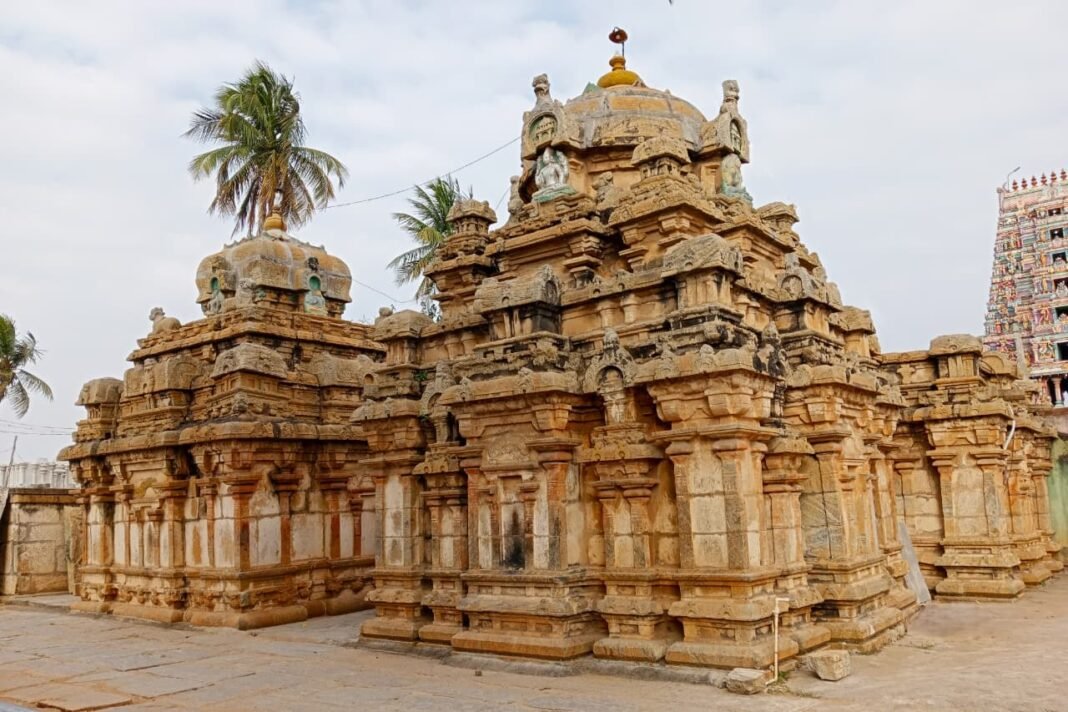
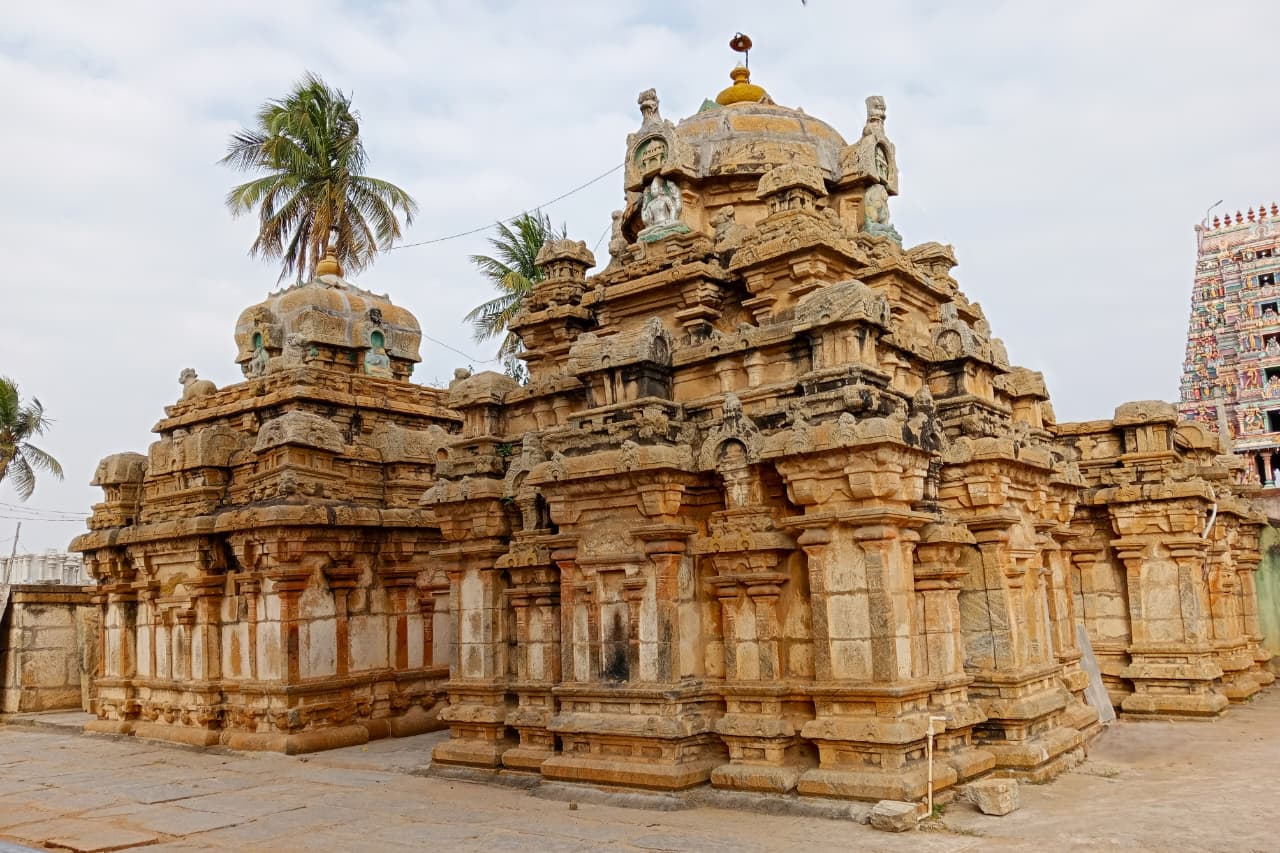
The oldest temple in this complex is dedicated to the deity now known as Nāgēśvara. The earliest inscription found in association with this temple is dated approximately 890 CE. It records Nāgattara building a Sōmanātha temple in Bempūr to commemorate his triumph over one Bīravarma.10 The name Nāgēśvara is thought to have developed in time due to the deity’s association with Nāgattara.11 The first mention of this nomenclature appears in a 13th-century inscription on the temple’s Kumuda, which mentions the Tamil name Tirunāgēśvaram Uḍaiya Mahādēvar. The same is also used in a successive inscription. Patronage to this temple was apparently not limited by dynastic considerations, as these inscriptions record grants made to the temple during Hoysaḷa rule.
V. Anuradha aptly identifies the architectural style of this temple as Ganga-Noḷamba.12 Due to the location of the temple being on the frontier of the two realms, features of both styles can be identified in this temple. Its layout consists of a square Garbha Griha, an Antarala, and a walled Navaranga Mandapa. Also connected to the shrine is a Nandi Maṇḍapa, which originally must have been an open-air structure but is now enclosed within a larger pillared maṇḍapa of a later period, connecting the two main shrines of the complex.
The Adhiṣṭhān of the structure is in the Kapōtabandha style, with a Jagati followed by a Tripaṭṭa Kumuda, Kapōta with Nāsīs, and a Prati interspersed with pilastered Galas. A Praṇāla emanates from the Kapōta on the northern side, and was likely styled like a Makara, but is now damaged. The outer architecture of the shrine is dynamic, with smaller aedicules or false shrines projecting out of the Dvitala Vimāna. The four corners of the Vimāna have Kūta aedicules, and the walls facing the four cardinal directions have Śala aedicules. These latter contain shallow Koṣṭhas created with split-pilasters and topped with Tōraṇas. Pañjara aedicules intersperse the Kūtas and Śalas. These are topped by Kīrtimukhas and Gādhas, which include miniature Śala shrines in low relief.
The Antarāla Bhitti contains Śala aedicules identical to the Vimāna. The features of the Maṇḍapa are similar to those of the Vimāna, except that the Pañjara aedicules are replaced by Jālāndras decorated with latā and dancer motifs. Sharma identifies these motifs as typical of Noḷamba iconography.13 The Pādas on the bhitti of the whole structure are of the Brahmakānta kind.

The Prastāra runs continuously across the Garbha Gṛha, Antarāla, and Maṇḍapa. The Valabhī contains iconography of Kubjas and fauna, amongst which those of geese are most notable, as they are characteristic of Ganga temples.14 The Kapōta is decorated with floral Nāsī motifs. The Prāsāda has a Vyālamāla base, and the Hāras of the first Tala, connecting the Śikharas of the aedicules, have further pairs of miniature Pañjara aedicules.
The second Tala is similar in layout to the first, but has a wide empty Koṣṭha facing the cardinals instead of the Śala aedicules. This tala is topped with a Vyālamāla. Above these Koṣṭhas and below the Mahānāsīs with Kīrtimukhas on the four cardinals of the Stūpī are the Vimāna Dēvatas. The east houses Indra; the south, Dakṣiṇāmūrti; the west, Viṣṇu, and the north, Brahma. Similarly, Nandis are carved facing all four deities on both flanks. A Kalaśa tops the Stūpī.
Of the interiors, most noteworthy are the reliefs of Ganga and Yamuna flanking the doorway of the Navaranga. This Maṇḍapa contains four Rudrakānta pillars. The Nandi Maṇḍapa features eight Brahmakānta pillars and a monolithic Nandi statue, positioned on a Padmapīṭha.
The Cōḻēśvara Temple

No concrete epigraphical evidence for this temple has been found. The architectural features and the deity’s nomenclature itself lend to its classification. Its features, in comparison to the Nāgēśvara Temple in the south, are much flatter and less dynamic. The complexity and detail of the Vimāna are comparatively less. These features are noted in temples built under Cōḻa in this region. Additionally, as the Nāgēśvara temple was constructed under Nāgattara rule, it can be argued in analogy that the Cōḻēśvara temple was built under Cōḻa rule.
The temple consists of a Garbha Gṛha, an Ardhamaṇḍapa, and a Navaranga Maṇḍapa. The Adhiṣṭhān of the temple is of the Pratibandha type, though the lower sections are now not visible above ground. It is constructed with a Vṛtta Kumuda, topped with a Gala and Prati strip with Vyāla motifs, and capped by a set of plain Gala and Prati. A damaged Praṇāla emanates from the Prati on the southern wall. Similar to the Nāgēśvara shrine, the four corners of the Cōḻēśvara Vimāna have Kūta aedicules, and the walls facing the four cardinal directions have Śala aedicules. These projections are much shallower than the aedicules of Nāgēśvara Vimāna, and therefore make the structure look much flatter and simpler than the former, as mentioned earlier. The Śala aedicules here also contain shallow Koṣṭhas, created with split pilasters (also of the Brahmakānta kind) and topped with floral toranas.

The first Tala extends out to the Ardhamaṇḍapa and Navaranga Maṇḍapa too, with the former having Śala aedicules and the latter replicating the Garbha Gṛha’s features, except with no outward aedicular projections on the Bhitti. The Prastāra similarly runs continuously across the structure, with the Valabhī containing iconography of Kubjas and fauna, and the Kapōta adorned with Nāsīs. The Hāra of the first Tala has a Vyālamāla base, and the space between the aedicules of the Śikharas has singular miniature Pañjara aedicules. The second Tala is much simpler, with Bhitti, Pādas, and topped with a Kapōta adorned with Nāsīs and a Vyālamāla successively. Four Nandis are placed facing away from the Stūpī, two each towards the North and South. Mahānāsīs with Kīrtimukhas are placed at the four cardinal points of the square-based Stūpī, containing typical Vimāna Dēvatas as in the Nāgēśvara Prāsāda.
The pillars of the Ardhamaṇḍapa are of the Śrīkara type and are four in number.15 The pillars of the Navaranga, also four in number, are Viṣṇukānta in style. The doorway into the shrine is well-decorated, featuring a Gajalakṣmī Lalāṭabimba, flanked by Kumbha and lamp motifs, and a lion and Nandi on either side.
The Nagarēśvara Temple

The earliest name of the deity housed in the Nagarēśvara shrine seems to be Kaḍikaṇḍiyaśuram Uḍaiya Nāyanār, as mentioned on an inscription on the basement dated to the 13th century. The name presently in vogue appears in the inscription on the inner doorframe to the Navaranga, dated 1400 CE, and in a copper plate inscription dated 1402 CE. Both record endowments of various kinds for the deity.16
The shrine today is the southernmost in the complex and has undergone heavy renovation, with most of the Vimāna being completely rebuilt over the last decade. Of the original structure, only the Adhiṣṭhān, doorframes, some pillars, and the Nandi Maṇḍapa are of antiquity. Sharma identifies the original shrine with the Gangas, pointing to the pillars and the Hamsa motifs on the Vājana of the Antarāla of the temple.17 The dynamic projections still visible from the Adhiṣṭhān suggest a level of complexity intermediate to the Nāgēśvara and Cōḻēśvara shrines. The present structure has a Garbha Gṛha, an Antarāla, a walled Navaranga Maṇḍapa, and an open Nandi Maṇḍapa.
The Adhiṣṭhān of the main structure is of Pādabandha style, with an Upāna, Jagati, Tripaṭṭa Kumuda, Gala, and Paṭṭika. The original Praṇāla emanates from the northern side of the Paṭṭika. Projections on the Adhiṣṭhān suggest the original structure had aedicules extending out prominently from the Bhitti. The Antarāla and Navaranga do not have projections. The doorway to the Navaranga features a Gajalakṣmī Lalāṭabimba, among other religious signs. The rest of the frame is decorated with flora and humanoid figures. The ceiling of the Navaranga has an Aṣṭadikpālaka panel centred around Umāmaheśvara. The four pillars of the Navaranga are of the Rudrakānta type.

The Nandi Maṇḍapa is best preserved, with a Kapōtabandha Adhiṣṭhān consisting of an Upāna, Jagati, Tripaṭṭa Kumuda, Gala, and plain Kapōta. Also of note is the Vyālamāla atop the Kapōta in the Prastāra. A monolithic Nandi placed on a Padmapīṭha in the Maṇḍapa. Six Saumyakānta pillars line the Maṇḍapa. Sopānas are attached to it on the north and south and have balusters with Yakṣa reliefs.
Other Shrines
Apart from the three major shrines of the complex, two smaller temples dedicated to Śiva and numerous subsidiary shrines are also located within the complex. The Karṇēśvara and Kālī Kamaṭēśvara shrines, along with the three previously discussed, comprise the Pañcalinga complex. Of this, the Karṇēśvara shrine is the northernmost and is the simplest, with a single plain-walled Garbha Gṛha and a four-Brahmakānta-pillared Nandi Maṇḍapa.

Kālī Kamaṭēśvara shrine is more ornate and is situated to the south of the Nāgēśvara Nandi Maṇḍapa. It is now attached to the wall of the latter period Maṇḍapa, connecting the Nāgēśvara and Cōḻēśvara shrines. The part of the Ēkatala Vimāna still exposed has a rudimentary Adhiṣṭhān with a Kumuda, Gala, and plain Kapōta. The Bhitti is flat, with Brahmakānta pilasters. The Valabhī is decorated with Kubjas, and the Kapōta has Nāsīs topped with prominent Kīrtimukhas. A Vyālamāla tops the Prastāra. The Grīvā and Stūpī are square-based, and the latter has Kīrtimukhas-topped Mahānāsīs on the cardinal. The shrine also has a later-period Mukhamaṇḍapa.

Among other subsidiary shrines are as follows: Sūryanārāyaṇa facing the Nagarēśvara; Caṇḍikeśvara facing west and located between the Nāgēśvara and Cōḻēśvara Vimānas; Navagrahas to the north-east of the Cōḻēśvara Navaranga and a Pārvati shrine east of the Navagrahas. The latter two are connected to the large central pillared Maṇḍapa.
Cennakēśava Temple

This temple is approximately one hundred meters away from the Pañcalinga complex and is likely a relatively recent structure. It is notable for having idols that appear to be of considerable antiquity in its vicinity. A grant of land was made for the upkeep of this temple by the Muzarai department of the Princely State of Mysore in 1912, suggesting that it is at least over a century old.18
Vīrabhadra Temple


The Trikūṭa temple is situated between the Pañcalinga complex and Jinālaya, and lacks substantial epigraphical evidence. It can stylistically be dated between the 14th and 16th centuries CE. It has seen considerable renovations but retains elements of antiquity. The central shrine, facing north, is dedicated to Vīrabhadra and features a decorated doorway with a Vīrabhadra Lalāṭabimba, as well as Nandi and Liṅga iconography above the Dvārapālakas. The shrine facing east is dedicated to Rāmaliṅgēśvara. It features a two-layered doorway, with the inner layer consisting of Dvārapālakas and floral decorations, and the outer layer featuring a Gajalakṣmī Lalāṭabimba and Padma decorations. The shrine facing west is dedicated to Nandikēśvara and features a doorway with Dvārapālakas. The Mukhamaṇḍapa of the shrine has Citrakhanḍa pillars with floral and faunal motifs, mostly in low relief. While very little of the original outer wall is maintained, traces of a Prastāra with a Kapōta with Nāsīs are still visible.
Ruined Jinālaya

Some 400 meters southeast of the Pañcalinga complex are the ruins of a Jain shrine. All that remains are a few Pīṭhas with Kapōta bases, carved with seated Tīrthaṅkaras, a monolithic Pārśvanātha idol, a large, headless Tīrthaṅkara seated on a Pīṭha, and an inscription slab. This inscription records a grant by one Nāgiya Kariyappa Daṇḍanāyaka to the Chokkimayya Jinālaya. This inscription is dated to 1426 CE, but the Jain presence is considered to have existed for centuries before in Begur, as the Western Gangas were primarily followers of the Jaina sect.19
The Fort

The Begur fort is located to the south of all other monuments discussed. While most of the fort is in a state of disrepair, its gateway remains largely intact. Parts of the rampart wall are also visible in some sections, but most of the erstwhile circular fence now appears to be an earthen mound. The gateway is built on a high basement and has rows of pillars supporting a ceiling. The basement and a pillar in this structure have inscriptions dated to the 10th century CE. The notable pillar inscription records the sallekhanā and death of the aforementioned Nāgattara’s daughter. Other pillars also have reliefs of Garuḍa and Hanumān.

The fort contains a well and two temples. The Veṇugopāla temple is a single-chambered shrine with plain outer walls. Facing it is a Stambha with conch and disk motifs. This structure likely dates from between the 14th and 16th centuries CE and resembles the subsidiary shrines in the Pañcalinga complex.


Beside the Veṇugopāla temple is the Kāśi Viśvēśvara temple. It is heavily renovated but is likely of considerable antiquity. At the entrance of the temple are placed two Dvārapālakas, which were apparently once attached to a whole doorframe. The Maṇḍapa of the temple contains Saumyakānta pillars, which also appear to be of antiquity. The outer walls of the temple show few signs of the original structure, but amongst the discarded debris in the vicinity of the temple can be recognized slabs that were once part of the Tripaṭṭa Kumuda of the original Adhiṣṭhān. Muzarai records from the 1930s indicate that the structure was in considerable ruin, which led to the deity being removed from it.20 The renovation must have been undertaken in the subsequent decades.
Acknowledgements – The author extends his thanks to Stuthi S. Dasari and Amrutha Namburi for their help with fieldwork and photography.
References:
1 Rice, B. L. (1905). Epigraphia Carnatica. (Vol. 9). Mysore Government Central Press. pp. 89-90
2 Fleet, J. F. (1900). Three Western Ganga Records in the Mysore Government Museum at Bangalore. In E. Hultzsch (Ed.), Epigraphia Indica and Record of the Archæological Survey of India (Vol. 6). pp. 45-50
3 Rice, B. L. (1905). Epigraphia Carnatica. (Vol. 9). Mysore Government Central Press. pp. 20-23
4 ರೆಡ್ಡಿದೇವರ ಕೊಂಡಾ. (1988). ದೊಡ್ಡಬೇಗೂರಿನ ನಾಗತ್ತರನ ಶಾಸನ. ಇತಿಹಾಸ ದರ್ಶನ, 3. pp. 158–159
5 Annaswamy, T. V. (2003). Bengaluru to Bangalore—Urban History of Bangalore from Pre-Historic period to End of the 18th Century. Vengadam Publications. p. 18
6 Kanisetti, A. (2025, April 26). A Crossroads of Empires. Bangalore International Centre. (00:23:00)
7 Rice, B. L. (1905). Epigraphia Carnatica. (Vol. 9). Mysore Government Central Press. p. 9
8 Mathur, A., & Cunha, D. da. (2006). Deccan Traverses: The Making of Bangalore’s Terrain. Rupa. pp. 26-27
9 Annaswamy, T. V. (2003). Bengaluru to Bangalore—Urban History of Bangalore from Pre-Historic period to the End of 18th Century. Vengadam Publications. p. 25
10 ರೆಡ್ಡಿದೇವರ ಕೊಂಡಾ. (1988). ದೊಡ್ಡಬೇಗೂರಿನ ನಾಗತ್ತರನ ಶಾಸನ. ಇತಿಹಾಸ ದರ್ಶನ, 3. p. 159
11 Sarma, I. K. (1992). Temples of the Gaṅgas of Karṇāṭaka. Archaeological Survey of India. p. 78
12 Anuradha, V. (2008). Development of Temple Architecture in South India—Southern Karnataka. Bharatiya Kala Prakashan. p. 13
13 Sarma, I. K. (1992). Temples of the Gaṅgas of Karṇāṭaka. Archaeological Survey of India. p. 83
14 Sarma, I. K. (1992). Temples of the Gaṅgas of Karṇāṭaka. Archaeological Survey of India. p. 37
15 Anuradha, V. (2008). Development of Temple Architecture in South India—Southern Karnataka. Bharatiya Kala Prakashan. p. 312
16 Rice, B. L. (1905). Epigraphia Carnatica. (Vol. 9). Mysore Government Central Press. pp. 21-24
17 Sarma, I. K. (1992). Temples of the Gaṅgas of Karṇāṭaka. Archaeological Survey of India. p. 79
18 Grant of Lands to Sri Channakesavaswamy Temple at Begur (Muzarai Department No. Fn-397-12;Sl-1 & 2). (1912). Karnataka State Archives.
19 Kanisetti, A. (2025, April 26). A Crossroads of Empires. Bangalore International Centre. (00:09:30)
20 Removal of Sri Kasiviswesvaraswami of Begur in Bangalore Taluk to Sri Vinayaka temple at the place (Muzarai Department No. Fn-112-3; Sl-1-4). (1932). Karnataka State Archives.
[ad_2]
Source link

