

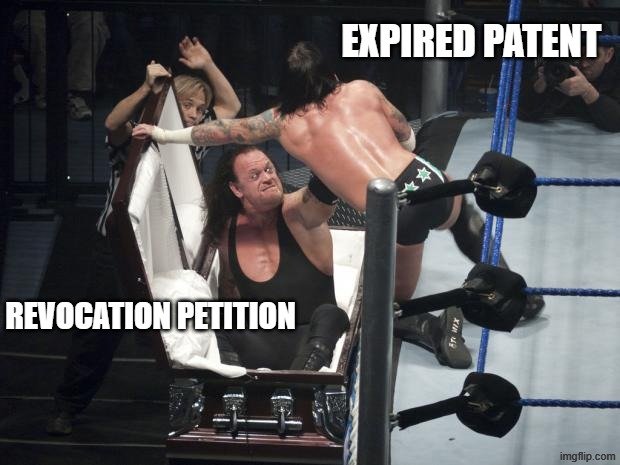

Boehringer Ingelheim Pharma GmbH v. The Controller of Patents (Boehringer Ingelheim) led to colourful and dramatic language from both the bar and the bench. For example, the Division Bench of the DHC while expressing a prima facie view on the matter of revoking a “dead” patent, had asked quite dramatically, “Can one kill a dead body?” Dr Abhishek Singhvi, who had appeared for Boehringer Ingelheim, stated that transmission of the order of the revocation for an expired patent is akin to “flogging a dead horse”. The ‘dead’ metaphors might be a bit depressing for some, but like the Undertaker, patents do occasionally cheat death and are reborn.
Boehringer Ingelheim was not about patents cheating death, but dead patents haunting the living for their past deeds. Boehringer Ingelheim and its alter ego, Macleods v. Controller, have been the subject of discussion on this blog (see here, here, and here). The case is part of a multi-litigation fight spanning two High Courts surrounding the anti-diabetic drug Linagliptin.
The issues, in brief, before the SB and DB, are as follows: 1) Is a revocation petition sustainable after a patent is “dead” or expired due to efflux of time? 2) Is a revocation petition under Section 64 sustainable after the petitioner had pleaded an invalidity defence under Section 107 in an infringement suit?
The Division Bench affirmed the ruling of the SB and held:
(i) a revocation petition would be maintainable, and would continue to survive, even after the patent of which revocation is sought expires by efflux of time, and
(ii) a revocation petition can be instituted even after a Section 107 invalidity defence is taken in the infringement suit.
The litigation has shed light on some interesting technical issues, including the missing Supplemental record, which, when I checked last time, was nowhere to be found, even though it was pivotal to this litigation. If more informed readers are aware of its status currently, please let me know in the comments.
With that said, it’s useful to examine DB’s reasoning.
Examining the Reasoning of the Court:
(i) Issue:
On the first issue, the Division Bench had previously been unconvinced by the argument that a revocation petition can lie against a patent that has expired due to its statutory term coming to an end, a position that prompted the dead body metaphor. So, what changed?
Firstly, the DB stated that revocation by either counter claim or revocation via petition had the same legal effect. Then it noted that, in an infringement suit, when a counterclaim is filed, the expectation is that the patent will be declared invalid retrospectively. As any infringement action would be based on a cause of action that took place in the past, it does not make sense for a defendant to file a counter claim to revoke the patent prospectively. In other words, any revocation petition would have to have a retrospective effect and declare the patent is void from the start to have any real teeth. Since revocation via either a counter claim or a petition has the same legal effect, revocation via petition also has a retrospective effect.
Secondly, the DB implicitly recognised Section 64 as an administrative corrective adopted in the statute to account for the fact that ex-ante examination is imperfect and can lead to the grant of legally suspect patents. In Para 58, DB observed that if the defendant in an infringement suit were to succeed in showing that a patent ought to be revoked on the grounds provided under Section 64, it is also true that such a patent should not have been granted in the first place. Thus, implicitly recognising the fact that a revocation under Section 64 operates as a post-grant corrective with retrospective effect.
Thirdly, the DB adopted the UK Supreme Court’s ruling in Virgin Atlantic Airways Ltd v. Zodiac Seats UK Ltd as relevant to the case at hand. This case involved a more complicated set of facts, in which, under the European Patent Convention, the national courts and the EPO enjoyed concurrent jurisdiction over questions of patent validity. This obviously led to problems of multiplicity of decisions, where the EPO might find a patent invalid or order a granted patent to be amended in revocation/opposition proceedings, while the UK Courts, in an earlier concluded litigation, might have found the same patent to be valid, infringed and grant relief on that basis. The question was whether the later EPO or Technical Board of Appeal’s (TBA) finding on patent validity disturbed the UK courts’ decisions, especially when the patent in question was a European patent?
In this context, the UK Supreme Court said that a later decision by the EPO or TBA would affect the UK courts’ decisions. To buttress this point, among other things, they relied on Article 68 of the EPO, which provided that any revocation or limitation of a granted patent via revocation/opposition proceedings had a retrospective effect from the date the patent came into effect.
Fourthly, it relied on a definition of patent provided under Section 2(m) as a “patent for any invention granted under this Act”. Plugging this definition into Section 64, which states “a patent, whether granted before or after the commencement of this Act, may, be revoked …” DB concluded that an expired patent still remains a patent for the purposes of Section 64.
Finally, it concluded that Macleods was a“person interested” under Section 64, simply because an infringement suit is pending against them. Since the outcome of the revocation petition will directly affect the infringement suit, Macleods was a “person interested” for the purposes of Section 64.
(ii) Issue:
In a previous post, I had asked why there is a distinction between an invalidity defence and a revocation petition?
After some thought, the nub of the issue, as I see it, is a forum battle: those at the receiving end of infringement suits want to preserve their option to file a revocation petition in the forum of their choosing.
The one filing the infringement suit wants to limit the alleged infringer’s freedom to choose the forum by denying them the option to file a revocation petition, confining them instead to a counterclaim or invalidity defence in the patentee’s preferred forum.
The issue is also partly a relic of the past, when the Ayyangar Committee, seeking to avoid the multiplicity of proceedings on patent validity, recommended a tiered structure in which multiple regional patent offices were to be established with their own territorial jurisdictions. Applicants who are located within those territorial jurisdictions or conduct their business within these jurisdictions are to file their applications to that regional office, and then the High Court, which has jurisdiction over the regional office, will exercise the right to entertain a revocation petition against the patents granted by that regional office. It further recommended deleting the option to counter claim and offering instead an invalidity defence with only an inter partes effect.
These recommendations were not accepted, with the legislature allowing revocation via counter claim and also an invalidity defence, leading to the legal issues implicated in this case.
In Unilin Beheer B.V. v. Balaji Action Buildwell, the Delhi HC SB had previously observed that there is practically no difference between the Section 107 defence and a revocation petition under Section 64.
The argument was that any finding of invalidity, even though technically inter partes, would be utilised by future defendants in subsequent cases, thereby reducing the likelihood that the patent will ever be successfully enforced. Even though this case was cited, DB did not discuss it at length.
To be clear, Unilin Beheer’s observations are relevant in specific factual contexts, for example, after an infringement suit has been filed, following Aloys Wobben v. Yogesh Mehra, if the defendant files a counterclaim in the infringement suit, the defendant would not be allowed to file a revocation petition. In this scenario, there might not be much practical distinction between a Section 107 defence and a revocation via counterclaim.
But as I had mentioned earlier, this is, in the end, a forum battle. A reading of the Supreme Court ruling in Aloys Wobben v. Yogesh Mehra, Delhi DB in Ajay Industrial Corp v. Shiro Kanao of Ikbari City and the Single Bench decision in Dr Reddy v. Controller, shows us that 1) revocation of a patent can be sought only once by filing either a counter claim or a petition, not both. 2) The right to file a revocation petition or a counter claim is granted to “any person interested”, leading to situations in which a revocation petition may lie in a High Court distinct from where the infringement suit has been filed. This follows the static (registration of patent) and dynamic effects (in rem effect of granted patents) governing Section 64, as laid out in Dr Reddy, with the static (place of registration) and dynamic aspect (in rem effect of the patent i.e. preventing the public from working the patent) giving a “person interested” the freedom to file a case in the HC which might be different from the District Court or the High Court in which the infringement suit is filed.
This freedom to choose the forum is an important difference. A defence against invalidity under Section 107 and a Section 64 counterclaim are always in response to an infringement suit filed by the alleged infringer in the forum chosen by the patentee.
The DB in Boehringer Ingelheim affirmed and protected this freedom. Secondly, it also made clear that Sections 107 and 64 are not the same for the technical reasons discussed by the SB previously.
Finally, as to the unfounded fears that, due to this ruling, we would have an expired patent revocation spree leading to wastage of court resources, two points, one commercial and one legal, raised by Dr Victor Vaibhav Tandon and Eashan Ghosh are relevant, 1) it does not make commercial sense to go on a revocation spree against expired patents which cannot be enforced, since filing revocations consumes time, money and resources, 2) it is near impossible to establish oneself as a “person interested” and as having a “direct, present and tangible interest” with respect to an expired patent that cannot be enforced.