

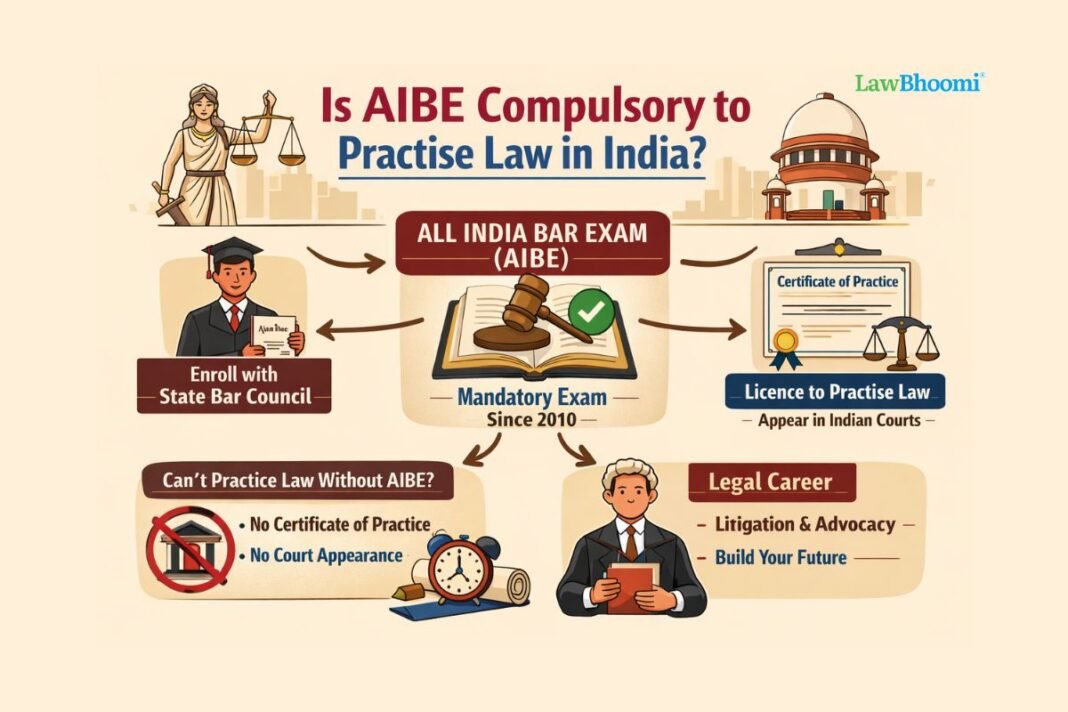
Many law graduates in India ask one very common question after completing their LL.B.: Is AIBE compulsory to practice law in India?
If this question is also in your mind, this article will give you a clear and simple answer. It will also explain why the AIBE was introduced, what happens if you do not clear it, and how it affects your legal career.
What is AIBE?
The All India Bar Examination (AIBE) is a national-level examination conducted by the Bar Council of India (BCI).
The exam was introduced in 2010 with one main objective — to check whether a law graduate has the minimum basic knowledge required to practice law in Indian courts.
When you pass the AIBE, you receive a Certificate of Practice (CoP) from the Bar Council of India. This certificate officially allows you to practice law in India.
Is AIBE Compulsory to Practice Law in India?
Yes, AIBE is compulsory for most law graduates.
If you completed your LL.B. degree in or after the academic year 2009–2010, then passing the AIBE is mandatory for practising law in India.
This requirement comes under the provisions of the Advocates Act, 1961 and the rules framed by the Bar Council of India.
Without clearing AIBE, you cannot get the Certificate of Practice. And without the Certificate of Practice, you cannot legally appear, argue, or file cases in courts.
So if you want to become a practising advocate, AIBE is not optional — it is compulsory.
Why Was AIBE Introduced?
Earlier, after completing LL.B. and enrolling with a State Bar Council, a law graduate could directly start practising in court.
However, the Bar Council of India felt that:
- The quality of legal education was not uniform across India.
- Many graduates were entering the profession without sufficient practical knowledge.
- There was a need to maintain minimum professional standards.
To address this issue, the AIBE was introduced in 2010.
The purpose of AIBE is not to create pressure but to ensure that every advocate has basic understanding of:
- Constitutional Law
- Criminal Law
- Civil Procedure
- Evidence Law
- Professional Ethics
- And other core subjects
This ensures that clients receive proper legal representation.
What is the Legal Basis for AIBE?
The Bar Council of India derives its powers from the Advocates Act, 1961.
Under this Act, the BCI has the authority to:
- Regulate legal education
- Prescribe standards of professional conduct
- Lay down conditions for practising law
Using these powers, the BCI framed rules making it compulsory for new advocates to clear AIBE in order to continue practice.
So the AIBE requirement is legally valid and enforceable.
What Happens After Completing LL.B.?
Many students get confused about the sequence. Let us understand the correct process.
After completing LL.B.:
- Enroll with the State Bar Council: First, you need to apply for enrolment with your respective State Bar Council. After enrolment, your name is entered in the roll of advocates.
- Receive Provisional Enrollment: Initially, you may be allowed to practice provisionally.
- Appear for AIBE: You must appear for the All India Bar Examination conducted by BCI.
- Get Certificate of Practice (CoP): Once you clear AIBE, the BCI issues a Certificate of Practice. Only after this, your right to practice becomes permanent.
So enrollment alone is not enough. Passing AIBE is the final step to becoming a full-fledged practising advocate.
Can You Practice Law Without Clearing AIBE?
This is one of the most important questions.
If you have not cleared AIBE:
- You cannot obtain the Certificate of Practice.
- Your right to practice law in courts is not fully valid.
- You cannot independently appear and argue cases.
In some situations, if an advocate does not clear AIBE within the prescribed time, practice rights may be restricted or suspended.
So if you want to build a serious career in litigation, clearing AIBE is essential.
Are There Any Exceptions?
Yes, there is one important exception.
Law graduates who completed their LL.B. degree before the academic year 2009–2010 are generally exempted from AIBE.
This means:
- If your degree was completed before AIBE was introduced,
- You are not required to pass AIBE,
- You can continue practising without this exam.
However, for all students graduating after that period, AIBE is compulsory.
Is AIBE Required for Corporate Jobs or Legal Firms?
This is another area where many students get confused.
If you want to:
- Work in a corporate company as in-house counsel
- Join a law firm as a non-litigation associate
- Work in legal research, compliance, or academics
In such cases, AIBE may not be strictly required because you are not appearing in court as an advocate.
However, if your designation is that of an advocate and you plan to appear in courts, then AIBE becomes necessary.
Even for corporate roles, many employers prefer candidates who have cleared AIBE, as it shows professional credibility.
Structure of AIBE
The AIBE is:
- An open-book examination
- Conducted in offline mode (generally)
- Based on multiple-choice questions
The exam tests practical understanding rather than deep theoretical knowledge.
The subjects generally include:
- Constitutional Law
- BNS
- BNSS
- Code of Civil Procedure
- BSA
- Professional Ethics
- Alternative Dispute Resolution
- Labour and Industrial Law
- Administrative Law
The exam is designed to test whether you have basic competence to practice law.
Is AIBE Difficult?
Many students feel nervous about AIBE.
In reality:
- It is not designed to fail large numbers of candidates.
- It is a basic competency test.
- The syllabus is from subjects already studied in LL.B.
If you revise core subjects properly and understand bare provisions, clearing AIBE is manageable.
The purpose is not to make life difficult for law graduates but to maintain minimum standards in the profession.
Why AIBE Matters for Your Career
If you want to build a long-term career in litigation, AIBE is not just an exam — it is your professional gateway.
Clearing AIBE:
- Gives you legal recognition as an advocate.
- Enhances credibility in front of clients.
- Allows you to practice in any court in India.
- Strengthens your professional profile.
Without the Certificate of Practice, your legal identity remains incomplete.
Practical Advice for Law Graduates
If you are a final-year law student or a recent graduate, it is important to plan properly.
Here are some practical suggestions:
- Do not delay enrolment with your State Bar Council after graduation.
- Keep track of AIBE notifications released by the Bar Council of India.
- Revise core subjects from standard textbooks and bare acts.
- Practice previous years’ AIBE question papers.
Preparing early reduces stress and increases confidence.
The Bigger Picture: Professional Standards in Law
The legal profession plays a very important role in society. Advocates represent clients, argue before courts, and assist in administration of justice.
By making AIBE compulsory, the Bar Council of India ensures that:
- Only qualified and competent individuals practice law.
- Professional standards are maintained.
- Public trust in advocates remains strong.
This ultimately protects both the profession and the public.
Final Conclusion
So, is AIBE compulsory to practice law in India?
Yes, for all law graduates who completed their degree in or after 2009–2010, clearing the All India Bar Examination is mandatory.
Without passing AIBE and obtaining the Certificate of Practice from the Bar Council of India, one cannot legally practice law in Indian courts.
If you are serious about a career in litigation, AIBE is not just another exam — it is a professional requirement.
Attention all law students and lawyers!
Are you tired of missing out on internship, job opportunities and law notes?
Well, fear no more! With 2+ lakhs students already on board, you don’t want to be left behind. Be a part of the biggest legal community around!
Join our WhatsApp Groups (Click Here) and Telegram Channel (Click Here) and get instant notifications.
