


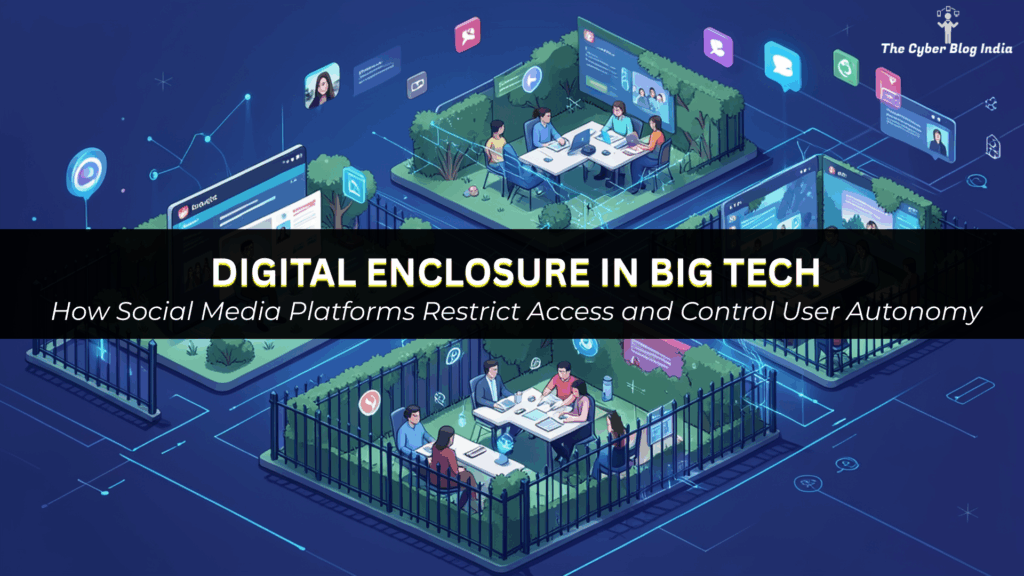
Imagine a friend sends you a link to watch, you open it and bam, you are hit with a ‘Please Log in’ pop-up. Do you also immediately close the tab the second it pops up, or do you sign up just to watch it?
Almost every platform now uses a login wall to force users into its ecosystem. Take, for example, X (formerly Twitter), which has become much stricter after Musk’s takeover. Earlier, you could scroll for ages; now you often get redirected to a sign-in page after just one or two posts.
But why are platforms now imposing a login wall on their users? Is this about security and user experience, or about data extraction instead? Does it violate user freedom?
Background: How did we reach here?
1. The Early Years of Social Media
In the early years of social media, roughly from the 2000s to 2012, platforms prioritised rapid growth over privacy controls. User profiles were often publicly searchable, indexed by search engines, and accessible without creating an account, and revealed personal details. This openness was a deliberate design choice to increase visibility and attract new users. By making users easy to find, platforms benefited from network effects and expanded quickly. Concerns about privacy and data protection received limited attention during this phase.
2. Mid-2010s
By 2015, platforms realised that these ‘anonymous lurkers’ were of no use for advertising. Then Pinterest came into the picture. It was one of the first major sites to aggressively implement the login wall. They realised that their content was highly scrollable. By removing their login wall after a few posts, they saw their sign-ups skyrocket. Watching this, the other platforms soon followed. This tactic is a classic example of a Dark Pattern, specifically a Forced Action. By showing some content and then blocking further access, the platform encourages users to sign up.
3. Recent Developments
Now that laws like the General Data Protection Regulation (GDPR) in Europe and the California Consumer Privacy Act (CCPA) in California have come into effect, it has become more difficult for these platforms to track you without your explicit consent. The GDPR is a comprehensive European Union law that gives individuals control over their personal data by requiring companies to obtain explicit consent before collecting or processing it. On a similar side, the CCPA is a state-level law that provides California residents the right to know what personal information is being collected about them and the power to opt out of the sale of that data to third parties.
Earlier, by signing up, users allowed platforms to link all their activity to a single account, consented to data use without real choice, and were tracked across the internet, with little control over how their information was used. Along with this, users now have the “Right to Opt-Out”; businesses are required to provide a “Do Not Sell My Personal Information” link.
At the same time, publicly accessible social media content became a key resource for training AI models, leading to increased large-scale data scraping from open platforms. Due to AI companies stealing billions of posts from Reddit and X to train AI models, the platforms are now forcing people to log in to stop this data pillaging, as seen with X (formerly Twitter). To tackle these financial and legal struggles well, it became easier for them to cover themselves if the person being tracked was a registered user (yes, the one who clicked “I Agree” to the terms and conditions during sign-up).
The Debate
The login wall increased sign-ups, provided more ad data, and eased legal compliance. Originally, the web was open and decentralised. Now, it has become a ‘walled garden’ controlled by big tech over data, content, and ads. Is this fair to users?
It now makes sense why these platforms prioritise user logins, not just for legal compliance, but also to boost revenue through personalised content, maintain accurate valuation by eliminating ghost users (as the number of active users helps determine the platform’s valuation and engagement), and prevent data leakage to external AI models.
Enforcing a login wall is beneficial not only for platforms but also, in some ways, for users. The walls prevent anonymous ‘lurking’ and stop malicious bots from mass-scraping users’ info (automated harvesting of large amounts of data from a website using software such as bots) without their consent.
Some arguments can be raised against this wall. Firstly, if a post is shared publicly, then blocking it behind a login wall breaks the core logic of sharing it publicly. “Is it still public if you can’t see it publicly?” Secondly, users don’t sign up because they want to; they’re coerced into doing so to avoid being blocked from a single piece of information.
The wall creates additional problems for small creators and businesses, as they lose reach when sharing links externally to visitors who are unwilling to log in. The reach to non-platform audiences decreases. With forced participation through sign-ups, this choice becomes an illusion.
Global Regulations and Privacy Angle
Laws like GDPR and India’s Digital Personal Data Protection Act, 2023, mandate that companies obtain explicit, informed consent from users before tracking them, and companies argue that they must force a login wall to obtain consent to comply with the laws. This creates a paradox; the European Data Protection Board (EDPB) has increasingly labelled this kind of consent as “consent wall” or “forced action”. They argue that when access to information is made conditional on data surrender, the consent is actually coerced rather than freely given.
Under the EU’s Digital Markets Act, regulators are now investigating whether blocking public posts behind a login wall constitutes anti-competitive behaviour. The question before regulators is whether “locking” public data behind walls facilitates Digital Enclosure (the process of fencing off the “digital commons” to create proprietary datasets). A powerful example of Digital Enclosure occurred in 2023 when X (formerly Twitter) implemented aggressive login walls and shut down its free API. For decades, the data were publicly available and free.
Because of this move, the automated accounts that used to tweet wildfire and flood warnings could no longer work, as they could no longer communicate with the platform for free. Researchers were left helpless as over 100 major studies on online hate speech and political polarisations were cancelled or halted because “the digital commons” were now too expensive to access.
Potential Solutions
A question that can be raised here is, “Is it even legal to restrict a platform which serves as a primary source of news?” There’s a growing debate over making it mandatory for platforms to provide “read-only” access to public content, especially for the public profiles of government officials or journalists.
For instance, platforms like X and Instagram are often used by Indian police, politicians and journalists to directly disseminate information to the public. In addition to read-only access, another solution has been proposed: making it mandatory for platforms to obtain clear opt-in consent for data collection, rather than requiring a forced login.
Conclusion
Social media login walls are less about technology or safety and more about control. Control over the data, the attention and ultimately, control over the access to the information that was once freely available. The “Please log in to continue” prompt is not harmless; it is a gatekeeping mechanism which decides who gets to see the digital world and on what terms.
When access to public posts depends on surrendering personal data, privacy stops being a right and becomes a price instead. This is “the Digital Enclosure in Big Tech.”
So, the next time a friend sends you a link, and you’re met with a login wall, remember what’s being asked of you. It’s not just an account; it’s consent extracted under pressure. Which raises a simple question:
If something is shared publicly, why does seeing it require giving up a piece of yourself?


