


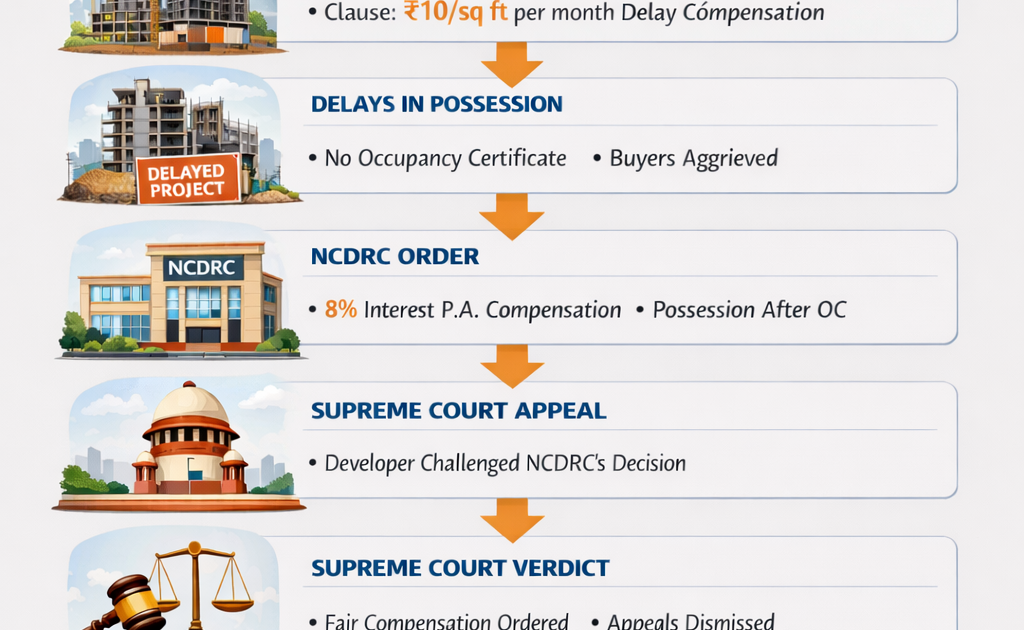
Reasonable Compensation in Delayed Housing Projects:
A Case Comment on Parsvnath Developers Ltd. v. Mohit Khirbat, 2026 INSC 170

I. Introduction
On 20 February 2026, the Supreme Court of India delivered a significant ruling in Parsvnath Developers Ltd. v. Mohit Khirbat, reaffirming the statutory authority of consumer fora to award reasonable compensation in cases involving delayed possession of residential units. The Court clarified that contractual clauses limiting compensation do not restrict statutory powers under the Consumer Protection Act, 1986.
This judgment strengthens consumer jurisprudence in real estate disputes and curtails the enforceability of one-sided builder-buyer agreements.
II. Factual Matrix
The dispute arose from prolonged delays in handing over possession of flats in the “Parsvnath Exotica” project at Gurugram. The developer had included a clause (Clause 10(c)) in the Apartment Buyer Agreement providing compensation for delay at ₹10 per square foot per month.
Homebuyers approached the National Consumer Disputes Redressal Commission (NCDRC) alleging deficiency in service. The NCDRC awarded compensation at 8% simple interest per annum and directed possession after obtaining the Occupancy Certificate.
The developer appealed to the Supreme Court.
III. Issues for Determination
-
Whether consumer fora are bound by contractual caps on compensation in builder-buyer agreements.
-
Whether delay in handing over possession amounts to “deficiency in service.”
-
Whether awarding interest at 8% per annum was justified.
IV. Judgment and Ratio
The Bench (B.V. Nagarathna and R. Mahadevan JJ.) dismissed the appeals and held:
1. Statutory Powers Override Contractual Caps
The Court held that Sections 12, 14 and 22 of the Consumer Protection Act, 1986 empower consumer fora to grant just and reasonable compensation. These powers are statutory and cannot be curtailed by unfair contractual terms.
2. One-Sided Clauses as Unfair Trade Practice
The nominal compensation clause (₹10/sq.ft./month) was viewed as manifestly one-sided and reflective of unequal bargaining power. Such clauses cannot defeat statutory remedies.
3. Delay = Deficiency in Service
Housing construction and delivery constitute “service” under Section 2(1)(o) of the Act. Prolonged delay amounts to deficiency.
4. 8% Interest Upheld
The Court upheld 8% simple interest as reasonable compensation for delay, emphasizing fairness rather than mechanical enforcement of contract terms.
5. Occupancy Certificate Mandatory
Possession without a valid Occupancy Certificate constitutes further deficiency in service.
V. Legal Significance
This decision reinforces:
-
Primacy of statutory consumer remedies over restrictive contractual clauses.
-
Judicial recognition of unequal bargaining power in real estate contracts.
-
Consumer fora’s authority to grant equitable compensation based on hardship.
The ruling aligns with prior jurisprudence protecting homebuyers from exploitative real estate practices.
VI. Conclusion
Parsvnath Developers Ltd. v. Mohit Khirbat marks another milestone in strengthening homebuyer protections. The Supreme Court has unequivocally clarified that statutory consumer rights cannot be diluted through cleverly drafted compensation caps.
The decision has wide ramifications for ongoing and future real estate litigation across India.


