



By Sanjay Raman Sinha
On April 7, 2026, a landmark constitutional hearing will commence at the Supreme Court—one that may redefine how faith intersects with law in India. At the heart of the matter lies the contentious 2018 verdict on the Sabarimala Temple, where a five-judge bench lifted the long-standing prohibition on the entry of women between the ages of 10 and 50.
Now, a nine-judge Constitution bench will examine not just the correctness of that ruling, but deeper constitutional questions: What is the scope of religious freedom under Article 25? How far do the rights of religious denominations under Article 26 extend? And to what degree may courts intervene in matters deemed “essential” to religious practice?
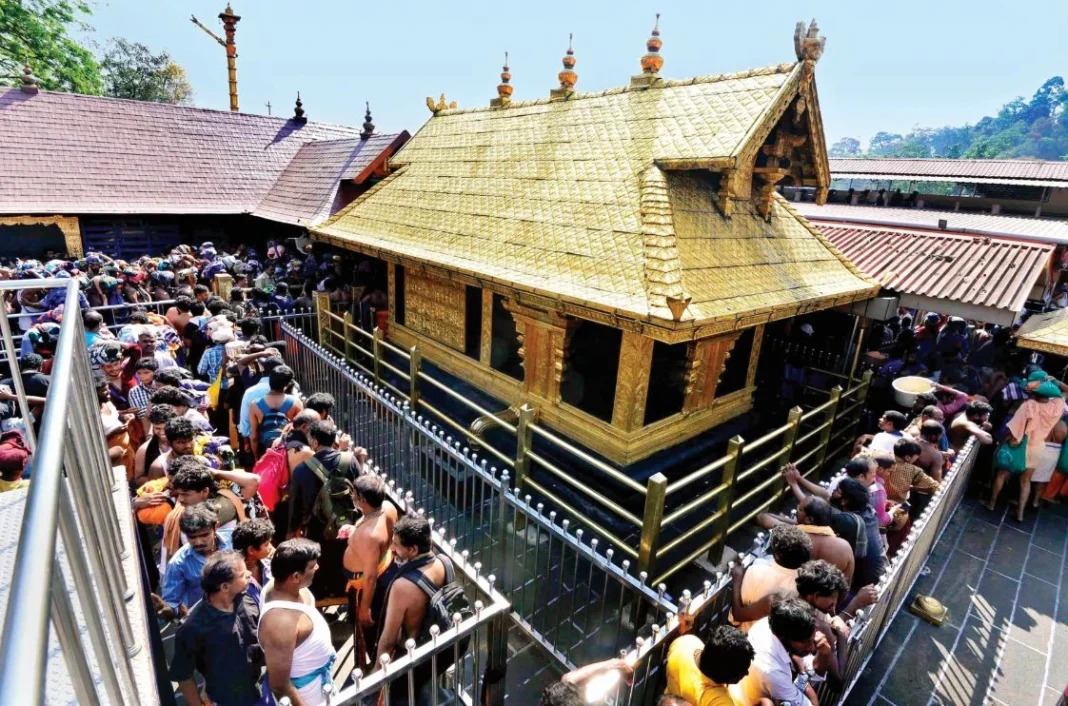
The flashpoint remains the hill shrine in Kerala dedicated to Lord Ayyappa, revered as a Naistik Brahmachari—an eternal celibate. For generations, custom barred menstruating women from entering the Temple, a practice devotees defended as intrinsic to the deity’s character and worship.
In Indian Young Lawyers Association vs State of Kerala, a Constitution bench ruled 4:1 that the exclusion violated women’s fundamental right to freedom of religion under Article 25(1). The Court struck down Rule 3(b) of the 1965 Kerala Hindu Places of Public Worship Rules, which had permitted exclusion based on custom.
The then Chief Justice Dipak Misra, writing for the majority and joined by Justices RF Nariman, AM Khanwilkar and DY Chandrachud, declared: “Patriarchy in religion cannot be permitted to trump over the element of pure devotion borne out of faith and the freedom to practise and profess one’s religion.”
Justice Indu Malhotra stood alone in dissent. She cautioned against judicial overreach into theological domains: “What constitutes an essential religious practice is for the religious community to decide. It is not for the courts to determine which of these religious practices are to be struck down, except if they are pernicious, oppressive, or a social evil, like Sati.”
Justice DY Chandrachud, in a powerful concurring opinion, argued that constitutional morality must prevail over practices that erode dignity and equality. He characterized the exclusion as derogatory to equal citizenship and likened it to a form of untouchability.
The aftermath was immediate and intense. Over 60 review petitions were filed. In 2019, a five-judge bench, by a 3:2 majority, referred broader constitutional questions to a larger bench. These extended beyond Sabarimala to related controversies—Muslim women’s access to mosques, Parsi women’s entry into fire temples after inter-faith marriage, female genital mutilation in the Dawoodi Bohra community, and the validity of excommunication practices.
In 2020, the Court framed seven core constitutional questions for determination by the nine-judge bench. Among them:
- What is the scope of freedom of religion under Article 25?
- How do Article 25 rights interact with denominational rights under Article 26?
- Is Article 26 autonomy subject to other fundamental rights beyond public order, health and morality?
- What is the meaning of “morality” in Articles 25 and 26—does it include constitutional morality?
- To what extent can courts review and define “essential religious practices”?
- Who qualifies as “sections of Hindus” under Article 25(2)(b)?
- Can non-members of a denomination challenge its practices through public interest litigation?
The Union government has indicated its inclination towards reconsidering the 2018 judgment. The present bench, headed by Chief Justice of India Surya Kant, has laid out a detailed schedule for arguments that are expected to be extensive and philosophically charged.
At the core of the debate lies a constitutional tension. Article 25 protects the individual’s right to worship. Article 26 protects the collective autonomy of religious denominations to manage their own affairs, subject only to public order, health, and morality. But what is morality? Is it societal morality rooted in tradition, or constitutional morality grounded in dignity and equality?
Another crucial doctrine under scrutiny is the “essential practices test,” articulated in the 1954 Commissioner, Hindu Religious Endowments, Madras vs Sri Lakshmindra Thirtha Swamiar of Shirur Mutt (commonly known as the Shirur Mutt case). That ruling empowered courts to determine which religious practices are essential and therefore constitutionally protected. Critics argue that this places secular judges in the delicate position of theological arbiters.
Can a temple claim denominational status to exclude certain worshippers? Or must denominational autonomy yield to the individual’s right to equality and worship? Where does reform end and judicial overreach begin?
The battle lines between constitutional morality and religious morality are sharply drawn. Whatever the outcome, the verdict will reverberate far beyond Sabarimala. It will shape the future of religious reform, minority rights, and the judiciary’s role in interpreting faith in a secular republic.
As arguments unfold, the Court is not merely reviewing a temple entry dispute. It is revisiting the very grammar of the Constitution’s promise: liberty of belief, equality of citizenship, and the limits of state intervention in matters of the soul.