





The Supreme Court of India recently made strong observations against WhatsApp and its parent company, Meta, regarding WhatsApp’s privacy policy approach. The issue relates to the company’s earlier policy update where users were effectively required to accept new data-sharing terms or stop using the service.
Key Points
-
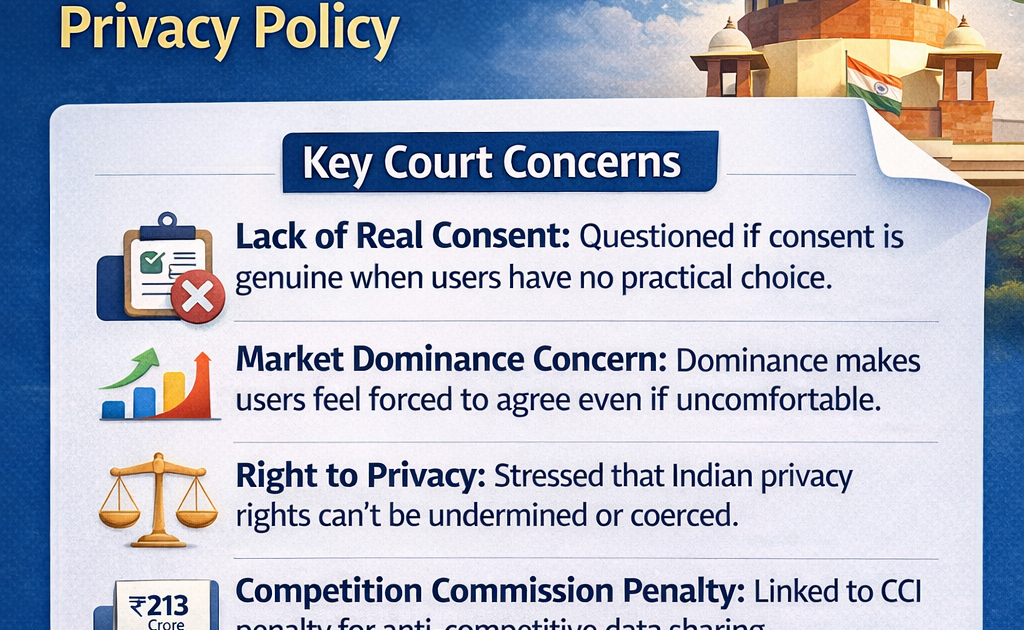
Lack of Real Consent:
The Court questioned whether user consent can be considered genuine when people are given no practical choice but to accept the policy to continue using the platform.
-
Market Dominance Concern:
Because WhatsApp holds a very large share of the messaging market in India, the Court noted that users may feel compelled to agree, even if they are uncomfortable with the terms.
-
Right to Privacy:
Judges emphasised that privacy is a constitutional right in India and companies cannot design policies that undermine or pressure users into sharing personal data.
-
Competition Commission Penalty:
The matter is also connected to a penalty imposed by the Competition Commission of India (CCI), which had earlier found that the policy change could amount to anti-competitive behaviour and forced data sharing.
-
Transparency & Fairness:
The Court expressed concern that lengthy and complex privacy documents make it difficult for ordinary users to fully understand how their data is used.
Overall Significance
The Supreme Court’s remarks highlight that digital platforms operating in India must ensure clear communication, genuine consent, and respect for user privacy. The case signals stricter judicial scrutiny of large technology companies, especially where personal data and competition issues overlap.

“Companies cannot “play with the right to privacy of this country” and warned that if Meta cannot respect Indian privacy protections, it could cede its operations in India.”
– Chief Justice Surya Kant
Supreme Court of India