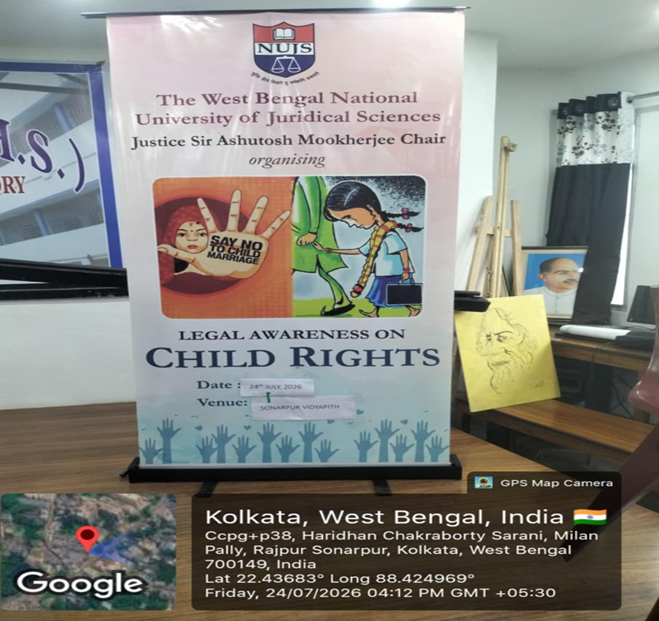

Legal Awareness Programme on Child Rights
Organised by: Justice (Sir) Ashutosh Mookerjee Chair

Venue: Sonarpur Vidyapith (H.S.), South 24 Parganas, West Bengal
Date: 24 July 2026
On 24th July, 2026, a Legal Awareness Programme on Child Rights was organised by the Justice (Sir) Ashutosh Mookherjee Chair, The West Bengal National University of Juridical Sciences (WBNUJS), Kolkata, at Sonarpur Vidyapith (Higher Secondary), South 24 Parganas, West Bengal. The Legal Awareness Programme on Child Rights was structured in alignment with the objectives of the Justice (Sir) Ashutosh Mookerjee Chair, which promotes constitutional values, legal literacy, and social justice through academic and community outreach initiatives. Reflecting the Chair’s commitment to advancing awareness of contemporary legal issues, the programme awared students on the constitutional and statutory protections available to children through expert lectures, discussions on child rights legislation, and an interactive question-and-answer session. By enhancing students’ understanding of their legal rights and the mechanisms for their protection, the programme furthered the Chair’s mission of fostering constitutional awareness and legal empowerment among the younger generation.
The programme was organised to raise legal awareness among school students about their constitutional and statutory rights and to sensitise them to the various legal mechanisms available for their protection. It aimed to familiarise students with issues relating to education, child protection, child labour, child trafficking, child marriage, and crimes against children while encouraging them to recognise, prevent and report violations of their rights.
The programme commenced with a welcome address by the Principal, Asish Kumar Ghosh, of Sonarpur Vidyapith (H.S.), who welcomed the members of the Justice (Sir) Ashutosh Mookherjee Chair and introduced the resource persons to the students, teachers, and other participants. In his inaugural address, he appreciated the Chair’s initiative and emphasised the importance of legal literacy in empowering children to understand and protect their rights.
The event began with an introductory address by Chair Professor Dr. Shachi Chakrabarty, Justice (Sir) Ashutosh Mookerjee Chair Professor at WBNUJS. She explained the significance of organising legal awareness programmes for school students, and emphasised that children constitute one of the most vulnerable sections of society and therefore require special legal protection. Referring to both national and international legal frameworks protecting children’s rights, she introduced the concept of child rights as fundamental human rights available to every child irrespective of caste, religion, gender, economic status or social background. She highlighted the importance of ensuring children’s rights to survival, development, protection and participation. Commencing her address with the celebrated words of former American President John F. Kennedy, “Children are the world’s most valuable resource and its best hope for the future,” she further referred to William Wordsworth’s famous expression, “The Child is father of the Man,” to underline the indispensable role of children in shaping the future of society. She also discussed the growing concern of child marriage and emphasised that legal awareness is the first step towards preventing violations of children’s rights.
Following the introductory discussion, Ms Kinkini Mukherjee, Research Assistant, Justice (Sir) Ashutosh Mookherjee Chair, delivered a presentation on the constitutional and statutory framework that protects children’s educational rights in India. She discussed Article 21A of the Constitution, which guarantees free and compulsory education for children aged 6 to 14 years, along with Articles 45, 39(e), and 39(f), which promote children’s education, welfare, and protection. She also explained the key provisions of the Right of Children to Free and Compulsory Education Act, 2009, and the Child and Adolescent Labour (Prohibition and Regulation) Act, 1986 (as amended in 2016), emphasising that child labour hinders education and overall development of a child. She illustrated the reality of the children who are employed at a tender age, concluding their childhood. She has also mentioned the helpline number 1098 to make the students aware of any wrongful situation. She encouraged students to pursue their education and report instances of child labour to the appropriate authorities. She welcomed questions which arose during her discussions.
The next presentation was delivered by Ms. Surupa Das, Research Assistant, Justice (Sir) Ashutosh Mookherjee Chair, who discussed laws relating to crimes against children with particular emphasis on the Protection of Children from Sexual Offences (POCSO) Act, 2012. She explained that the Act provides comprehensive legal protection against sexual assault, sexual harassment and aggravated sexual offences committed against children. Considering the age of the participants, she addressed the subject with sensitivity and clarity by explaining the concepts of good touch and bad touch and helping students understand personal boundaries and inappropriate behaviour. Apart from POCSO, she had also discussed the ‘Juvenile Justice Act’ where she explained the concept of ‘child in need of care and protection’ (CNCP) which includes the abandoned, missing, neglected and mentally ill children and explained if the students come across such child in their daily life it is important to report such cases so that those children could be saved and taken care of. She encouraged children to communicate openly with trusted adults, report incidents of abuse without fear or hesitation, and seek assistance from parents, teachers and the appropriate legal authorities whenever required. Lastly, she explained the cautious usage of social media that is use of Insta, Facebook- get any dm’s messages, comments- qualifies for stalking/harassment- important to save the evidence and report to the police, or take help of their teachers/guardians or online cyber crime portal quick action taken. She stressed that reporting abuse is an act of courage and plays a crucial role in protecting not only oneself but also other children from similar offences.
The final presentation was delivered by Assistant Professor Sampa Karmakar Singh, Faculty Coordinator, Justice (Sir) Ashutosh Mookherjee Chair, who discussed the serious issue of child trafficking and the legal measures available for protecting child victims. She explained various forms of trafficking, including trafficking for forced labour, sexual exploitation, domestic servitude, begging, organ trafficking, and other illegal activities. She also discussed the legal provisions relating to the rescue, rehabilitation, reintegration and protection of child victims of trafficking, and explained the role played by law enforcement agencies and child welfare authorities in ensuring that rescued children receive counselling, education, rehabilitation, reintegration, and other necessary support services. A significant part of her presentation focused on the Child Helpline (1098), where she informed the students about the importance of the helpline in providing immediate assistance to children in distress. She also discussed the Emergency Response Support System (ERSS), a Pan-India single number (112) based emergency response system for citizens in emergencies. She encouraged the students to remember the helpline numbers (1098 and 112) to seek help whenever they or any other child required protection or emergency support. She concluded by emphasising that each member of society has a collective responsibility to report suspected cases of child trafficking and child exploitation for the protection of children.
Following the presentations, an interactive discussion and question-and-answer session was conducted in which the students enthusiastically participated. They raised several questions relating to child rights, educational opportunities, child protection laws, reporting mechanisms and the role of the police and Child Welfare Committees in safeguarding child rights. The resource persons responded to each query patiently, explaining the legal provisions in a simple and comprehensible manner. The interactive session helped clarify misconceptions, encouraged active participation and inspired students to communicate openly about issues affecting children.

