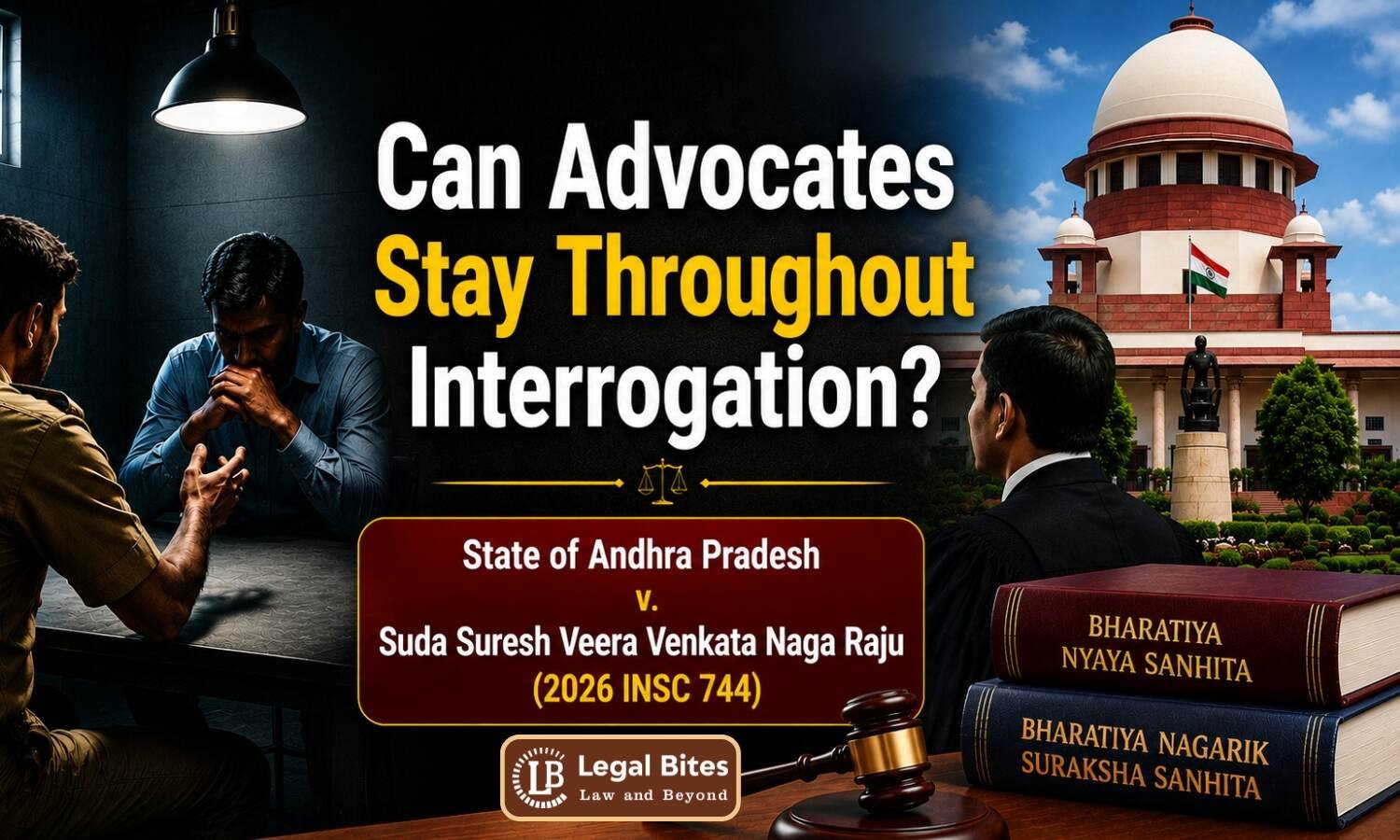

The right of an arrested person to consult an advocate is one of the most important safeguards against arbitrary police action. At the same time, the criminal justice system must ensure that police investigations remain effective and free from unnecessary interference. This balance came under scrutiny before the Supreme Court in State of Andhra Pradesh v. Suda Suresh Veera Venkata Naga Raju (2026 INSC 744), where the Court was called upon to interpret Section 38 of the Bharatiya Nagarik Suraksha Sanhita, 2023 (BNSS). The judgment settles an important question: Can an accused insist that his advocate remain present throughout police interrogation? The Supreme Court answered this question in the negative while reaffirming constitutional protections against custodial abuse.
Police interrogation is one of the most critical stages of a criminal investigation. It enables investigating agencies to gather evidence, recover incriminating material, trace co-accused, and uncover facts essential to solving a crime. At the same time, custodial interrogation must be conducted within the framework of constitutional safeguards to protect individuals from coercion, abuse, or other unlawful practices.

Recognising this balance, the Bharatiya Nagarik Suraksha Sanhita, 2023 (BNSS) introduced Section 38, which grants an arrested person the right to meet an advocate of their choice during police interrogation. Significantly, however, the provision also makes it clear that this right does not extend to the advocate’s continuous presence throughout the interrogation.
The scope of this statutory safeguard recently came under scrutiny before the Supreme Court in State of Andhra Pradesh v. Suda Suresh Veera Venkata Naga Raju (2026 INSC 744). The Supreme Court examined the true meaning of Section 38 BNSS and clarified the extent of an accused’s right to legal assistance during custodial interrogation while balancing it against the investigating agency’s need to conduct an effective and unhindered investigation.

