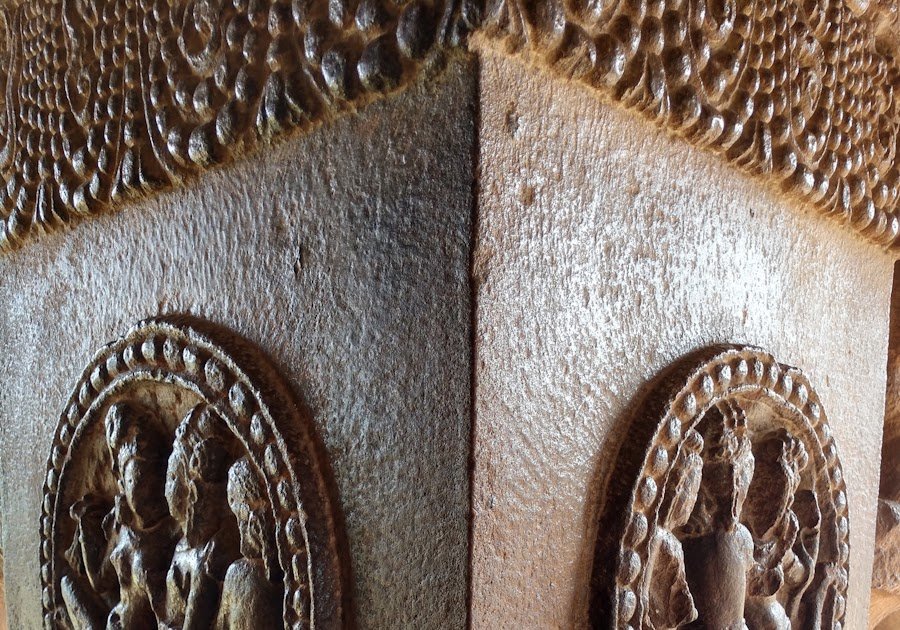

When you see places like Hampi, Badami, Aihole and the likes, one could photograph them at macro and micro levels, relatively. A scene from an elevated spot to a group of temples to an individual temple to a pillared hall inside a temple to a large statue to a tiny sculpture on a pillar. One could find countless subjects to shoot. Many a times, I’ve appreciated sculptures more on my laptop screen than at the site. At the site, a small image catches my eye, I look at it for a second or two, I shoot it and move on. At home I look at pictures of those tiny sculptures for minutes, trying to figure out so many things… what’s that expression or the talent of the sculptor or the purpose of that image. One could get lost in that world of sights and thoughts.
Now, coming to a particular pillar in the VIII Century CE Chalukyan monument Durga Gudi at Aihole. There’s a pair of heavily decorated pillars in the Mukha-mantapa. However, the middle part of the pillars is eye-catching. Plains surface with a circular image on each of the four faces. It’s so elegant. The plain surface highlights the circular image. One might imagine that the other two faces have similar sculptures.


No, the opposite faces have blank circles. Why these are plain.. possibly incomplete. Was it meant to be polished to mirror finish. Or, was it like a blank canvas for another sculptor. I remember one of the guides say that blanks were left to invite foreign sculptors in a way of challenge or, a simple display of talent. There could be other reasons.

The more I look at these sculptures, the more I wonder how the sculptors achieved the forms, those straight lines, right angles, perfect circles, the precision, those expressions. It’s a big question- how? And another question- why? Why these elaborate designs?
………

