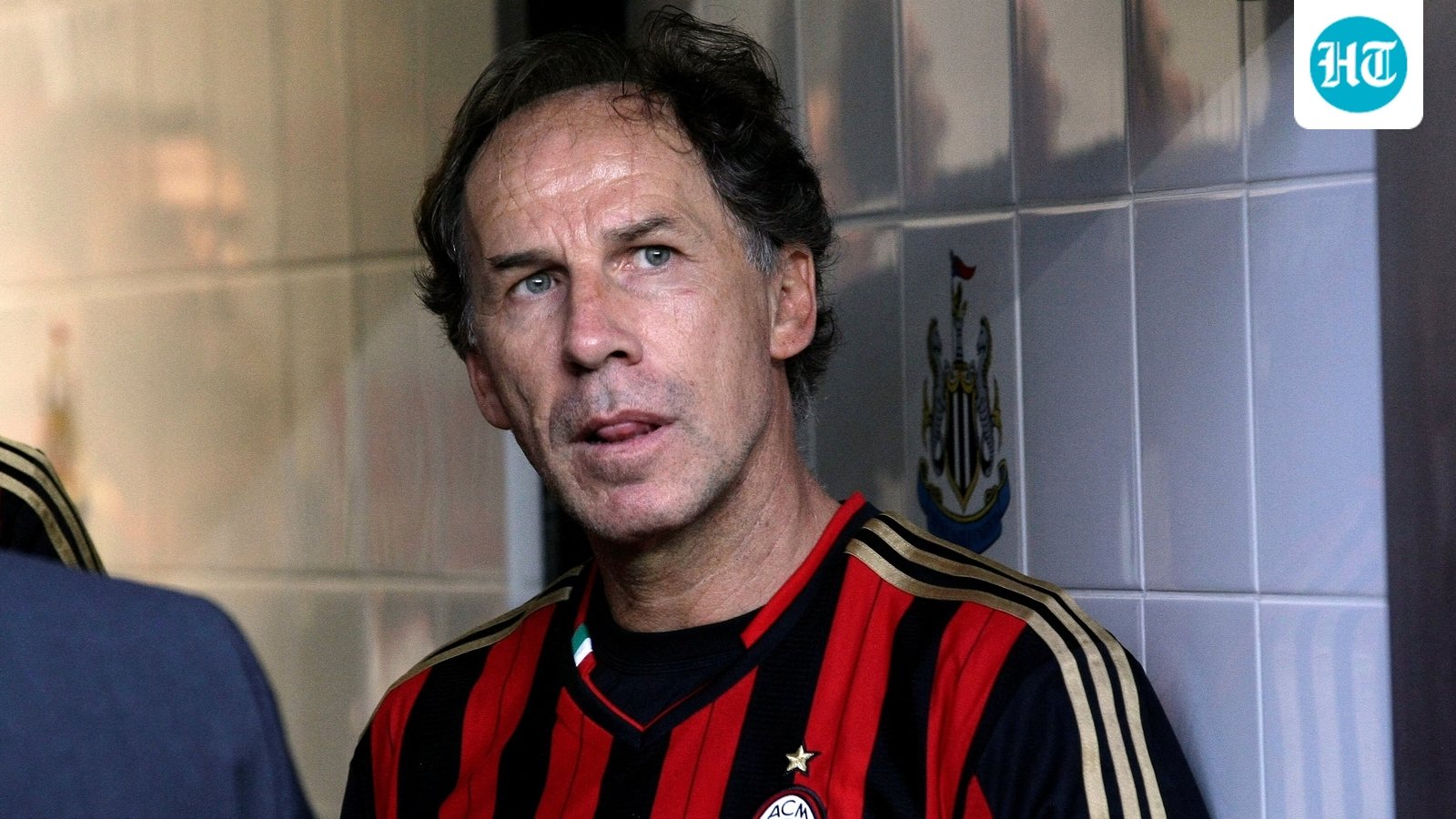

Former AC Milan captain Franco Baresi, one of Italian football’s greatest players ever, has died at the age of 66. The legendary’s centre-back’s passing was mourned by his former club in an emotional statement.
“The entire history of AC Milan is in tears following the passing of Franco Baresi. His example and integrity will be forever etched into the Club’s DNA, just as his iconic number 6 shirt is. The condolences AC Milan extends to Franco Baresi’s family at such a difficult time are shared by every Rossonero, who feels this loss as their own.”

Also Read: FIFA defends forward enterprise proposal amidst investment backlash
Baresi was the epitome of a one-club man, amassing 719 appearances across twenty seasons at Milan through relegations and championship victories. He guided the team to three European Cups and six Serie A titles under Arrigo Sacchi and Fabio Capello, and was part of the Rossoneri’s golden generation alongside legends like Paolo Maldini, Ruud Gullit, Frank Rijkaard and Marco van Basten.
His 81-cap international career was similarly part of a golden era of Italian football. Baresi was a young member of Italy’s victorious 1982 World Cup squad, despite not playing a game. He later anchored the defence to a third-place finish on home soil in 1990. Four years later, he produced one of the most heroic captain’s performances in World Cup history, facing Brazil in the 1994 final just twenty-two days after meniscus surgery. It was far from a fairy-tale ending for him: he missed a penalty in the shootout alongside Daniele Massaro and Roberto Baggio as Italy suffered a massive heartbreak.
The Johan Cruyff of defenders
Often called the Johan Cruyff of defenders, Baresi redefined the libero role. He lacked the imposing physical stature of a traditional centre-back, but that never inhibited him. Instead, he relied on anticipation, tactical intelligence, and supreme technical ability to dictate the tempo of matches from deep within his own half, stepping out of defence with an elegance that masked a fierce competitive streak and snuffing out opposition attacks before they fully formed. He finished as the runner-up for the Ballon d’Or in 1989, and when he announced his retirement, the club retired his number 6 shirt too. Such was his standing within their history. He was later voted AC Milan’s Player of the Century and inducted into the Italian Football Hall of Fame.
Following his retirement in 1997, he served as a youth coach and director at AC Milan, before settling into a long-standing role as club ambassador and honorary vice-president. Illness largely kept him away from the public eye in recent years. His final public appearance came earlier this year at a packed San Siro during the opening ceremony for the Winter Olympics being hosted in Milan. No finer way for Italy’s greatest captain to bow out of the limelight!

