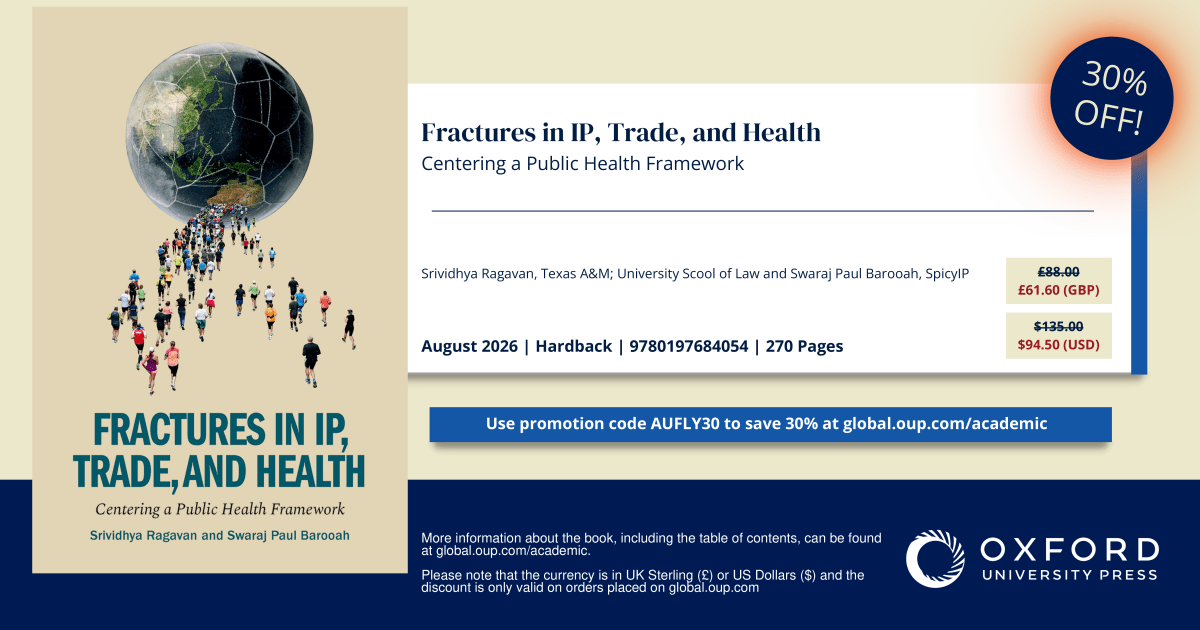


After a few years (!) of discussing these developments bit by bit (across US-India timezones), and weaving together thoughts and issues that we’ve also separately been writing on over the last few years, I’m thrilled to say that Prof Srividhya Ragavan and I have just published our book titled “Fractures in IP, Trade, and Health: Centering a Public Health Framework” (OUP 2026). The book is available on Oxford Academic’s online platform here or for purchase here. An Indian edition is also expected soon. Please read on below for a brief write up on the book.
Six years on from the Covid-19 Pandemic and the world is still ill-prepared for the next pandemic when the next one inevitably comes. Why? The structural and systemic failures on display were not ‘new’ but rather symptomatic of how Public Health has been allowed to become an accepted ‘casualty’ in the Trade-IP nexus, over the last few decades. The response, unfortunately, has consistently been limited to stop-gap measures. As we point out in the book, these cracks in the foundation are unlikely to continue bearing the weight that’s being put on them. We argue that it is high time to stop trying to carve health out of trade, but rather that we must centre health, if we are to adequately deal with future disruptions, including those to trade.

The first two chapters (Ch1: Healthcare Access as an International Game; Ch2: Presumption Risks: Impact of Local Realities on Patent Goals) revisit the historical path of how we’ve reached this current position: From patents being tools of industrial policy for building domestic capacity, to getting shoe-horned into trade through the WTO negotiations between structurally unequal players, to TRIPS+ bilateralism. In Chapter 2, we lay out the ‘presumption risk’ of assuming that stronger IP = stronger innovation = stronger economies. This risk, we argue, is sharpest when “harmonizing” without adequately accounting for local realities, such as prevalent disease burdens, per capita income, social structure, etc. On top of this, the rhetorical utility of “harmonization” is not only frequently ineffective at spreading benefits it claims to, but also inadvertently seems to hide how IP policy failures are exported.
Chapter 3 (Government as Guardians of Public Health), is kept as an open-ended discussion. Here, we have looked past the commonly discussed actors (Big Pharma, Generics, Patients), and look at the role that Governments play in framing and using (or not using) policy spaces relevant to patents and public health. Whether its the well known examples of Brazil’s constitutionalisation of the right to health, or India’s utility of policy space in legislation, or the USA’s public funding quietly underwriting privately captured exclusivities – the larger question that comes out from here is not whether governments ‘can’ utilise policy space, but rather why so much of it still remains unutilised.
The next part of the book (Ch4: Pragmatic Multilateralism: Reimagining a Framework, and Ch5: A Globalist Approach to Harmonizing Health) comes back to the Pandemic and its aftermath as an example of how the inflexible trade regime is weakening itself, even while opening up opportunities to discuss public health from different perspectives such as access, safety, affordability, supply chains, innovation and regulation. At the same time, the tendency of global governance to repeat different versions of its earlier mistakes cannot be ignored, especially if health continues to be treated as merely a matter of diplomacy. While we hope to be proven wrong eventually, we point towards the ongoing discussions of the Pandemic Agreement, which, despite certain clear areas of improvement, risk becoming yet another patchwork bandaid. This takes us to our call for the need to centre public-health in a systems thinking framework, through the mechanism of an instrument or treaty, which we then expand on in our final chapter (Ch6: Imagining Public Health as the Fulcrum of Global Trade).
In this process, we have not attempted to define the end-state of what this instrument should look like, but rather we see the writing of this book as an attempt to help further ongoing conversations on the existing IP-trade tensions, to trigger more conversation around the need for this approach, as well as discussion around the types of norm setting exercises that may strengthen a much needed public health focus! Comments and thoughts welcome!

