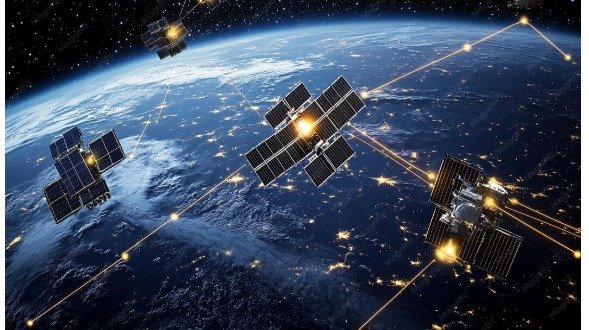

The Earth is not the only place where humans leave footprints. We have also left thousands of pieces of junk floating silently above us.
When you think about space you probably picture astronauts floating around inside spacecraft rockets taking off into the air or cool pictures of galaxies that are really far away. Space seems like a calm and mysterious place that just goes on forever.. There is something else going on in space that a lot of people are not aware of. Now the area around the Earth is filled with thousands of satellites old rocket parts and millions of tiny pieces of junk. This brings up a question:

Who is going to clean up outer space?
It is not like a city, where there is a government that takes care of things. There is no one in charge of space no police to enforce rules no department to clean up trash and no single government that owns space.. Even with all this countries and companies are still launching satellites all the time. That is where Space Law comes in.
Space Law is a new area of international law that is growing really fast. It determines how countries and companies can explore space use it and protect it while making sure that space is still available for things.
This article is going to talk about the interesting world of Space Law explain why we need it discuss the problem of space junk and look at whether the laws we have now are good enough to keep space safe for people, in the future.
What is Space Law?
Space law refers to the collection of international treaties, conventions, principles, and national laws that regulate activities carried out in outer space. Its primary objective is to ensure that outer space is explored peacefully, safely, responsibly, and for the benefit of all humanity. Unlike land or oceans, no country owns outer space. It is considered the “province of all mankind,” meaning every nation has the freedom to explore and use it without claiming sovereignty.
Space law answers questions such as:
- Can a country own the Moon?
- Who is responsible if a satellite crashes into another satellite?
- What happens if space debris damages property on Earth?
- Can private companies mine asteroids?
- Who is liable if an astronaut gets injured during an international mission?
As technology advances and private companies become major participants in space exploration, these legal questions become increasingly important.
Why Do We Need Space Law?
Imagine driving on a highway where there are no traffic rules, no signals, and no speed limits. Chaos would be inevitable. The same principle applies to outer space. Today, thousands of satellites provide:
- GPS navigation
- Internet services
- Weather forecasting
- Television broadcasting
- Disaster management
- Military communication
- Scientific research
Without legal rules, countries could interfere with each other’s satellites, claim ownership over celestial bodies, or even deploy weapons in space.
Space law helps by:
- promoting peaceful exploration;
- preventing conflicts between nations;
- protecting astronauts;
- regulating liability for accidents;
- encouraging international cooperation;
- The Growing Problem of Space Debris
One of the greatest challenges facing modern space law is space debris, commonly called space junk.
Space debris includes:
- dead satellites,
- broken spacecraft,
- discarded rocket stages,
- bolts and screws,
- fragments created by satellite collisions,
- pieces produced after anti-satellite weapon tests.
According to the European Space Agency (ESA), millions of debris objects are currently orbiting Earth. Even a tiny fragment travelling at nearly 28,000 km per hour can seriously damage an operational satellite or spacecraft. One famous example occurred in 2009, when the active Iridium 33 satellite collided with the inactive Cosmos 2251 satellite. The collision generated thousands of additional debris fragments, increasing the risk for other spacecraft. This situation has led scientists to describe Earth’s orbit as becoming an increasingly congested environment.
Who Actually Cleans Outer Space?
The simple answer is: Nobody is legally responsible for cleaning all of space.
This surprises students because they think someone must be in charge of cleaning outer space. There is no organisation whose duty is to remove every piece of space debris. Instead responsibility mainly lies with:
1. Individual Countries
Each country that launches something into space is responsible for it.Even if the thing they sent into space stops working that country still owns it.This means another country cannot get rid of it or destroy it without permission because that would be against international law.
2. Space Agencies
Agencies like NASA, ESA, JAXA and ISRO have rules to reduce space debris.These rules include:
- getting rid of satellites safely
- moving old satellites to a “graveyard orbit”
- reducing the amount of junk they create during missions
- designing spacecraft that burn up when they come back to Earth
3. Private Companies
Companies like SpaceX, OneWeb and Amazons Project Kuiper launch satellites.These companies have to follow the rules of the country they’re from and international rules to reduce space debris.
International Treaties Governing Space Law
1. Outer Space Treaty, 1967
This treaty is like the rule book for space law.Its main points are:
- outer space belongs to everyone
- no country can say they own the Moon or other things in space
- space must be used for peaceful things
- countries are responsible for what they do in space
- countries own the things they send into space
This treaty’s still the most important rule for space activities.
2. Rescue Agreement, 1968
This agreement says countries have to help astronauts who’re in trouble and get them back home safely. Astronauts are thought of as representatives of all humans.
3. Liability Convention, 1972
This convention says who is responsible when something in space causes damage. For example if a satellite crashes into the Earth and causes damage the country that launched it is responsible. If something happens in space the country that launched the thing that caused the damage is responsible if they were at fault.
4. Registration Convention, 1975
Countries have to register everything they launch into space. This helps figure out who owns something if there is an accident.
5. Moon Agreement, 1979
This agreement says the Moon and its resources belong to all humans. But not many countries have agreed to this. It does not have much effect.
India’s Role in Space Law
India is now one of the leaders in space exploration. India’s space agency, ISRO has sent successful missions into space, such as Chandrayaan, Mangalyaan and Aditya-L1.India is also letting private companies get involved in space activities.
The Indian Space Policy 2023 aims to:
– encourage companies to invest in space
– promote new ideas in space technology
– regulate commercial space activities
– make India a bigger player in global space exploration
As Indias space industry grows it will need to make sure it has good laws to follow international rules.
Can Anyone Own the Moon?
Some people think countries or individuals can buy parts of the Moon. The Outer Space Treaty says no country can claim ownership of the Moon or other things in space. Some private companies say they sell land on the Moon. This is not recognised by international law. This rule helps prevent fights over territory in space and promotes cooperation.
The Future of Space Law
Space law is changing quickly because technology is advancing faster than the laws can keep up. Future issues in space law include:
- mining asteroids
- space tourism
- commercial space stations
- using intelligence in spacecraft
- military competition in space
- managing big groups of satellites
- getting rid of space debris
Countries are talking about making stronger rules to require satellite operators to get rid of old satellites after they are done using them.If we do not update the rules the growing amount of junk in space could make it hard to explore space in the future.
Challenges Facing Modern Space Law
Space law has some limitations. First many of the rules were made during the Cold War, when a few countries had access to space. Now private companies are playing a role. Second the rules do not say much about getting rid of junk in space. If one country tries to get rid of another country satellite even if it is not working it could cause problems with ownership and national security. Third there is no one in charge of making sure countries follow the rules. Finally technology is moving faster than the laws can keep up which creates uncertainty about activities like mining asteroids and exploring the Moon.
Conclusion
Space is no longer a place for scientists to explore. It is now a part of our lives from helping us navigate to predicting the weather. This also means we have new responsibilities to take care of space.
The question of who cleans up space does not have a simple answer. No one is in charge of getting rid of all the junk in space. Instead countries, space agencies and private companies all have to work. The Outer Space Treaty and other rules are important. They were made before private companies started launching so many things into space.
As we get ready to send people to live on the Moon, mine asteroids and have space tourism we need to work and update the rules. Space law is important because it helps make sure outer space is peaceful, sustainable and accessible for generations. Taking care of space now is like investing in the future of science, international cooperation and what is good, for all humans.
References
- United Nations Office for Outer Space Affairs (UNOOSA). Treaty on Principles Governing the Activities of States in the Exploration and Use of Outer Space (1967). https://www.unoosa.org/oosa/en/ourwork/spacelaw/treaties/outerspacetreaty.html
- United Nations Office for Outer Space Affairs (UNOOSA). Agreement on the Rescue of Astronauts (1968). https://www.unoosa.org/oosa/en/ourwork/spacelaw/treaties/rescueagreement.html
- United Nations Office for Outer Space Affairs (UNOOSA). Convention on International Liability for Damage Caused by Space Objects (1972). https://www.unoosa.org/oosa/en/ourwork/spacelaw/treaties/liability-convention.html
- United Nations Office for Outer Space Affairs (UNOOSA). Convention on Registration of Objects Launched into Outer Space (1975). https://www.unoosa.org/oosa/en/ourwork/spacelaw/treaties/registration-convention.html
- United Nations Office for Outer Space Affairs (UNOOSA). Agreement Governing the Activities of States on the Moon and Other Celestial Bodies (1979). https://www.unoosa.org/oosa/en/ourwork/spacelaw/treaties/moon-agreement.html
- European Space Agency (ESA). Space Debris Office. https://www.esa.int/Safety_Security/Space_Debris
- NASA. Orbital Debris Program Office. https://orbitaldebris.jsc.nasa.gov
- NASA. Space Law and Policy. https://www.nasa.gov
- Indian Space Research Organisation (ISRO). https://www.isro.gov.in
- Government of India. Indian Space Policy, 2023. https://www.isro.gov.in/IndianSpacePolicy.html
- Bin Cheng, Studies in International Space Law. Oxford University Press, 1997.
- Francis Lyall & Paul B. Larsen, Space Law: A Treatise. Routledge, Latest Edition.
- Stephan Hobe, Cologne Commentary on Space Law. Carl Heymanns Verlag.
- European Space Agency. ESA Annual Space Environment Report (latest edition).
- United Nations Committee on the Peaceful Uses of Outer Space (COPUOS). https://www.unoosa.org/oosa/en/COPUOS/copuos.html

