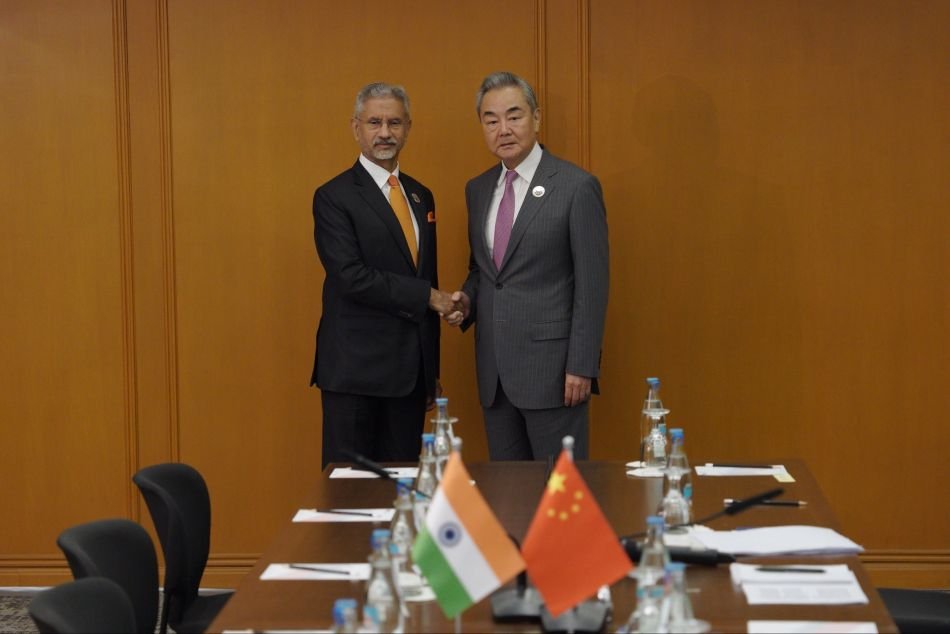

India’s External Affairs Minister S. Jaishankar met with Chinese Foreign Minister Wang Yi on July 22 on the sidelines of the ASEAN Foreign Ministers’ meeting in Manila.
Jaishankar referred to the improvement in ties between both countries in the aftermath of the meeting between PM Modi and Chinese President Xi Jinping on the sidelines of the BRICS+ Summit held in Kazan in 2024.

In 2025, Indian PM Narendra Modi visited China for the Shanghai Cooperation Organization (SCO) Summit held at Tianjin. This was Modi’s first visit to China after 2018. Modi met with Xi Jinping on the sidelines of the SCO Summit at Tianjin. Both sides reiterated the need for cooperation between both countries.
While commenting on the importance of the India-China relationship, India’s External Affairs Minister said that ties between both countries will play an important role in contributing towards a “multi-polar Asia” and “multi-polar world”. He underscored the fact that important pre-requisites for a stable relationship are: “mutual respect, mutual interest and mutual sensitivity.”
Important steps taken by both countries towards improvement of relations
Resumption of direct flights between both countries
Direct flights between India and China resumed in October 2025 after a gap of five years (flights were suspended during the COVID-19 pandemic and subsequent tensions between both countries). While the resumption of air connectivity began with a Kolkata-Guangzhou flight, other carriers which have resumed direct flights are Air India, Air China, China Eastern Airlines and China Southern Airlines. Airlines have also introduced new routes.
The Kailash Mansarovar Yatra also resumed after a hiatus of five years in July 2025.
India-China economic ties
Earlier this year, the Government of India made an important change to the Foreign Direct Investment (FDI) policy permitting companies with up to 10% Chinese shareholding to invest under the automatic route. This was a reversal of FDI policy rules introduced in 2020, where countries belonging to neighbouring countries — China, Bangladesh, Pakistan, Bhutan, Nepal, Myanmar, and Afghanistan – could only invest after getting permission from the government. Here it would be pertinent to point out that these rules will not apply to companies registered in Hong Kong, China or other countries sharing land borders with India.
Companies with minority shareholding of Chinese and Hong Kong citizens or entities were facing problems due to this rule. It would be pertinent to point out that officials have been supporting better economic ties with China – especially encouraging Chinese investment. Some have also recommended a re-think vis-à-vis regional trade-pacts like the Regional Comprehensive Economic Partnership (RCEP). While India could adopt a more pragmatic approach towards Chinese investments, joining the RCEP is highly unlikely.
China has also repeatedly extended its support to India for its Chairmanship of BRICS. Chinese Ambassador to India, Xu Feihong, while reiterating this said:
“China supports India in fulfilling its responsibilities as the BRICS Chair, and stands ready to work with relevant parties to promote the growth of the BRICS mechanism.”
During his meeting with Wang Yi, Jaishankar flagged two important issues. First, stability along the Line of Actual Control (LAC) and second, fair market access and trade issues. In the first half of 2026 itself, the trade deficit with China has widened to $67.1 billion and is set to surpass last year’s trade deficit.
While ties have witnessed an improvement since 2025, it would be important to bear in mind that differences between both countries persist over several issues. In the strategic sphere for instance, India is a pro-active stakeholder in the Free and Open Indo-Pacific Vision and the Quad (India, US, Australia and Japan). Modi’s recent visits to Indonesia, Australia and New Zealand highlight this point. During all these visits, one of the focus areas was greater maritime cooperation between India and these three countries under the umbrella of the Indo-Pacific. Even on the sidelines of the ASEAN Summit at Manila, Foreign Ministers of Quad met and reiterated their firm commitment towards a Free and Open Indo-Pacific, while also underscoring ASEAN ‘centrality’ in the region.
In May 2026, Quad Members, including India announced the Quad Critical Minerals Initiative with the aim of strengthening minerals supply chains. India is also trying to benefit from the China+1 policy – under which companies are trying to diversify from China. Several companies are investing in India in areas like tech, semiconductors, and auto parts. Significantly, many Taiwanese companies are showing interest in India.
In this context, the statement made by S. Jaishankar during his meeting with Wang Yi is important. Said Jaishankar:
“It is natural that as two large and important nations, and that too proximate neighbours, India and China would have their own particular interests. That is why our leaders had agreed that differences should not become disputes. It is the responsibility of diplomacy to properly manage them.”
In conclusion, while there is scope for India and China to cooperate in certain areas there are significant differences between both countries on important issues as has been discussed above. Apart from territorial issues, India would be wary of China’s approach vis-à-vis South Asia. While New Delhi and Beijing may have taken some important steps towards improving ties, it is important to have realistic expectations regarding the future course of the relationship.
[Photo by @DrSJaishankar/X]
The views and opinions expressed in this article are those of the author
Tridivesh Singh Maini is a New Delhi based analyst interested in Punjab-Punjab linkages as well as Partition Studies. Maini co-authored ‘Humanity Amidst Insanity: Hope During and After the Indo-Pak Partition’ (New Delhi: UBSPD, 2008) with Tahir Malik and Ali Farooq Malik. He can be reached at tridivesh80@hotmail.com.

