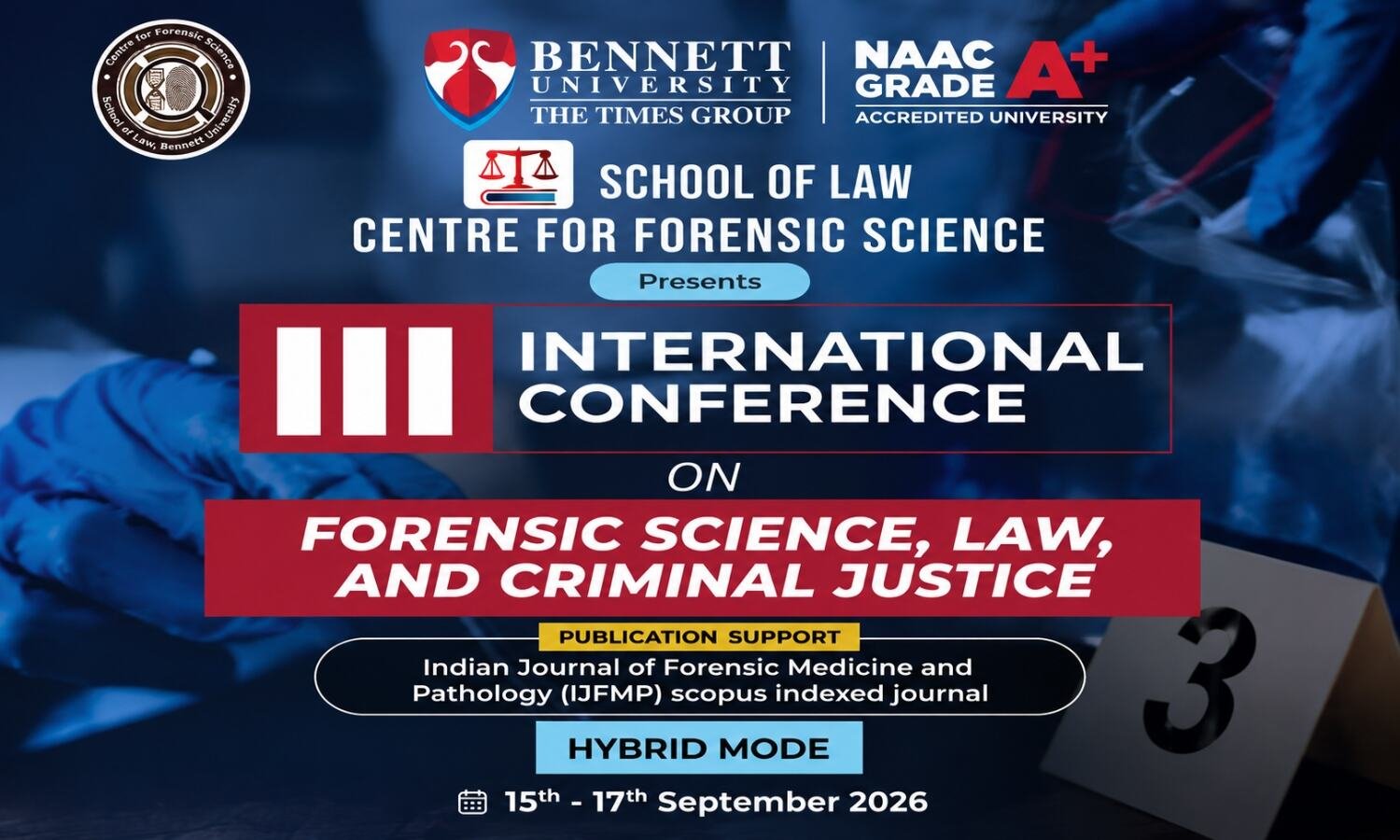

The Centre for Forensic Science, School of Law, Bennett University, is organising the 3rd International Conference on Forensic Science, Law, and Criminal Justice from September 15–17, 2026. The conference will be conducted in hybrid mode and invites abstracts and original research papers from academicians, professionals, practitioners, research scholars, students, administrators, social activists, and representatives of governmental and non-governmental organisations.
About Bennett University
Bennett University was established in 2016 by The Times Group, which has a legacy spanning more than 187 years.

The University is accredited with an A+ grade by the National Assessment and Accreditation Council (NAAC) and is recognised by the University Grants Commission (UGC), Association of Indian Universities (AIU), and Bar Council of India (BCI). Bennett University offers an interdisciplinary curriculum intended to promote critical thinking, adaptability, lifelong learning, excellence, integrity, and global impact.
About the School of Law
The School of Law at Bennett University was established with a vision to strive for excellence in teaching, learning, research, and advocacy towards justice for all.
The School seeks to shape thought leaders in public policy at the national and international levels. It presently offers BA LLB (Hons.), BBA LLB (Hons.), LLM, and PhD programmes. The School incorporates contemporary practices in curriculum development, pedagogy, innovation, and teaching methods and aims to educate future legal professionals who can contribute to justice and progress.
About the Conference
The 3rd International Conference on Forensic Science, Law, and Criminal Justice seeks to bring together experts, scholars, practitioners, researchers, policymakers, and legal professionals from across the world.
The conference aims to strengthen criminal justice systems and address challenges emerging in the 21st century by promoting interdisciplinary dialogue among forensic science, law, criminology, sociology, psychology, anthropology, economics, political science, and related disciplines.
Conference Theme
Forensic Science, Law, and Criminal Justice
Law-Specific Sub-Themes
- Forensic Science in Justice Administration after the Criminal Law Reforms, 2023
- Contemporary ethical dilemmas and professional standards in criminal justice
- Ethical and legal issues in forensic psychology practice
- Artificial Intelligence in forensic science
- Technology and innovation in law enforcement and policing
- Advanced approaches towards the admissibility of forensic evidence in criminal trials
- Future strategies in criminal justice
- Increasing trends of juvenile offenders: criminological and forensic interventions
- Progress in police science to address crimes in the digital era
Forensic Science-Specific Sub-Themes
- Forensic biology and genetics
- DNA profiling
- Forensic anthropology
- Forensic entomology
- Bioterrorism
- Bodily fluid analysis
- Forensic serology
- Biological instrumentation in criminal investigation
- Principles and applications of chemistry in forensic investigation
- Forensic toxicology
- Explosive forensics
- Forensic pharmacology
- Chemical sensors and chemical instrumentation
- Application of physics and ballistics in criminal investigation
- Forensic ballistics
- Multimedia forensics
- Cyber forensics and digital forensics
- Mobile forensics
- Network forensics
- Cyberterrorism
- Digital forensic tools and techniques to detect and prevent cybercrime
- Forensic psychology
- Behavioural science
- Polygraph tests
- Brain mapping
- Narco analysis
- Forensic pathology
- Medico-legal aspects of death
- Post-mortem examinations and related legal challenges
- Estimation of time since death
- Pathological aspects of sexual assault and child abuse cases
- Ethical considerations in forensic medicine and pathology
- Investigation of injuries and deaths
- Humanitarian forensics
- Disaster victim identification
- Questioned document analysis
- Fingerprint analysis
- Progress in behavioural forensics in criminal investigation
- Artificial Intelligence and Machine Learning techniques in forensic investigation
- Crime scene investigation and forensic evidence
- Antemortem and post-mortem injuries
- Appreciation of forensic evidence
- Behavioural forensics and the judiciary
- Issues and challenges in the functioning of CFSLs and SFSLs
Who Can Submit?
Original and well-researched papers are invited from:
- Professionals
- Academicians
- Practitioners
- Research scholars
- Administrators
- Undergraduate and postgraduate students
- Social activists
- Representatives of governmental organisations
- Representatives of non-governmental organisations
Abstract Submission Guidelines
- Each applicant must submit an abstract of approximately 500 words.
- The abstract must provide an overview of the proposed research paper.
- The abstract must follow the OSCOLA citation system.
- It must contain the names of the author or authors, designation, institutional affiliation, email address, and contact details.
- A maximum of five keywords may be provided.
- The abstract must be submitted in .doc or .docx format.
- Co-authorship is permitted, subject to a maximum of one co-author.
- Acceptance of the abstract will be communicated through email.
Full Paper Submission Guidelines
- The full paper must contain between 5,000 and 6,000 words.
- The paper must follow the OSCOLA citation system.
- The full paper must contain the abstract and details of the author or authors.
- The main text must be in Times New Roman, font size 12, with 1.5 line spacing.
- Footnotes must be in Times New Roman, font size 10, with single spacing.
- Only original and unpublished work will be accepted.
- A maximum plagiarism level of 10% is permitted.
- The paper must be submitted in .doc or .docx format.
- Where a paper has been co-authored, at least one author must attend and present the paper.
How to Submit?
The abstract and full paper must be submitted by email to [email protected].
The payment portal will be shared with authors whose abstracts are selected, along with the acceptance email.
Important Dates
- Last date for registration: August 1, 2026
- Last date for abstract submission: August 5, 2026
- Intimation of selected abstracts: August 10, 2026
- Last date for final paper submission: August 15, 2026
- Dates of the conference: September 15–17, 2026
Mode
The conference will be conducted in hybrid mode.
Venue
Bennett University Campus, Greater Noida, Uttar Pradesh, India
Registration Charges
- Faculty Members, Academicians, and Professionals: ₹2,500
- Research Scholars: ₹1,500
- UG and PG Students: ₹1,000
- Bennett University Faculty Members, Scholars, and Students: No registration fee
Publication Opportunities
Selected research papers may be considered for publication in the following:
- Indian Journal of Forensic Medicine and Pathology (IJFMP), a Scopus-indexed journal
- An edited book with an ISBN
- A conference proceedings book with an ISBN
A publication charge of ₹10,000 per paper will be applicable for publication in the Scopus-indexed journal.
Contact
Email: [email protected].

