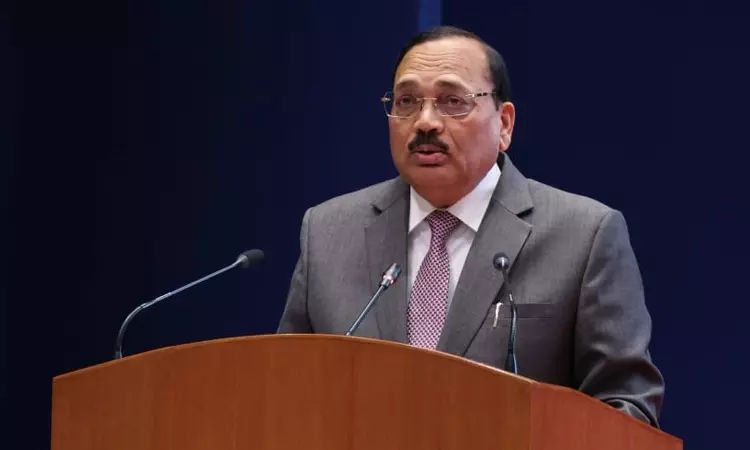


Chief Justice of India (CJI) Surya Kant on Friday highlighted India’s increasing presence across the globe as a fair, credible and efficient jurisdiction for resolving international commercial disputes, attributing this transformation to sustained legislative reforms, progressive judicial interpretation, institutional strengthening and the rapid evolution of the country’s arbitration and mediation ecosystem.
Delivering the keynote address at the international conference commemorating the 60th anniversary of the United Nations Commission on International Trade Law (UNCITRAL), jointly organised by the Supreme Court of India, the Ministry of External Affairs and UNCITRAL, the CJI said the country’s arbitration framework has undergone significant development through legislative refinement, specialised arbitral institutions and greater international engagement.
India is no longer merely a venue where international commercial disputes arise but is increasingly viewed as a jurisdiction capable of resolving them efficiently, fairly and with global credibility, he added.
Tracing the origins of international commerce, the CJI referred to the ancient dockyard at Lothal in present-day Gujarat, built by the Indus Valley Civilisation nearly 5,000 years ago. He said the archaeological discoveries, including seals and carnelian beads found in Mesopotamia, demonstrate that India was engaged in cross-border trade long before modern commercial laws, trade treaties or contractual frameworks came into existence.
According to him, commerce historically flourished because merchants relied on trust, certainty and the expectation that agreements would be honoured, principles that continue to underpin modern international trade and the rule of law.
The CJI noted that when the United Nations General Assembly established UNCITRAL in 1966, international commerce was expanding rapidly but remained fragmented by divergent domestic legal systems, conflicting legal traditions and uncertain enforcement mechanisms.
UNCITRAL was entrusted with the responsibility of harmonising international trade law by creating legal frameworks that bridge national legal systems rather than replacing them, thereby enabling businesses to focus on commercial enterprise instead of legal uncertainty, said the CJI, adding that over the past six decades, the organisation has significantly shaped the legal architecture governing international sales, commercial arbitration, mediation, electronic commerce, insolvency, secured transactions and digital trade.
Referring to India’s contribution to the development of international trade law, Chief Justice Kant praised the work of the UNCITRAL National Coordination Committee for India.
He said its continued engagement with UNCITRAL Working Groups, contributions to the Case Law on UNCITRAL Texts (CLOUT) programme, stakeholder consultations and institutional collaboration have strengthened India’s participation in the progressive development and harmonisation of international commercial law while ensuring that Indian jurisprudence and legal experience contribute meaningfully to evolving global legal norms.
The Chief Justice also highlighted the transformation of India’s judicial system through technological and institutional reforms. He referred to the integration of the National Judicial Data Grid (NJDG), live-streaming and real-time transcription of Constitution Bench proceedings, and the proposed Artificial Intelligence regulatory framework.
These initiatives have enhanced transparency, accessibility and public confidence in judicial administration while making the functioning of the Supreme Court more accessible to citizens, lawyers and scholars worldwide, he added.
Emphasising the growing role of consensual dispute resolution, the CJI said the Supreme Court, in collaboration with the National Legal Services Authority (NALSA) and the Mediation and Conciliation Project Committee (MCPC), has undertaken several initiatives, including the Mediation for the Nation campaign and the Special Lok Adalat initiative, to promote amicable settlement of disputes.
He observed that mediated settlements receive judicial recognition through court decrees and that the Mediation Act, 2023 has, for the first time, established a comprehensive statutory framework governing both domestic and international mediation, reflecting India’s commitment to institutionalising alternative dispute resolution within the justice delivery system.
The CJI described arbitration and mediation as indispensable pillars of the modern international trading system, observing that conventional court litigation, constrained by territorial jurisdiction, procedural diversity and jurisdictional limitations, was often not the most effective mechanism for resolving complex cross-border commercial disputes.
In contrast, arbitration and mediation provide parties with neutral forums, procedural flexibility, technical expertise and internationally enforceable outcomes, thereby promoting commercial certainty, investor confidence and continuity of business relationships.
Explaining the complementary role of courts, the CJI said the judiciary does not compete with arbitration or mediation but provides the constitutional and legal foundation on which both systems function.
He observed that courts uphold party autonomy, safeguard procedural fairness, enforce arbitral awards and mediated settlement agreements, and intervene only where judicial oversight is necessary to preserve the rule of law. The Chief Justice termed the judiciary a lighthouse that guided commerce by inspiring confidence in the legal system rather than directing every commercial transaction.
Speaking about the distinction between arbitration and mediation, the CJI referred to a hypothetical dispute between an Indian manufacturer of specialised medical equipment and its Southeast Asian distributor following global shipping disruptions.
He explained that while arbitration could efficiently determine contractual rights and liabilities, mediation could enable the parties to renegotiate delivery schedules, revise pricing mechanisms, share commercial losses and preserve their long-standing business relationship, thereby ensuring that commercial disputes remain temporary interruptions rather than permanent obstacles to trade.
The CJI further observed that technological advancements, digital trade, artificial intelligence, cross-border insolvency, public procurement, public-private partnerships and geopolitical instability continue to reshape international commerce and present new legal and regulatory challenges.
He said these themes would be examined during the three-day conference, alongside discussions on commercial mediation, international arbitration, digital commerce, AI regulation and cross-border restructuring. Despite these evolving challenges, the foundational principles governing commercial justice remain unchanged, namely trust, neutrality, fairness, legal certainty and the rule of law, added the Chief Justice.
He expressed hope that the conference would generate practical recommendations to deepen cooperation among jurisdictions, strengthen harmonisation of international trade law and reinforce the rules-based international trading system.
Noting that UNCITRAL’s six-decade journey has demonstrated the enduring importance of legal certainty, equitable dispute resolution and international cooperation in facilitating global commerce, the CJI exuded confidence that the conference would contribute meaningfully to the next phase of international commercial law.
The conference was also attended by External Affairs Minister S Jaishankar, Union Law Minister Arjun Ram Meghwal, Attorney General of India R Venkataramani, senior members of the Bar, judges from several foreign jurisdictions, arbitration practitioners, policymakers and legal scholars as part of the global celebrations marking six decades of UNCITRAL.
Addressing the conference, External Affairs Minister S Jaishankar said the increasing geopolitical volatility and disruptions to global supply chains have reinforced the importance of a predictable, rules-based international legal order.
He observed that countries were increasingly seeking harmonised legal frameworks, efficient dispute resolution mechanisms and greater certainty in cross-border commercial transactions to strengthen the resilience of international trade and investment, while highlighting UNCITRAL’s continuing contribution to promoting legal certainty and facilitating global commerce.
Union Law Minister Arjun Ram Meghwal said India’s judicial reforms have focused on legislative modernisation, institutional strengthening and digital transformation. He observed that Indian courts were increasingly drawing upon internationally accepted legal principles alongside domestic statutes while adjudicating commercial disputes.
The government has undertaken wide-ranging reforms to improve judicial efficiency, modernise the arbitration framework, strengthen mediation mechanisms and enhance the ease of doing business by creating a more predictable and investor-friendly legal environment for domestic and international commercial transactions, he added.

