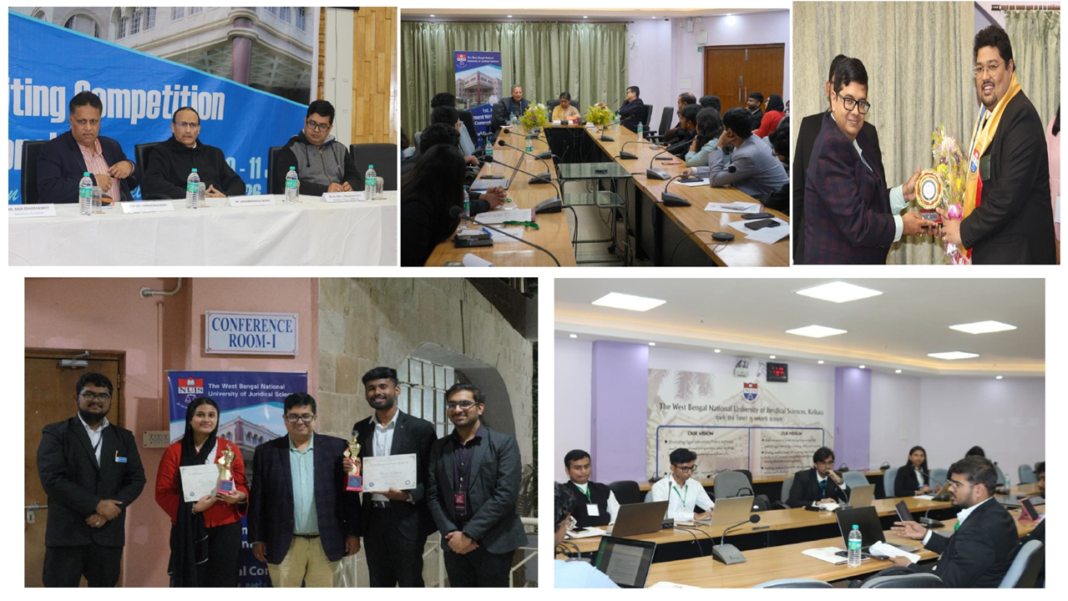
The inaugural edition of the NUJS Judgment Writing Competition and Juridical Conclave was recently concluded on the main campus of the West Bengal National University of Juridical Sciences (WBNUJS), Kolkata. It was held from 9th to 11th January 2026.
The NUJS Judgment Writing Competition was a pioneering judicial simulation designed to put the brightest legal minds across the nation in the shoes of constitutional court justices adjudicating on complex problems touching on culture, civilisation, and other sensitive topics, and to experience firsthand the various pressures faced by the judiciary in deciding questions of national interest. It featured a first-of-its-kind event format, incorporating deliberative sessions, crisis events, and interim drafting work in addition to the main overarching constitutional problem and judgment.
Uniquely, the event was also intended to create a lasting contribution to judicial scholarship by compiling the winning judgments into a bench opinion to be published in a landmark volume by Eastern Book Company, one of India’s most reputable legal publishers, alongside analyses by leading law and policy experts.
After a preliminary online round, the top ten finalist teams attended the three-day final rounds on campus, where they assumed the role of justices of the constitutional court of a fictitious country. They heard detailed oral arguments from arguers representing each party in the dispute and deliberated on complex questions of judicial propriety and constitutional ethics in structured deliberation and crisis sessions, with the ultimate goal of delivering reasoned and persuasive judgments. Alongside the ultimate goal of getting their judgments selected for publication and winning one of the three marquee awards, finalists also vied for the Best Strategy Brief, Best Deliberations, and Best Crisis Management awards. Other opportunities included internship slots with Think India and free/discounted access to Jurisphere AI.
The submitted judgments were then forwarded to the panel of judges, comprising legal academics and justices, for final scoring. The panel was graced with the valuable expertise of distinguished retired justices from the Supreme Court and various High Courts for the judging panel, including:
•
Justice (Retd.) Navin Sinha, former Judge at the Supreme Court of India;
•
Justice (Retd.) Hemant Gupta, former Judge at the Supreme Court of India;
•
Justice (Retd.) Dilip Bhosale, former Chief Justice of the Allahabad High Court;
•
Justice (Retd.) Girish Chandra Gupta, former Chief Justice of the Calcutta High Court;
•
Justice (Retd.) Dr Vineet Kothari, former Acting Chief Justice of the Gujarat High Court;
•
Justice (Retd.) A. Rajasheker Reddy, former Judge at the Telangana High Court;
•
Justice (Retd.) Aditya Kumar Trivedi, former Judge at the Patna High Court;
•
Justice (Retd.) Ram Surat Ram Maurya, former Judge at the Allahabad High Court;
•
Justice (Retd.) Umesh Kumar, former Judge at the Allahabad High Court;
•
Justice (Retd.) J. K. Ranka, former Judge at the Rajasthan High Court.
•
Justice (Retd.) Ambadas H. Joshi, former Judge at the Bombay High Court;
•
Justice (Retd.) Sudhir Kumar Saxena, former Judge at the Allahabad High Court;
•
Justice (Retd.) Pankaj Naqvi, former Judge at the Allahabad High Court;
•
Justice (Retd.) M. N. Gilani, former Judge at the Bombay High Court;
•
Justice (Retd.) K. Vijaya Lakshmi, former Judge at the Andhra Pradesh High Court;
•
Justice (Retd.) Dr Bharat Bhushan Parsoon, former Judge at the Punjab & Haryana High Court;
The final winners will be selected based on the consolidated scores given by the panel. Three cash prizes and trophies will be given out as marquee awards: the Chief Justice’s Award (for the best overall judgment), the Best Written Award (for the highest score in writing and immersion), and the Best Dissent Award (for the highest scoring dissenting opinion). Other winners will receive a certificate and a memento. All winners will also receive a complimentary copy of the book and an invitation to the book launch ceremony.
This edition of the NUJS Judgment Writing Competition and Juridical Conclave was held with the valuable collaboration and support of SCC Online (Knowledge Partner), Think India (Institutional Partner), Jurisphere AI (Artificial Intelligence Partner), Eco Corporate Inn (Hospitality Partner), SCC Times (Media Partner), and EBC (Publishing Partner). It was also a great honour to receive the valuable support of our Chief Patron, Sr. Adv. Soumendra Nath Mookherjee, in taking this event to greater heights.
The competition problem, entitled “The Curious Case of Conehead Hill”, was drafted by Mr Budhaditya Ghosh, Chief Student Editor, under the guidance of Dr Shameek Sen, Faculty
Coordinator and Professor of Law at WBNUJS. The competition was conducted under the capable leadership of the Faculty Coordinator, assisted by Mr Budhaditya Ghosh, Mr Atri Chattopadhyay, Mr Swaprabha Chattopadhyay, and Mr Priyanshu Kar, the Event Chairs, as well as the capable Organising Committee and Board of Editors.
In addition to the core competition, the NUJS Juridical Conclave was also held on 11th January 2026 in an offline format. Anchored in delving into core juridical principles and judicial ethics, the Conclave featured discussions and interactive sessions on themes such as the role of a judge in a court of law, the essentials of a well-reasoned judgment, and the broader responsibilities of judicial officers in a constitutional democracy, alongside broader burning issues of law, constitutionalism, and jurisprudence.
Justice Aniruddha Roy, Hon’ble Justice at the Calcutta High Court, also conducted an interactive session with the participants, during which he shared invaluable insights into the nuances and discipline involved in the art of judgment writing. His interaction provided participants with a rare opportunity to engage with judicial reasoning from the perspective of a sitting judge, significantly enriching the academic and experiential value of the event.
The panel for the Conclave included distinguished personalities such as Justice (Retd.) Madhumati Mitra, former Hon’ble Justice at the Calcutta High Court, Mr Sanjeev Chopra, former Director of the Lal Bahadur Shastri National Academy of Administration and Acclaimed Author and Historian, Mr Aditya Kashyap, practising Advocate at the Supreme Court of India and former Co-convenor at Think India, and Mr Sourav Chunder, practising Advocate at the High Court at Calcutta.
The goal of the NUJS Judgment Writing Competition was to create a lasting academic resource that will stimulate conversation in legal spheres for years to come. The outcome is not merely a few prizes and photographs, but a permanent contribution to Indian constitutional discourse. This event sets a precedent by bringing jurisprudential questions into the academic mainstream and inviting the thought leaders of tomorrow to reflect deeply on the questions countries and societies worldwide will face in the coming days.